
Salmuera, and Why Six Hours of Lamb Needs It
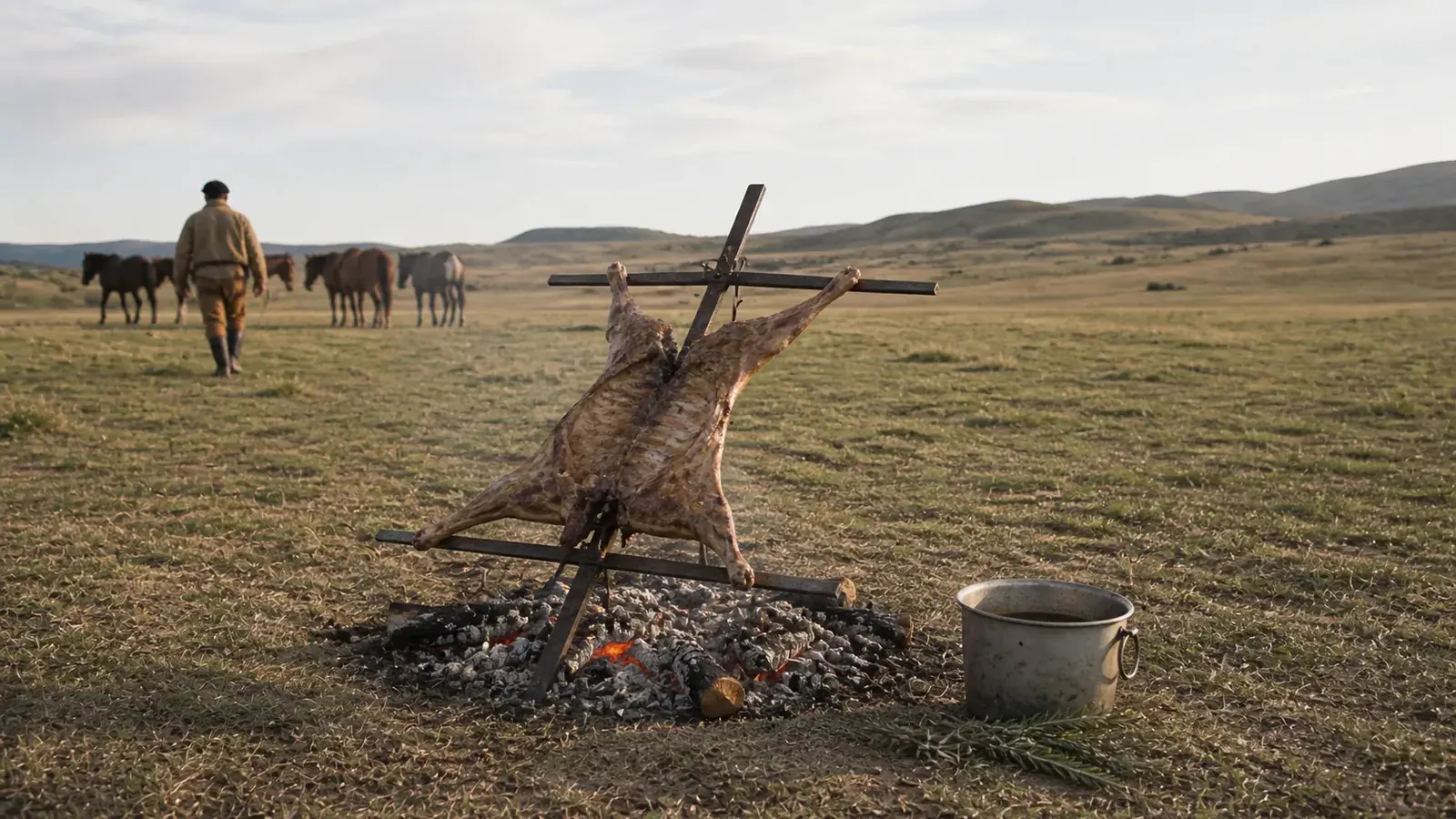
Nobody outside Argentina knows this exists, which is most of the reason to tell you about it.
Go to a long asado — a lamb on the iron cross, a goat, a side of ribs — and somewhere near the fire there is a bucket. Cloudy water, a bit of salt settled at the bottom, and a branch of rosemary lying across the rim. Every twenty minutes somebody walks over, dips the branch, and swipes it across the meat. That is salmuera, and it is the difference between lamb that has been over coals for six hours and lamb that has been ruined over coals for six hours.
Why salt alone fails
Over a short cook, salt on the surface is fine. Over six hours in moving air beside a fire, the outside of the meat dries faster than the inside renders. You get a hard grey shell, and under it meat that never got seasoned, because nothing could travel through the shell to reach it.
Brine solves both problems at once. The water keeps the surface from setting hard, so the fat underneath has time to render and baste. The salt arrives dissolved, which means it penetrates rather than sitting on top. And because you apply it twenty times across an afternoon rather than once at the start, the seasoning builds in layers.
The ratio
Seventy grams of salt per litre of hot water. Roughly a quarter cup to a quart, though weight beats volume here because coarse and fine salt measure differently and this is the one number that matters.
Hot water, not boiling — you want it to dissolve, not to cook anything. Stand it ten minutes before using it. With Salmuera Seca it is five tablespoons to the litre, and the garlic, bay and oregano are already in it; the ten-minute stand matters more in that case, because the dried aromatics need time to open.
Make more than you think. A leg of lamb over six hours will take most of a litre, and you do not want to be mixing a second batch with greasy hands.
The branch is not decoration
Argentine cooks baste with a bundle of rosemary, or thyme, or a stalk of something woody out of the garden. It looks like theatre. It is not.
A brush lays brine on. A branch lays brine on and drags aromatic oil across the surface with it, and that oil is heated by the meat and the fire the moment it lands. Twenty passes across an afternoon builds something a brush cannot. A branch also holds more liquid than you would expect and does not melt, which a nylon brush beside a fire will.
No rosemary, a bundle of thyme tied at the stems works. So does a clean cotton rag, which is what most people actually use. The branch is better.
The rhythm
Every fifteen to twenty minutes, from the moment the meat goes on until about twenty minutes before it comes off. Stop early at the end — the last stretch is when the surface finally colours, and it needs to be dry enough to do that.
Do not brine and then crowd the fire. Salmuera works because the meat sits far enough from the coals to cook in radiant heat over hours. Close to the fire, all you are doing is repeatedly putting out a sear.
The indoor version
You do not need a lamb. Spatchcock a chicken, put it in a moderate oven — about 190 °C, 375 °F — or on the cool side of a covered grill, and baste every twenty minutes for an hour and a half. Same mechanism at a third of the scale, and it produces the best roast chicken most people have made at home — skin that browns without going leathery, meat seasoned the whole way through.
Pork shoulder works. So does a turkey, and if you have ever wondered why your turkey is dry, this is the answer, and it does not require a bucket in the fridge overnight.
Time is not doneness. Basting on a schedule makes it easy to treat the clock as though it were a thermometer, and it is not one. Take the temperature in the thickest part, away from bone. The USDA safe minimum internal temperature is 74 °C / 165 °F for all poultry — chicken and turkey alike, whole or in parts — and 63 °C / 145 °F for whole cuts of pork, lamb and beef, followed by a rest of at least three minutes before carving. A pork shoulder taken to pulling texture runs far past 145 °F, which is fine: it is a floor, not a target. A long slow cook beside a fire is exactly the situation in which elapsed time lies to you.
Get the next guide
An email when we publish a new salt guide or recipe, and first word when the Patagonian salts are ready to order.
We write when there is something to say, not on a schedule.