Gaucho Provisions

Patagonian Sea Salt

Sea salt evaporated from the South Atlantic off the coast of Chubut, in Argentine Patagonia. It became a defined category in Argentine law in 2024. Almost nothing has been written about it in English. This page is an attempt to fix that.

In brief. Patagonian sea salt is sea salt evaporated from Atlantic seawater off the coast of Chubut Province, Argentina. Since August 2024 it has had its own category in Argentine food law — Sal Marina Argentina, Article 1264 tris of the Argentine Food Code — which requires calcium, magnesium and potassium chlorides above 2 per cent of the dry residue. It is made by two small companies in Chubut, together under two tonnes a month, in closed evaporation at controlled temperature rather than in open solar pans. Almost all Argentine salt, about 1.4 million tonnes a year, is inland rock and brine salt that has never touched the sea.

Last reviewed 19 August 2026.

What it is

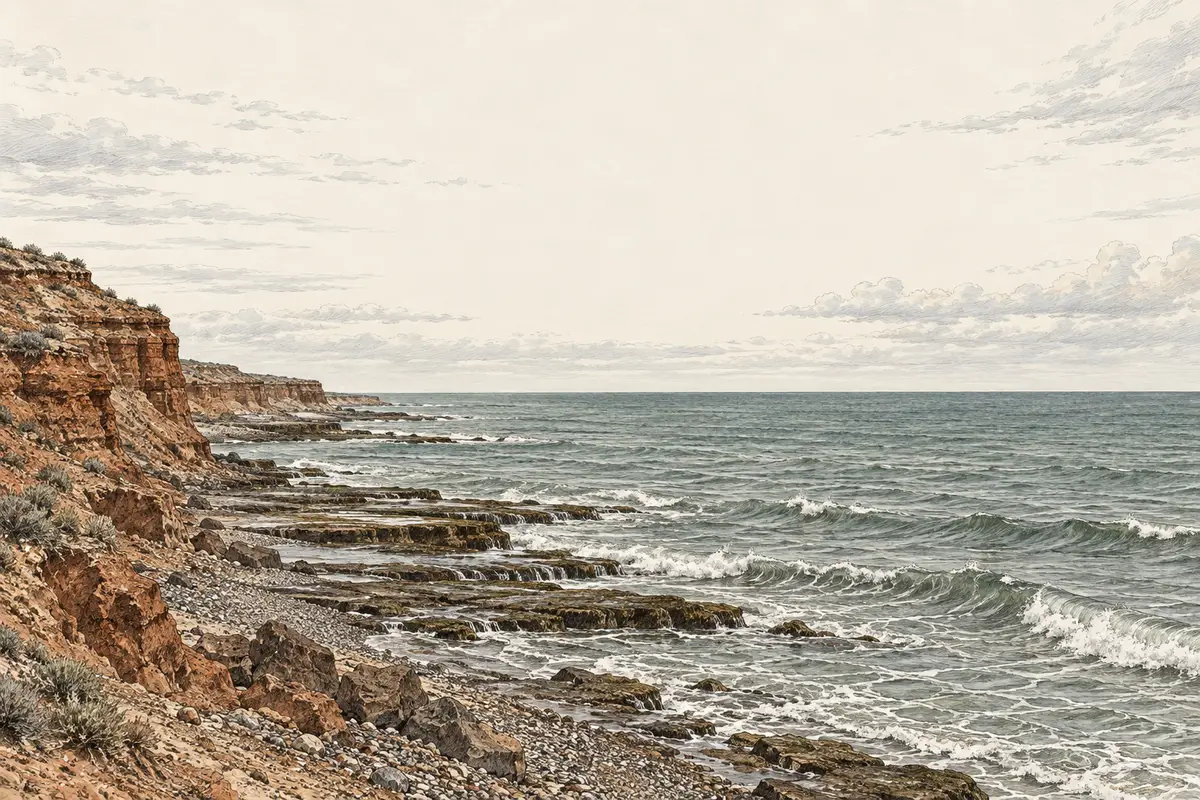
Present-day seawater, taken off the Chubut coast, filtered and evaporated until it crystallises, then dried and graded. Not mined. Not a dried-up ancient lake bed. The producers there work at controlled low temperature indoors rather than in open pans, and the salt is sold in four grades: ultra-fine, fine, coarse and flakes.

It is a young category. Commercial production in Chubut is measured in tonnes per month, not thousands of tonnes, and the total output of the region would not fill a single day at an industrial saltworks.

It became a legal category in 2024

On 14 August 2024, Resolución Conjunta 6/2024 added Article 1264 tris to the Código Alimentario Argentino, creating the denomination Sal Marina Argentina. It is not a marketing term. It is a compositional standard with a floor.

The article defines the product as crystalline salt, predominantly sodium chloride, obtained from the evaporation of Argentine seawater, and then sets two numbers:

It also sets limits for arsenic, copper, lead, cadmium and mercury, and requires compliance with several further articles of the Code.

That 2% floor is the interesting part. It is a mineral minimum, which means the category is defined by what has been left in rather than by where it comes from alone. A washed, refined sea salt from Argentine water would not qualify.

One caution about how this gets reported. Several articles describe the salt as obtained exclusively from Argentine seawater. That word does not appear in the regulation. It is a journalist’s summary, and we would rather quote the statute than the coverage of it.

How it compares

Every figure below comes from a producer’s own specification, a protected-designation document, or a government register. Where a producer publishes nothing, the cell says so.

SaltHow it is madeProtected nameMg
Patagonian
Chubut, Argentina
Evaporated at controlled temperature below 60 °C. Not washed, refined or bleachedSal Marina Argentina
CAA Art. 1264 tris, 2024
1.78%
Maldon
Essex, England
Brine evaporated in open pans over gas-fired fluesNone0.019%
Fleur de sel
Guérande, France
Sun and wind only. Hand-skimmed from the surface, not washedPGI
registered 2012
Not specified
Halen Môn
Anglesey, Wales
Gas heaters at 50–65 °C, oven-dried at 85 °C, rinsed in brinePDO
2014
0.2% min
Jacobsen
Oregon, USA
Reverse osmosis, boiled, evaporated, then rinsedNoneNot published
Himalayan pink
Khewra, Pakistan
Mined rock salt. Not evaporated, not sea saltGI is “Khewra Pink Rock Salt”~99% halite

Read that table carefully rather than triumphantly. The magnesium figures are not strictly like for like: Maldon’s is a typical analysis from a manufacturer spec sheet, Halen Môn’s is a regulatory minimum from its PDO document, and the Patagonian figure is a producer data sheet whose own note says values vary between lots because the product is marine in origin. The honest summary is that unwashed, low-temperature sea salt retains substantially more magnesium than washed or hard-dried salt, and that the gap is large enough to survive the imprecision.

What the mineral content is not

It is not nutrition. A quarter-teaspoon of salt is about 1.4 grams; at the 2% threshold that is roughly 28 mg of chloride salts, of which the metals themselves are a fraction. Against a daily magnesium requirement of around 400 mg, the contribution is negligible, and you would have to eat a medically inadvisable amount of salt to change that.

The mineral content matters for two honest reasons: it is evidence of process, proving the salt was not washed or refined, and it is the legal threshold the Argentine category is built on. Anyone selling you salt as a mineral supplement is selling you something else.

The most repeated claim in the salt aisle — that pink Himalayan salt contains 84 trace minerals — appears only in sellers’ copy. We could not find an analytical source for it anywhere.

Three things it is not

It is not Himalayan salt. That is mined rock salt from the Khewra mine in Punjab, Pakistan, from a deposit laid down before complex life. It is roughly 99% halite and it has not been near the sea in half a billion years. The geographical indication registered in Pakistan is for “Khewra Pink Rock Salt”; the phrase “Himalayan pink salt” is not itself a protected name.

It is not solar salt. The classic sea salts — Guérande, Trapani — are made in shallow pans by sun and wind. Chubut has the wind and not the climate. Both producers there evaporate indoors under controlled heat, and neither uses the word solar. It would be the easier story to tell and it would be false.

It is not from Península Valdés. The peninsula is the famous part of the Chubut coast and it is not where the salt is made. The producers are further south, on the open coast.

Who actually makes it

Two producers, both small, both artisanal, both on the Chubut coast. Neither is a large operation and neither exports at scale.

One filters seawater and evaporates it at controlled temperature below 60 °C over roughly eighteen days, then dries it for another four or five. Output is around a tonne a month across all grades, with a larger plant under construction.

The other trucks seawater in from a remote stretch of coast and crystallises it fast under continuous heat, producing small laminated pyramids — the Maldon method. Output is a few hundred kilograms a month.

Between them that is under two tonnes a month, for the entire category. For scale, a single mechanised solar saltworks in Rio Grande do Norte, Brazil, can exceed 150,000 tonnes a year. That comparison is the whole story of Patagonian sea salt: it is not a small industry, it is barely an industry at all.

The grades, and what they are for

Flakes are thin brittle plates, roughly 4 to 10 mm, that break under a thumb. They go on last, on food that is already cooked. Coarse is the grilling grade — in Argentina, sal parrillera, thrown on before the meat goes over the coals. Fine dissolves fast and belongs in dough, brine and anything stirred. Ultra-fine is a powder for dry blends and even dispersion.

The salt itself is identical across all four. What changes is the shape, and therefore how fast it dissolves and whether you feel it.

Read further

Who wrote this, and why

This page is published by Gaucho Provisions, which is building a line of Patagonian sea salt for the United States. We are a buyer, not a neutral party, and you should read it knowing that.

We wrote it because we went looking for this information and it did not exist in English. Reading the Argentine food code, comparing producer specification sheets and checking which finishing salts hold protected designations is not work anyone does for fun — it is work a buyer does. The facts are checkable either way, and every source is listed below.

Nothing on this page is for sale. If you want to know when the salt ships, leave an email.