
What Salt Do Argentines Actually Use for Asado?
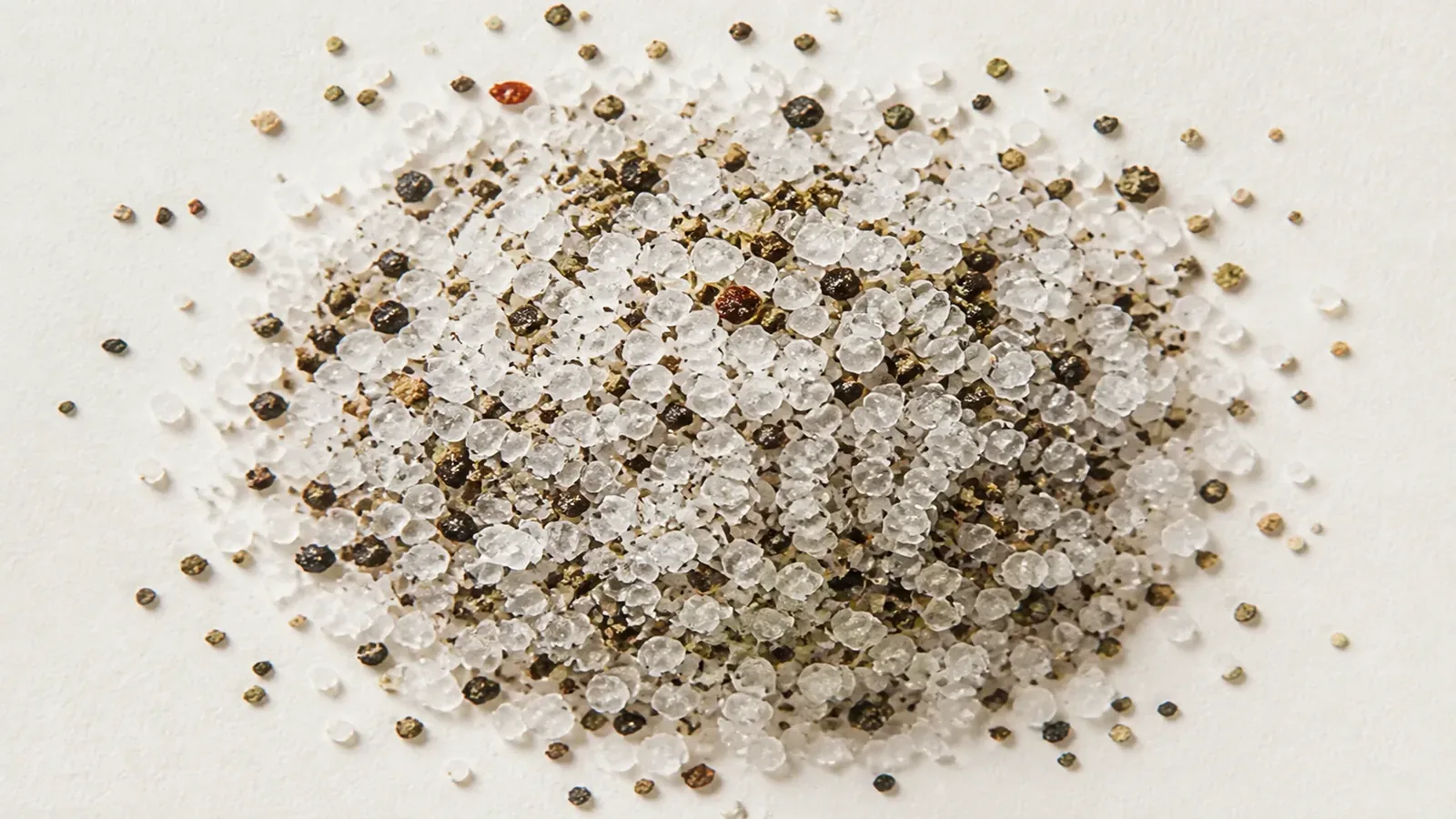
Argentine asadores use sal entrefina, sold at the grill counter as sal parrillera: a medium grain, coarser than table salt and finer than rock salt, applied to the meat before it goes over the coals and followed by nothing else.
Not sea salt. Not smoked salt. Not a rub. In the overwhelming majority of Argentine parrillas, salt is the entire seasoning, and the two dominant brands — Celusal and Dos Anclas — draw their salt from a brine well in subtropical Tucumán and an inland playa in La Pampa respectively. Neither is marine. Neither is Patagonian.
We think that is worth saying out loud, because we sell Patagonian sea salt and the honest version of this story is more useful than the flattering one.
Sal parrillera is a grain size, not an origin
Argentine salt is sold in three grades:
| Grade | What it is | Used for |
|---|---|---|
| Sal fina | Fine crystals, dissolve quickly | Table, salads, chimichurri, marinades |
| Sal entrefina | Medium — sold as sal parrillera | The grill |
| Sal gruesa | Coarse | Salt crusts, pollo a la sal, salt beds |
Parrillera means “for the parrilla” — the grill. It is a real, established commercial category, not a marketing coinage: both Dos Anclas and Celusal list sal parrillera entrefina as a standard SKU, and it sits on grocery shelves next to the fine salt.
The logic Argentine sources give is dissolution timing. The medium grain “dissolves properly with the cooking time” — fast enough to season, slow enough not to vanish into the first minute over the coals. Fine salt disappears too quickly and seasons unevenly if you are heavy-handed. Sal gruesa may not fully dissolve at all, which is why it is reserved for techniques where the salt is a cooking medium rather than a seasoning.
That is a texture argument, and it is correct. It is also entirely independent of where the salt was harvested.
How much, and when
Quantity: about one tablespoon of entrefina per kilogram of meat — roughly 9–10 grams per kilo, or 0.9 to 1.0% by weight, applied like a light snowfall rather than a crust.
That number is worth sitting with. Cook’s Illustrated’s dry-brine recommendation, arrived at through American test-kitchen methodology, works out to about 0.93% by weight. An Argentine grilling tradition and a Boston test kitchen converged on the same figure from opposite directions. When two independent traditions land on the same number, it is usually because the number is right.
Timing: Argentine sources genuinely disagree, and we are not going to pretend otherwise.
| Source | Timing |
|---|---|
| parrillasparaasado.com | Large cuts and whole animals 1–2 h; medium cuts (vacío, ojo de bife, costillas) 10–20 min |
| Chef Florencia Abella | Coarse salt 15–30 min ahead; fine salt 5–10 min; less for thin cuts |
| A Buenos Aires asador with 1,000+ asados behind him | 3 hours ahead, with fine salt, for deeper and more even penetration |
| carnes.com.ar | “Before or during cooking, never after” |
The one thing everyone agrees on is that salt goes on before or during, never as an afterthought at the table. Past that, the range runs from ten minutes to three hours, and anyone telling you there is a single Argentine rule is inventing it.
There is one sequencing detail that recurs and is easy to miss: dry the surface first, then salt. The standard instruction for tapa de cuadril is explicit — remove the moisture with kitchen paper, then salt both sides. Same principle we would give for any steak, arrived at independently.
Salmuera: the salt technique that has no American equivalent
For anything spending hours over fire — a lamb on the iron cross, a lechón, a whole costillar — salt alone will not survive the trip. The asador keeps a bucket of salmuera nearby and bastes throughout.
Proportions vary a lot by source:
| Source | Salt : water | Additions |
|---|---|---|
| hacerasado.com.ar | 200 g / L | Two heads of garlic, parsley, coriander, sweet paprika, black pepper, bay, lemon |
| Cocineros Argentinos | 150 g / L | Pepper, lemon juice, 7 garlic cloves, rosemary, thyme, oregano, mint — boiled briefly |
| Mendoza Post | 100 g / L | Garlic, smoked paprika, chilli, bay, rosemary, parsley |
The application is the culturally distinctive part. It is not a soak. It is basted on during cooking — with a bottle with a hole punched in the cap, a brush, or a ramillete de hierbas, a bouquet of herbs dipped in the brine and flicked over the meat. For thick pieces like patas de lechón, some asadores inject it.
The stated purpose is to season and to rehydrate a surface that would otherwise turn to leather over four hours. That functional logic is sound. The additional claim that it tenderises is folk wisdom, not tested.
One caution: some sources describe a completely different technique under the same name — full submersion for four or more hours before cooking. These are two distinct practices sharing one word. Do not conflate them.
Why the seasoning stops there
The minimalism is real and it is documented at the highest level of Argentine cooking.
Pablo Rivero, who owns Parrilla Don Julio in Buenos Aires — ranked number one in Latin America’s 50 Best Restaurants — puts it in six words:
“Es carne, vino y fuego. Nada más.” It’s meat, wine and fire. Nothing more.
Argentine beef-culture sources answer the question “should you marinate?” with a flat no: traditionally, only salt. Ask any Argentine what goes on the meat and the answer is the same one.
This is worth defending against a common misreading. The minimal-seasoning tradition is often explained by saying Argentine beef is grass-fed and therefore does not need masking. That explanation does not survive contact with the data. The USDA’s 2025 attaché report on Argentine livestock states that registered feedlots supplied about 35% of total slaughter in 2024, that unregistered feed yards finish perhaps 2.5 million head more, that grain-fed beef now accounts for “a little over half of the country’s total slaughter,” and — bluntly — that “there are very little cattle finished on grass or pastures only.”
So the tradition is not downstream of the cattle. It is older than the feedlots and it survived them. Which makes it a cultural position about restraint, not an agricultural consequence. We find that a better story anyway.
What this means if you are buying salt
Three practical conclusions.
Buy the grain size for the job. If you grill, a medium grain is the single most useful salt to own and the one most American kitchens are missing. Table salt is too fine and disappears; rock salt is too coarse and sits there.
Do not pay for origin and then use it wrong. A good sea salt ground into a marinade is indistinguishable from table salt, and every serious blind test says so. If you buy a finishing salt, finish with it.
Be sceptical of Argentine-authenticity claims on salt. The most authentic possible Argentine grilling salt is Celusal sal parrillera — pumped as brine from wells a hundred metres down in Burruyacú, Tucumán, roughly 1,700 km from Patagonia. It is excellent at its job and it makes no romantic claims at all.
Where Patagonian salt comes into it
Honestly: not through tradition. There is no long history of Patagonian sea salt on the parrilla, and we are not going to invent one.
What is true is narrower and, we think, more interesting. Argentina’s salt is overwhelmingly continental — inland playas, relict lake beds, brine wells. Salt actually evaporated from present-day Atlantic seawater on the Patagonian coast is a tiny, recent, artisanal category, measured in tonnes per month rather than the 1.4 million tonnes a year Argentina produces overall. Argentina’s food code only defined Sal Marina Argentina as a category in 2023 and 2024, requiring calcium, magnesium and potassium above 2% of dry residue.
So Patagonian sea salt is not the traditional asado salt. It is a new thing from an old place, and the case for it is the same case we would make for any salt: the grain suits the job, the crystal behaves the way you want it to, and you know where it came from.
That last part is the one we are still working to be able to say precisely, and when we can document it fully we will publish exactly what we know.
Common questions
Medium-grain salt sold in Argentina specifically for grilling — entrefina grade, between fine table salt and coarse rock salt. It is a grain size, not an origin or a blend.
Morton kosher is a reasonable stand-in by grain. Diamond Crystal is lighter and more fragile, so use it by weight rather than volume. Neither is quite the same, but both work.
Some do, most traditionally do not. The classic position is salt only. Pepper on a long, hot sear can turn acrid, which is part of the reason.
Chimichurri is a sauce served with the meat, generally after cooking and often on bread rather than beef. It is not a marinade, despite how it is usually sold outside Argentina.
About 1% of the meat’s weight, as a guide — roughly a tablespoon of medium-grain salt per kilo. Adjust down for thin cuts, which have more surface area per unit of mass.
Increasingly not. Grain-finished beef is now a little over half of Argentine slaughter, and cattle finished on pasture alone are rare.
Sources
- Forbes Argentina — Pablo Rivero, Don Julio: “Es carne, vino y fuego. Nada más.”
- ¡HOLA! — Consejos para el asado argentino, con la chef Florencia Abella
- parrillasparaasado.com — Cuándo salar la carne y qué tipo de sal usar
- parrillasparaasado.com — Cómo preparar salmuera
- hacerasado.com.ar — Salmuera · Picaña a la parrilla
- Cocineros Argentinos — Cordero a la cruz
- carnes.com.ar — Asado Argentino
- Steak Buenos Aires — Salt in Argentina
- Dos Anclas — Sal Parrillera Entrefina
- USDA FAS GAIN — Argentina Livestock and Products Annual, AR2025-0014 (PDF)
- Resolución Conjunta 4/2023 — CAA Art. 1264 bis (Sal Marina)
- Resolución Conjunta 6/2024 — CAA Art. 1264 tris (Sal Marina Argentina)
- Contexto Tucumán — Celusal, Burruyacú
The Salt Guide
We are recording the salts on the American shelf one jar at a time — label, panel, price paid, crystal on white. Browse the guide →
Get the next guide
An email when we publish a new salt guide or recipe, and first word when the Patagonian salts are ready to order.
We write when there is something to say, not on a schedule.