
Celery Salt and the Chicago Hot Dog
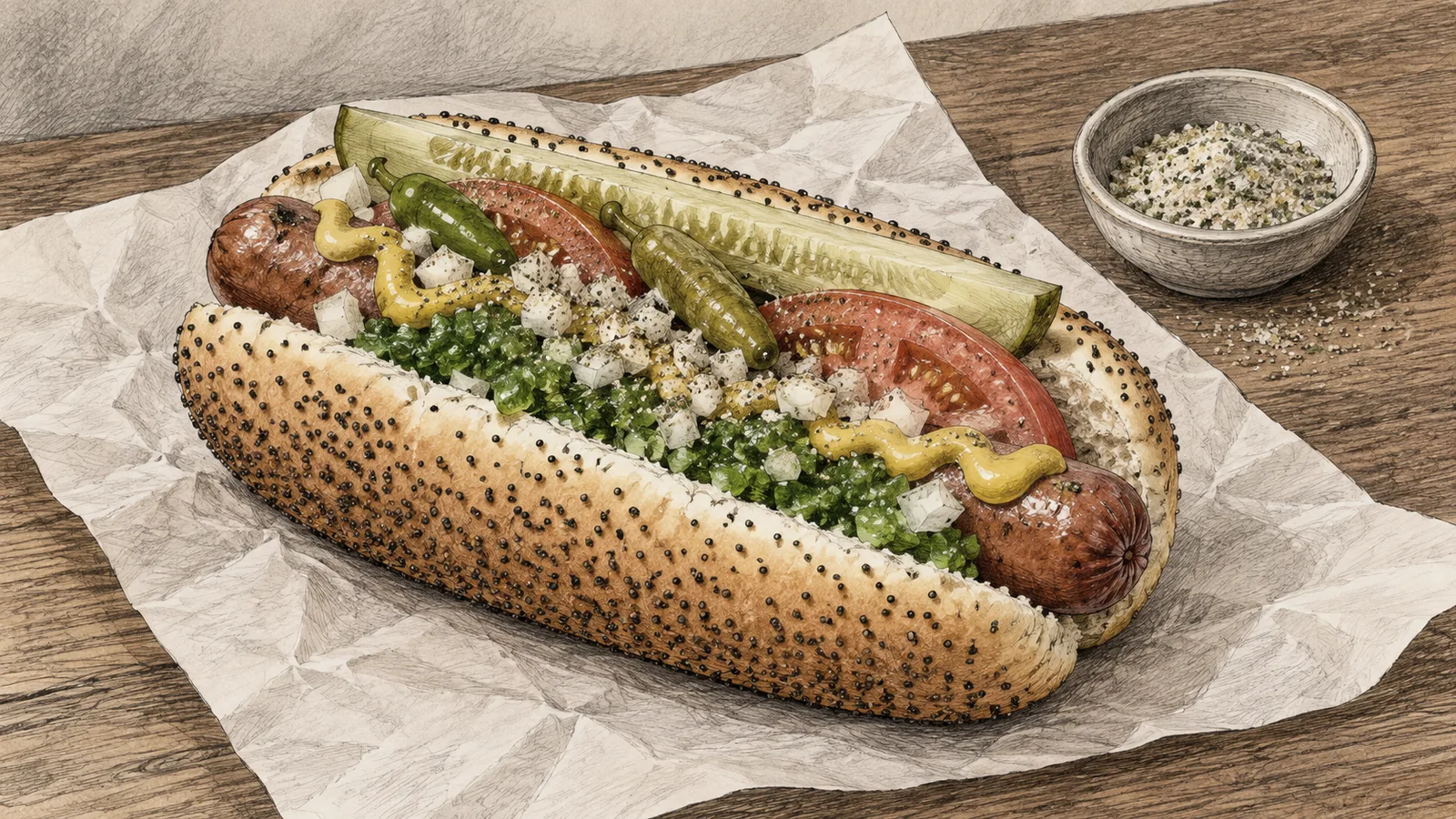
Celery salt is salt mixed with ground celery seed — the dried seed of the celery plant, Apium graveolens, not the stalk. On every label we checked salt is listed first, and no maker publishes the ratio. It is also the last of the seven toppings on a Chicago-style hot dog: yellow mustard, bright green relish, chopped onion, tomato, a dill pickle spear, sport peppers and celery salt, on a poppy seed bun, and no ketchup.
What is celery salt made of?
Two ingredients, in this order. McCormick’s standard jar reads “Salt & Celery Seed.” Its Gourmet line lists “Salt and Celery Seed” and describes “a blend of ground celery seed and coarsely ground salt.” Spiceology lists “Salt, Celery.” None of those three products lists an anti-caking agent. That will matter below.
The seed and the vegetable are the same species, but they are not the same ingredient. Celery seed is sold as a spice, harvested from plants allowed to flower. The seed carries the flavour in concentrated form, which is why a minority of seed can flavour a majority of salt.
What celery salt is not
Most people assume celery salt is dried celery with salt. The assumption is reasonable, because one brand we checked, Spiceology, lists only “Salt, Celery” without saying which part of the plant. But the standard product is seed-based, and three things sold near it are different:
- Celery seed on its own. No salt, and a much stronger flavour per gram. Swapping one for the other changes both the seasoning and the salt in a recipe.
- Celery powder. Dried and ground stalk, often listed on the labels of meats sold as “uncured,” where it does a different job entirely. It is not a seasoning salt.
- Celery oil or oleoresin salts. A 1936 US patent by Hugh E. Allen proposed replacing the ground seed with celery oil, monosodium glutamate and salt. Its argument was that seed-based celery salt was weak, expensive and “mottled or grayish.” Extract-based celery salts exist, and US rules let an essential oil or extractive appear on a panel simply as “natural flavor.” The word to look for is “seed.”
What is the ratio of salt to celery seed?
No manufacturer we checked publishes one. The ingredient order tells you only that there is more salt than seed by weight, and that is all it legally says. Any precise ratio you have read, whether two to one or four to one, comes from a home recipe, not from a label.
What the labels do give is sodium per quarter teaspoon, which lets you compare by volume.
| Product | Serving | Sodium per serving | Share of table salt’s sodium, by volume |
|---|---|---|---|
| Morton Plain Table Salt | ¼ tsp (1.5 g) | 590 mg | 100% |
| Spiceology Celery Salt | ¼ tsp | 350 mg | about 59% |
| McCormick Celery Salt | ¼ tsp | 270 mg | about 46% |
| McCormick Gourmet Celery Salt | ¼ tsp | 260 mg | about 44% |
Read that carefully. These are label figures, rounded, and per spoonful, not per gram. Celery seed is lighter and bulkier than salt crystals, and the grain sizes differ between brands. So a spoon of celery salt holds less salt partly because some of the volume is seed and partly because the crystals pack differently. The table shows that brands differ by a third. It does not reveal anyone’s recipe, and it would be a mistake to back-calculate one from it. The same spoon-versus-scale problem runs through sodium by salt type.
It is also not a sodium claim. Per gram, celery salt is still mostly salt. We report the numbers because they are printed on the jars, not to suggest anyone use it in place of anything. That territory has its own page on lower-sodium salts, and it is a minefield we do not intend to wander into here.
Why does celery salt clump?
Because both halves attract trouble. Salt is hygroscopic: pure sodium chloride begins to pull water from the air at 75.3 per cent relative humidity, which a Chicago kitchen in July can reach easily. Ground seed adds fibre and oil, and a great deal of surface area. None of the three products in the first section carries an anti-caking agent, so there is nothing in the jar to stop the particles bridging together.
The oil is also the part that fades. Allen’s 1936 patent claimed that celery oil “deteriorates when in intimate contact with sodium chloride,” losing aroma and colour. That is an inventor describing the problem his invention solves, so treat it as a claim, but it matches the ordinary experience of a jar that smells of less every month. The salt does not expire; plain salt effectively never does. What goes is the celery.
A clumped jar is not a spoiled jar. Break it up, keep the lid tight, and buy it in quantities you will finish.
The seven toppings on a Chicago-style hot dog
We are based on Chicago’s North Shore, so this part is local. The canonical list is best read from Vienna Beef, the Chicago company whose founders, by its own account, debuted their sausages at the 1893 World’s Columbian Exposition. Vienna’s own Chicago Style Hot Dog Kit contains the hot dogs, poppy seed buns, sport peppers, bright green relish, yellow mustard and celery salt. It then tells you to “add your own tomato, onions, and pickle spears for the complete experience.”
| Topping | How Vienna Beef supplies it |
|---|---|
| Yellow mustard | In the kit |
| Bright green sweet pickle relish | In the kit |
| Chopped white onion | Fresh, add your own |
| Tomato wedges or slices | Fresh, add your own |
| Dill pickle spear | Add your own |
| Sport peppers | In the kit |
| Celery salt | In the kit |
| Poppy seed bun | In the kit |
| Ketchup | Not mentioned anywhere |
The list is confirmed by WTTW, the city’s public television station, which gives the same seven on “an all-beef frankfurter, a poppy seed bun”.
Which topping is non-negotiable? The brief answer is none of them in law and one of them in custom: the absence of ketchup. Among the seven, celery salt has the best claim to be the city’s own. WTTW calls it “a Chicago contribution, since the city was key to celery production at the turn of the century.”
That explanation is the broadcaster’s account of why, and it is plausible, but it is hard to prove that nineteenth-century celery farms put a salt on a Depression-era sandwich. We report it as the city’s own story rather than as a documented chain of cause. The Chicago dog is a consensus, not a regulation, and it is policed by vendors rather than by anyone with a rulebook. It shares the city with quieter imports, including the sixteen Argentine kitchens we have written about.
Old Bay is mostly celery salt
The ingredient panel on a tin of Old Bay reads, in full: “Celery Salt (Salt, Celery Seed), Spices (Including Red Pepper and Black Pepper), and Paprika.” Ingredients are listed by weight, so celery salt is the largest component. McCormick describes the blend as celery salt, “18 herbs and spices” and paprika, sold since 1939.
The panel is a neat illustration of how much a label can withhold while complying. US rules allow “spices” as a collective term, so most of the eighteen are undisclosed. What you can say for certain is that the Chesapeake’s signature seasoning and Chicago’s hot-dog topping share their first ingredient. For how other seasoned salts are built, see what seasoning salt is.
Celery salt and the Bloody Mary rim
McCormick’s own suggestions for celery salt include tomato juice and the Bloody Mary, either mixed in or used to rim the glass. McCormick’s Gourmet page suggests rimming Bloody Mary glasses too. It is a sensible pairing: celery and tomato are an old combination, and the salt does two jobs at once.
As a rim on its own, fine celery salt has a practical weakness. It is close to a powder, and powder turns to paste on a wet glass edge. Cutting it with a coarser salt lets the rim keep some texture. That is a matter of grain size rather than of salt type, and any clean coarse salt will do the job.
One label note for anyone buying across borders. Celery is one of the fourteen allergens that must be declared under EU food labelling law, Regulation (EU) No 1169/2011. It is not one of the nine major allergens in the United States. Spiceology declares celery on its listing voluntarily; the McCormick listings we read do not. Neither practice is wrong under US law, which is exactly why the difference is worth knowing.
A caveat on our own sourcing: Vienna Beef’s website does not print the seven toppings as a single list. We assembled it from the company’s kit page and checked it against WTTW. The celery-farming explanation is secondhand. The sodium figures in the table come from three celery salts, from two brands’ web listings, and one table salt, and are not a laboratory comparison. We also looked for published ingredient pages from other celery salt makers and have left out any we could not link to.
Sources
- Vienna Beef — Chicago Style Hot Dog Kit
- WTTW Chicago — What is a Chicago style hot dog?
- McCormick — Celery Salt, ingredients and nutrition
- McCormick Gourmet — All Natural Celery Salt, ingredients and sodium
- Spiceology — Celery Salt, ingredients, allergen and sodium
- McCormick — OLD BAY Seasoning, ingredients
- Morton Salt — plain table salt nutritional facts
- US Patent 2,046,862 (1936), Celery salt, H. E. Allen
Read next
- What Is Seasoning Salt — how the other seasoned salts are built
- Does Salt Expire — why the salt lasts and the celery does not
- Sixteen Argentine Kitchens in Chicago — the other food on our home turf
- Fine Sea Salt — our fine grain, for what it is worth
The Salt Guide
We are recording the salts on the American shelf one jar at a time — label, panel, price paid, crystal on white. Browse the guide →