
What Is Chimichurri Salt? Ingredients, Uses and Sauce Differences
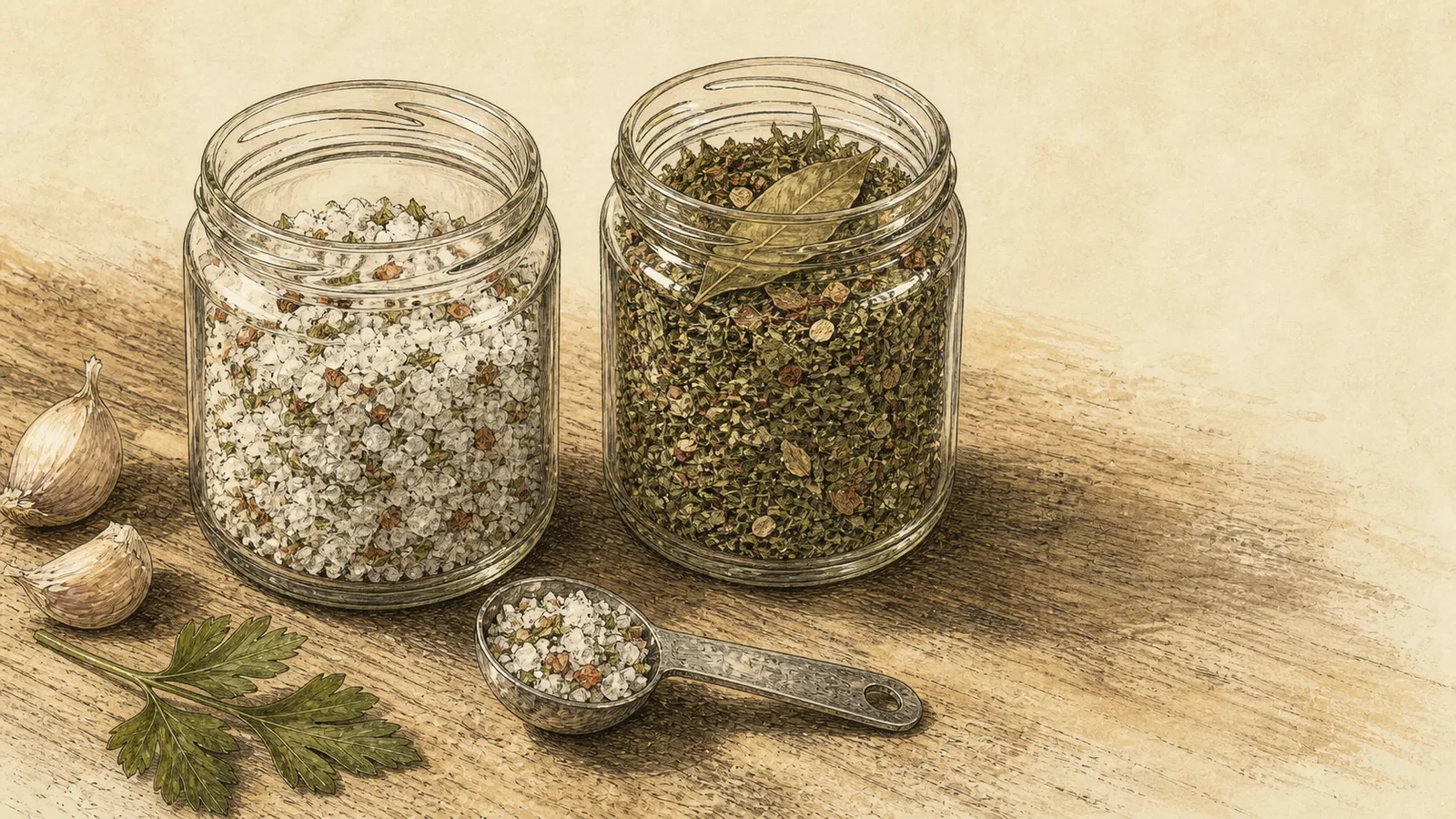
Chimichurri salt is a seasoned salt with herbs and aromatics inspired by chimichurri. Blends vary, but parsley, oregano, garlic and chili are common. Use it by the pinch to season food; it is different from a dry sauce base or a bowl of fresh chimichurri.
Salt, dry mix or sauce?
| Type | What it does | How to use it |
|---|---|---|
| Chimichurri salt | Salt carries the herbs and aromatics | Season eggs, potatoes, meat or vegetables with a small pinch |
| Dry chimichurri | Dried herbs and aromatics form a sauce base; salt content varies | Add oil and vinegar according to the recipe or label, then taste |
| Fresh chimichurri | A prepared herb sauce with oil and vinegar | Spoon over cooked food |
See our Chimichurri Salt, ingredients and cooking ideas, or follow the chimichurri sauce recipe. For the chili itself, see what ají molido means and how to use it.
Two products, one name
Pick up any jar labelled chimichurri seasoning and it is one of two things.
The first is a seasoned salt. Salt is the bulk of it, the herbs are a flavour layer, and you use it the way you use salt: on the meat, at the pan, at the table. The second is a dry chimichurri — a herb blend meant to be hydrated in oil and vinegar and spooned over the meat after it comes off the fire. It contains salt the way a sauce contains salt, which is to say not much.
Both are legitimate products. Dry chimichurri in particular is not an export invention: it is an ordinary Argentine supermarket item, sold openly as a base you turn into sauce. What is not reasonable is that the two sit side by side on an American shelf under nearly the same name, at nearly the same price, with nothing on the front of either telling you which job it does.
What the label has to tell you
US law requires ingredients to be listed “in descending order of predominance by weight” (21 CFR 101.4(a)(1)). That is the entire disclosure. Order, never amount.
Order gets you further than most people use it for. If salt is listed first, salt is the largest single component by weight. If salt is fourth, it is not. But order stops precisely where the useful question starts, because first could mean ninety per cent or it could mean twenty-six.
There is also a documented soft spot at the bottom of the list. Ingredients present at 2% or less by weight need not be in order at all, provided they sit at the end behind a qualifying statement (101.4(a)(2)). The tail of an ingredient list is not a ranking.
What the label is allowed to hide
More consequential for a herb blend: spices may be declared collectively as “spice” or “spices” without naming any of them (21 CFR 101.22(h)(1)). An entire herb bill can go behind one word.
There is one useful exception, and it comes out of the definition itself. A spice is an aromatic vegetable substance “except for those substances which have been traditionally regarded as foods, such as onions, garlic and celery.” Powdered or granulated onion, garlic powder and celery powder are understood by shoppers as food rather than flavour, and so must be declared by their own names (101.22(h)(3)).
That produces a small, reliable tell. On a compliant label, garlic is always named. If you cannot find the word, it is not in the jar in any meaningful quantity — and a chimichurri without garlic is not a chimichurri.
The arithmetic that answers the question anyway
The proportion is not disclosed. The sodium is, because the Nutrition Facts panel requires it — and in a spice blend, sodium comes almost entirely from salt.
FDA publishes the reference figure: the daily limit of 2,300 mg of sodium is “about 1 teaspoon of table salt.” A quarter teaspoon, which is the serving size nearly every spice blend on the shelf declares, is therefore about 575 mg.
So: take the sodium figure off the panel and divide it by 575. What you get is how salty that spoonful is compared with the same spoonful of table salt. It is the number the front of the jar will not give you, and it takes about four seconds.
Two jars off the same shelf
| Product | Sodium per ¼ tsp | Share of a plain salt spoonful | First ingredient |
|---|---|---|---|
| Table salt (reference) | ~575 mg | 100% | Salt |
| Lawry’s Seasoned Salt | 380 mg | ~66% | Salt |
| McCormick Chimichurri Flavored Seasoning | 30 mg | ~5% | Spices |
Same shelf, same size jar, same quarter teaspoon — and a twelvefold difference in what that spoon does to the food. One of them is a salt. The other is a herb blend that contains a little salt, and if you season a steak with it as though it were seasoned salt, you will have an under-salted steak with herbs on it.
The ingredient order tells the same story from the other side. Lawry’s reads salt, sugar, spices (including paprika, turmeric), onion, corn starch, garlic… — salt first, and sugar second, ahead of every spice in the jar. McCormick’s chimichurri reads spices (including parsley, oregano, jalapeño pepper), salt, garlic, citric acid & lemon oil. Herbs first, salt second. Neither label states a percentage. Neither has to.
One honest limit on the method. A quarter teaspoon measures volume, and a fluffy dried-herb blend weighs a great deal less per spoon than salt does. So 5% of the sodium per spoonful does not mean 5% salt by weight — the weight figure is higher, and we cannot tell you how much higher without the density. The spoonful comparison is the one that matches how anybody actually cooks, which is why we use it, but it is a kitchen number and not a composition figure. It is the same trap that makes flake salt look low-sodium, and we have written about it twice.
Why the ratio matters more here than in most blends
Because of parsley.
Chimichurri is a parsley sauce, and parsley is the ingredient in it that survives drying worst. Work published in European Food Research and Technology comparing drying methods on Petroselinum crispum found that air-drying at ambient temperature caused few losses against the fresh herb, while oven-drying at 45 °C and freeze-drying both cut the concentration of the majority of volatile components — with p-mentha-1,3,8-triene and apiole, two of the compounds that make parsley smell like parsley, among the worst affected.
The practical consequence is that in any dry chimichurri the flavour is being carried by oregano, garlic and ají molido, with parsley contributing colour and comparatively little aroma. That is not a defect. It is the nature of the format, and it is why the Argentine version adds the parsley fresh. But it does mean a jar that is two thirds salt and a little dried parsley has very little left in it to taste of.
What actually goes into chimichurri
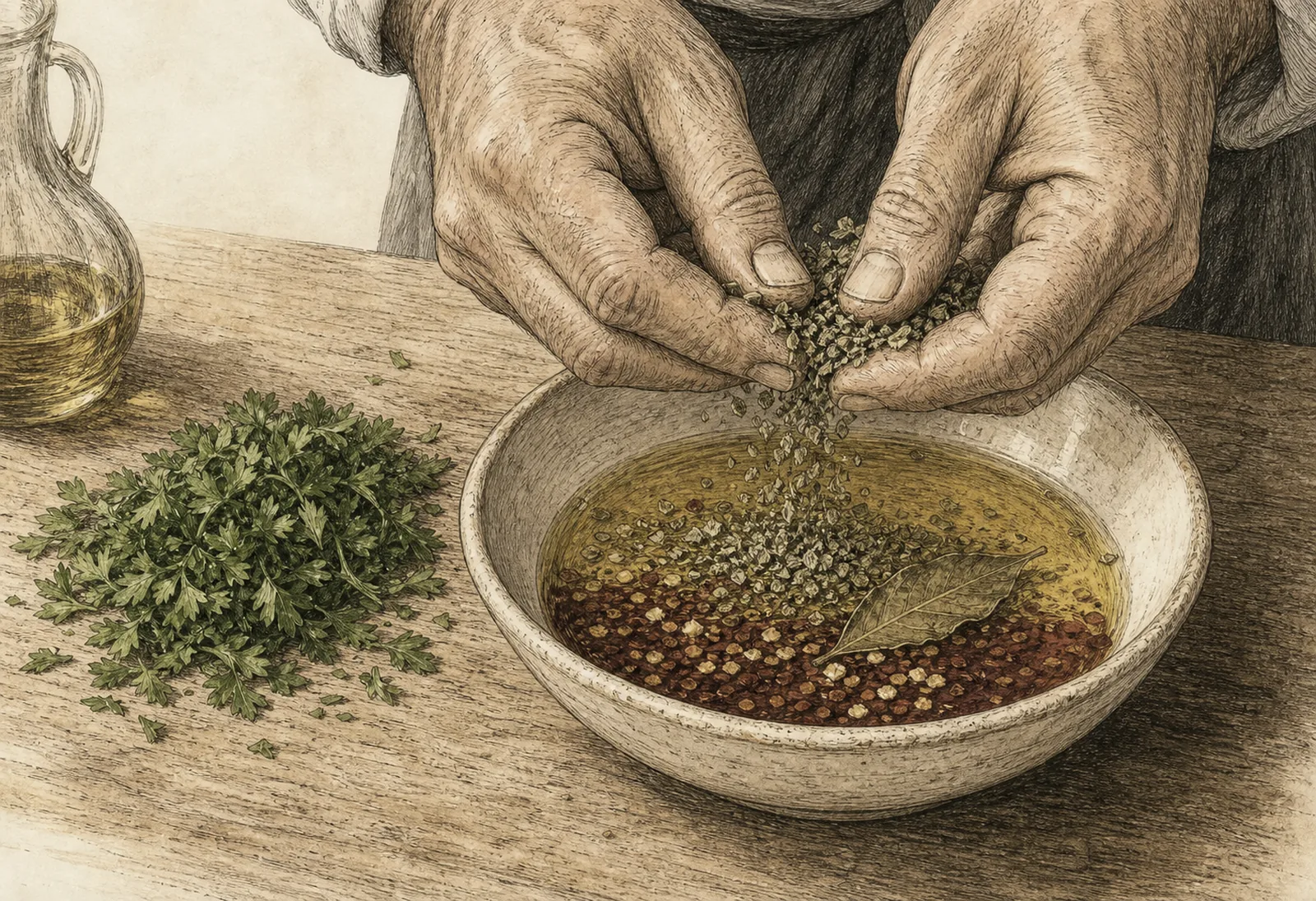
The classic Argentine dry base is short: oregano, granulated garlic, ají molido and bay. It is hydrated at roughly three parts oil to one part red wine vinegar, rested for at least half an hour, and the parsley goes in fresh, after the liquids, rather than into the dry mix.
Two things follow from that. Salt is not a defining ingredient of chimichurri — it is seasoned to taste at the end, and plenty of household versions leave it out of the base entirely. And chimichurri is a raw sauce applied after cooking, not a rub applied before it. A product that is two thirds salt is not doing that job. It is doing the seasoned-salt job, which is a perfectly good job, and it ought to say so on the front.
Nobody is required to tell you the ratio
Not in either country.
In the United States, 101.4 requires order and stops. In Argentina, Chapter XVI of the food code — the chapter that governs condiments — names compound condiments where it bothers to: Article 1213 defines curry powder as a mixture of assorted peppers, ginger and turmeric, with or without other condiments, and requires the components to appear on the label. It sets no proportions. It sets no ceiling on how much of a compound condiment may be salt, and requires no declaration of it. It does not mention chimichurri at all.
So the ratio is voluntary information everywhere it is sold. We read that as a reason to publish it, not a reason to leave it out.
Four checks before you buy one
- Divide the sodium by 575. Above about a half and you are holding a seasoned salt. Below about a fifth and you are holding a sauce base. That one number settles what the front of the jar will not.
- Find garlic by name. It has to be named if it is present. No garlic, no chimichurri.
- See how much is hiding behind “spices.” A blend that is proud of its herbs names them.
- Look for sugar. It is the second ingredient in the best-known seasoned salt in America. It has no business in chimichurri at all.
What we are going to print on ours
We are making both, because they are both worth making. Sal de Chimichurri is the seasoned salt — Patagonian sea salt carrying the herbs, for the pan and the table. Chimichurri Seco is the sauce base — the classic dry blend, for oil, vinegar and half an hour of patience.
The current Chimichurri Salt page shows the ingredients and ways to use it. We are not publishing a salt percentage or a sodium figure for our blend here without a verified basis.
Common questions
No, and the difference is the point. Chimichurri salt is a seasoned salt: mostly salt, used like salt. Dry chimichurri is a herb blend intended to be hydrated in oil and vinegar into a sauce. Check the sodium per serving — it separates them immediately.
A salt-heavy blend can make the sauce too salty before you have added enough herbs. Use a dry sauce base or fresh herbs for the main flavor, then add chimichurri salt a pinch at a time to season it.
Per spoonful, yes — the herbs are taking up room the salt would otherwise occupy. Per gram it is much closer, and for a fluffy blend the per-gram figure can be a long way above what the spoonful comparison suggests. This is the same volume-versus-weight problem that makes flake salt look low-sodium.
Ají molido is standard in the classic dry base and in most of the country. It is also entirely normal to meet a good chimichurri with none in it at all — including at one of the oldest Argentine parrillas in Chicago. Heat is a regional and household preference, not a definition.
Sources
- eCFR — 21 CFR 101.4, designation of ingredients (descending order of predominance; the 2 per cent provision)
- eCFR — 21 CFR 101.22, definition of a spice and the collective “spices” declaration, with the onion and garlic carve-out
- FDA — Sodium in Your Diet (2,300 mg is about one teaspoon of table salt)
- McCormick for Chefs — Lawry’s Seasoned Salt, ingredient statement and nutrition panel
- McCormick — Chimichurri Flavored Seasoning, ingredient statement and nutrition panel
- Díaz-Maroto, Pérez-Coello & Cabezudo (2002), “Effect of different drying methods on the volatile components of parsley,” European Food Research and Technology 215(3)
- Código Alimentario Argentino — Capítulo XVI, Correctivos y Coadyuvantes (Art. 1213, compound condiments)
- Especias 51 — chimichurri: the classic dry base and the three-to-one oil and vinegar hydration
The Salt Guide
We are recording the salts on the American shelf one jar at a time — label, panel, price paid, crystal on white. Browse the guide →

Celery Salt and the Chicago Hot Dog
Celery salt is salt and ground celery seed, not dried celery, and no maker publishes the ratio. It is the seventh and last topping on a Chicago dog, and the first ingredient in Old Bay.
Read the article →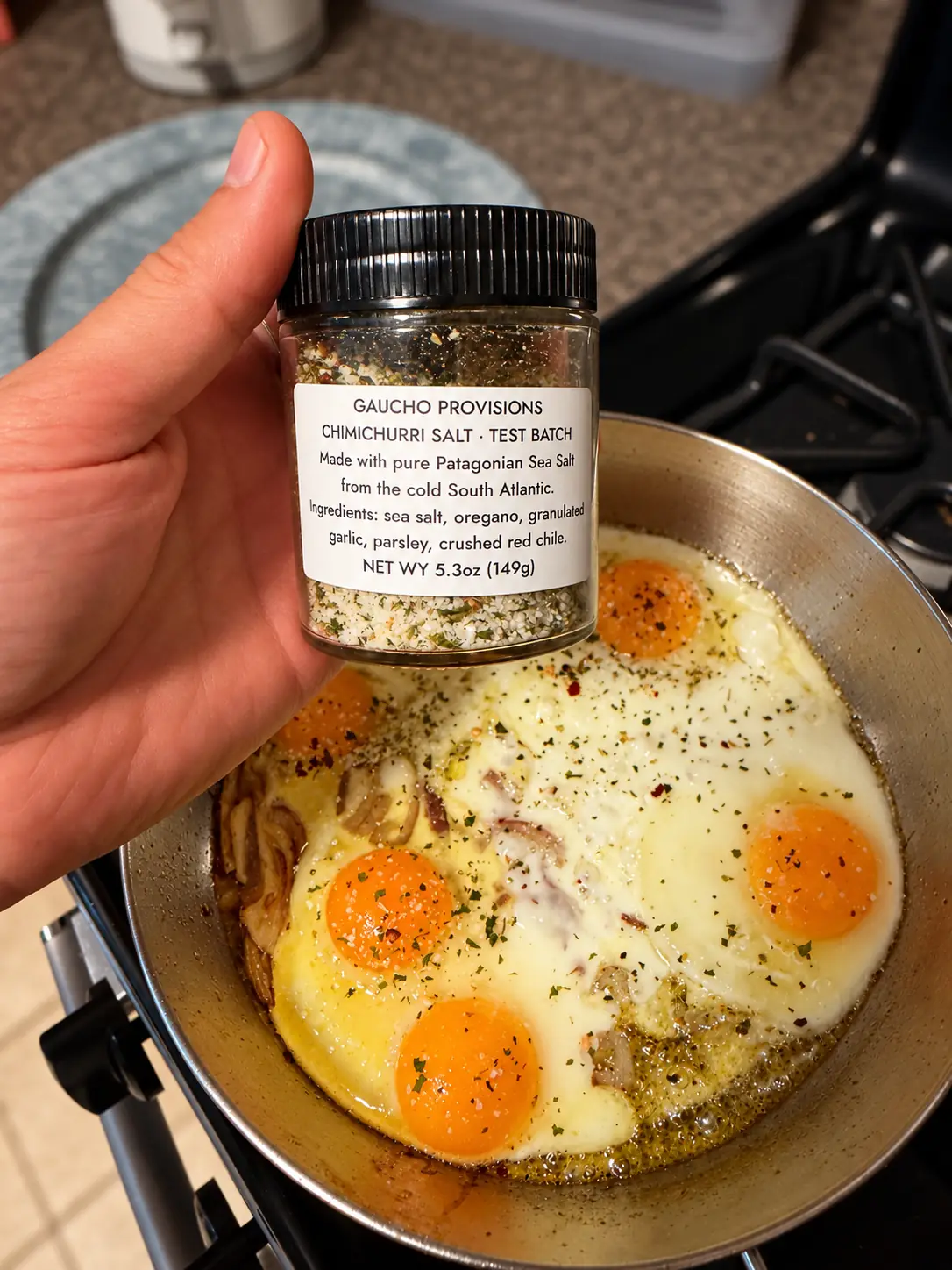
Testing Chimichurri Salt on Eggs
A kitchen note from Gaucho: our Chimichurri Salt test batch, a pan of eggs, and seasoning work in progress.
Read the article →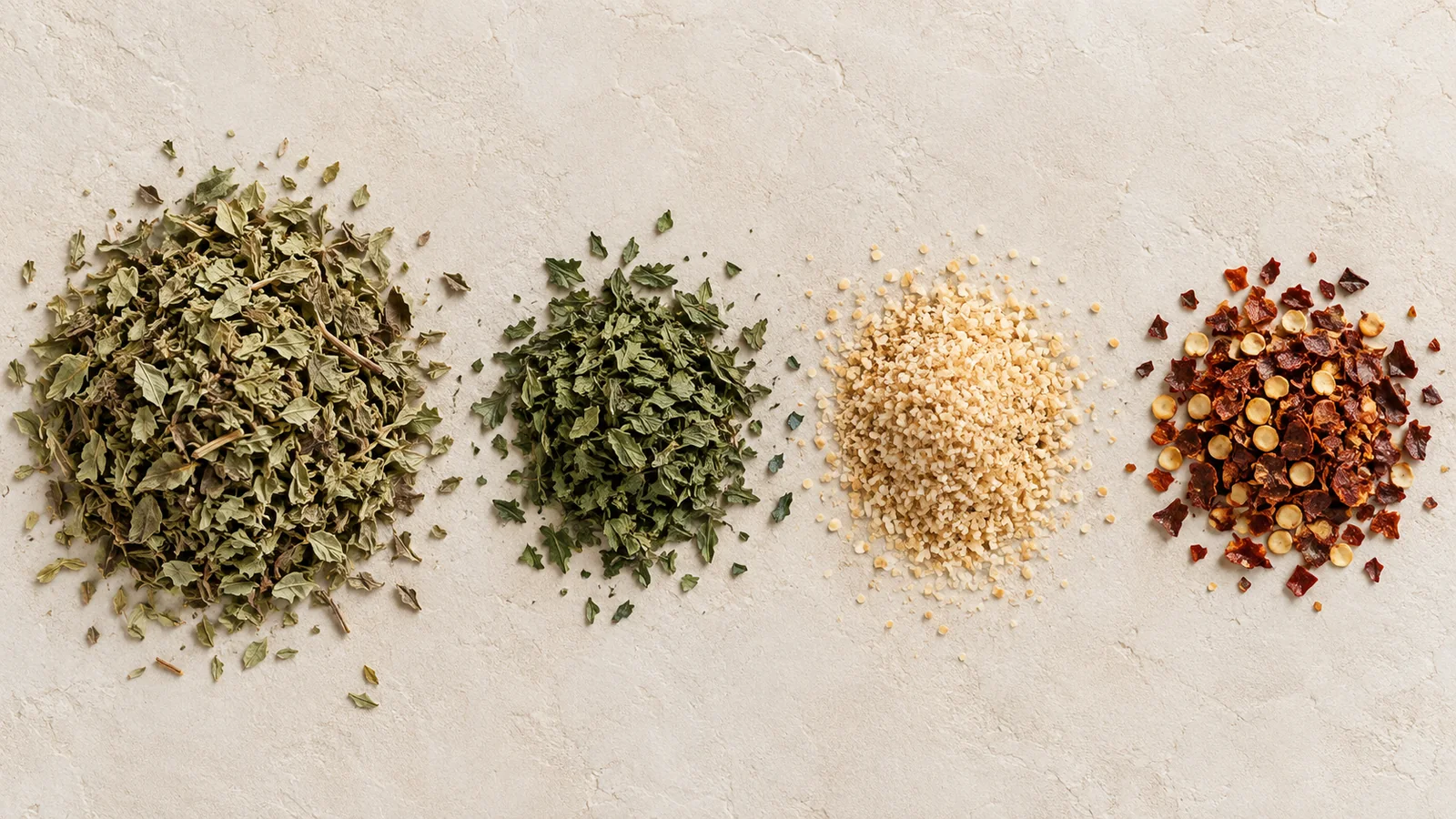
What Goes Into Chimichurri Salt? Testing the Four Core Ingredients
Oregano, parsley, garlic granules and crushed chile, bought jar by jar and examined before any salt enters the blend.
Read the article →Get the next guide
An email when we publish a new salt guide or recipe, and first word when the Patagonian salts are ready to order.
We write when there is something to say, not on a schedule.