
What Makes Hawaiian Salt Red and Black?
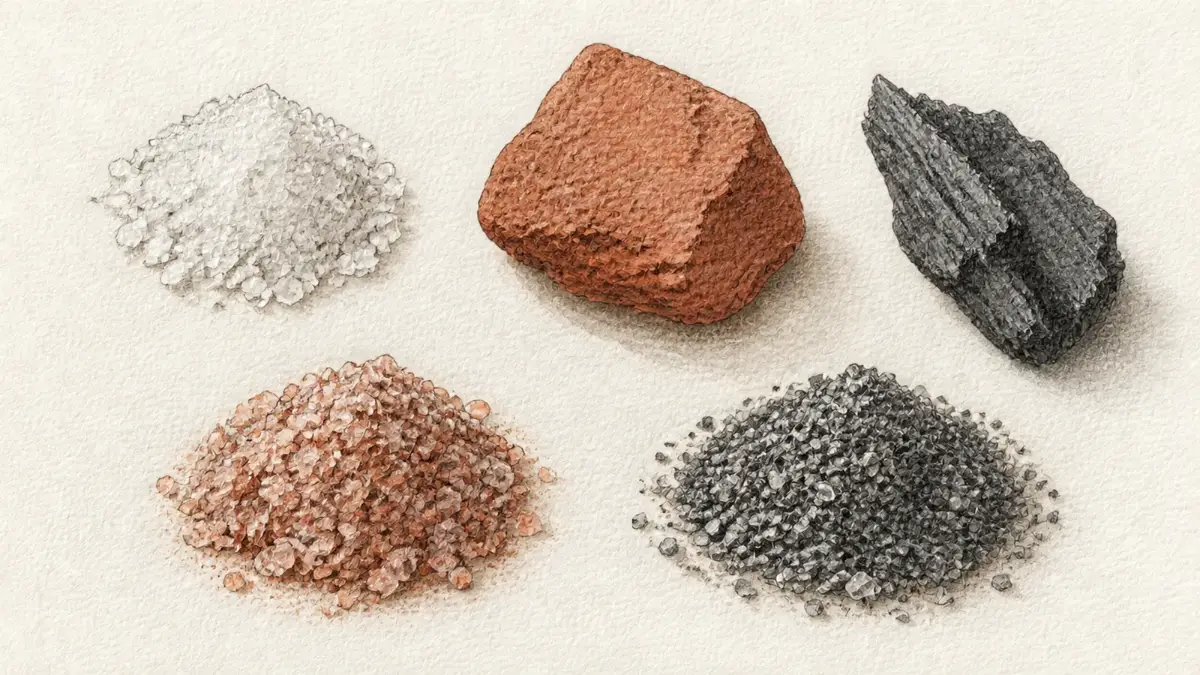
Two of the most recognisable salts on a specialty shelf get their colour from something mixed in afterwards. That is not a scandal. What is worth knowing is how little of the rest of the story survives checking.
Where does the red in alaea salt come from?
From clay, added to the salt. It is not a property of the salt itself.
ʻAlaea is an iron-oxide-rich volcanic clay, and mixing it with sea salt is a genuine Hawaiian practice with ceremonial standing — salt used in blessing and cleansing of tools, canoes, houses and temples. Retail ingredient statements say so plainly: “Sea salt, Red Alaea Clay.”
We could not find an authoritative figure for how much clay is added, so we are not going to invent one. And there is a live disagreement worth flagging: a University of Hawaiʻi at Mānoa publication states that store-bought alaea salt is not made with authentic ʻalaea clay, which contradicts what the labels say. We could not resolve it.
Is there lava in black lava salt?
No. None.
The black is activated charcoal, added to sea salt — confirmed on multiple retail ingredient statements and in reporting on the trade. One national spice retailer states it directly: the charcoal “is added to sea salt.”
The name describes a colour and an association. It does not describe a component. If you have been imagining crushed basalt, it is charcoal — the same activated charcoal sold in capsules and used in filters.
Is Hawaiian salt from Hawaii?
Sometimes. This is the part that should change how you read a label.
In September 2024 Honolulu Civil Beat documented a company selling salt labelled “Made in Hawaii” that was mainland salt, at least some of it sourced through a Houston-based distributor. The company president's own description of the operation: “It's just packaged.”
It was lawful. Hawaii's statute requires only that 51% of the wholesale value be added in-state for a “Made in Hawaii” label — a threshold a state regulator described as something “you could do very easily.” Local producers were unimpressed. One, who makes about 40,000 pounds a year, called it “really cheating people.”
And the word most often on the jar is not even covered by that law. “Hawaiian” and “Hawaiian style” fall outside the statute entirely — only “Made in Hawaii” is regulated. Inspector numbers were cut from six to three; the department has no jurisdiction outside the state.
The tell is often on the label. One widely sold “Hawaiian Black Lava” product declares its contents as “Natural Pacific Sea Salt.” Another discloses no origin at all.
The part that deserves more care than it usually gets
Traditional Hawaiian salt-making — paʻakai — continues at Hanapēpē on Kauaʻi, where 22 families work the salt beds. And there is a rule inside that practice that resolves a question people often ask: the salt may be traded or given away, but it may never be sold.
Which produces a conclusion that requires no editorialising from us. Every alaea salt on a shop shelf is, by definition, a commercial product rather than the ceremonial article. The two share a name and a colour. They are not the same thing, and the families who make the second one are clear about that.
Is it worth buying?
As a finishing salt with a colour, sure. Alaea has a mild earthy note from the clay and looks striking on white fish or pork. Black salt is dramatic on a pale plate. Both are pleasant and neither is doing anything a good flake salt would not do for flavour.
What we would not pay extra for is the story, unless the label supports it. Read the origin statement, and treat “Hawaiian” on its own as a style descriptor rather than a provenance claim — because legally, that is exactly what it is.
Common questions
It is used as a food colouring and is widely consumed. Worth knowing separately: activated charcoal can bind some medications, which is the property that makes it useful in poisoning. At the quantities in a finishing salt this is not a realistic concern, but it is why it is not an inert ingredient.
Faintly earthy, from the clay rather than the salt. The difference is small and easily lost in a cooked dish.
No. The iron in the clay is present in quantities far too small to matter, and the same is true of every trace mineral claim made for coloured salts.
Look for an explicit origin statement rather than the word Hawaiian, and be aware that the most traditional product of all is not legally sold at any price.
Sources
- Honolulu Civil Beat — investigation into “Made in Hawaii” salt labelling, September 2024
- Hawaii Revised Statutes §486-119 — “Made in Hawaii” labelling requirements
- Ka Wai Ola, Office of Hawaiian Affairs — Hui Hana Paʻakai o Hanapēpē, September 2019
- Hana Hou! — on alaea and Hawaiian salt-making, 2004
- 21 CFR 73.200 — synthetic iron oxide, permitted uses in food
The Salt Guide
We are recording the salts on the American shelf one jar at a time — label, panel, price paid, crystal on white. Browse the guide →
Get the next guide
An email when we publish a new salt guide or recipe, and first word when the Patagonian salts are ready to order.
We write when there is something to say, not on a schedule.