
How to Convert Salt Types Without Oversalting
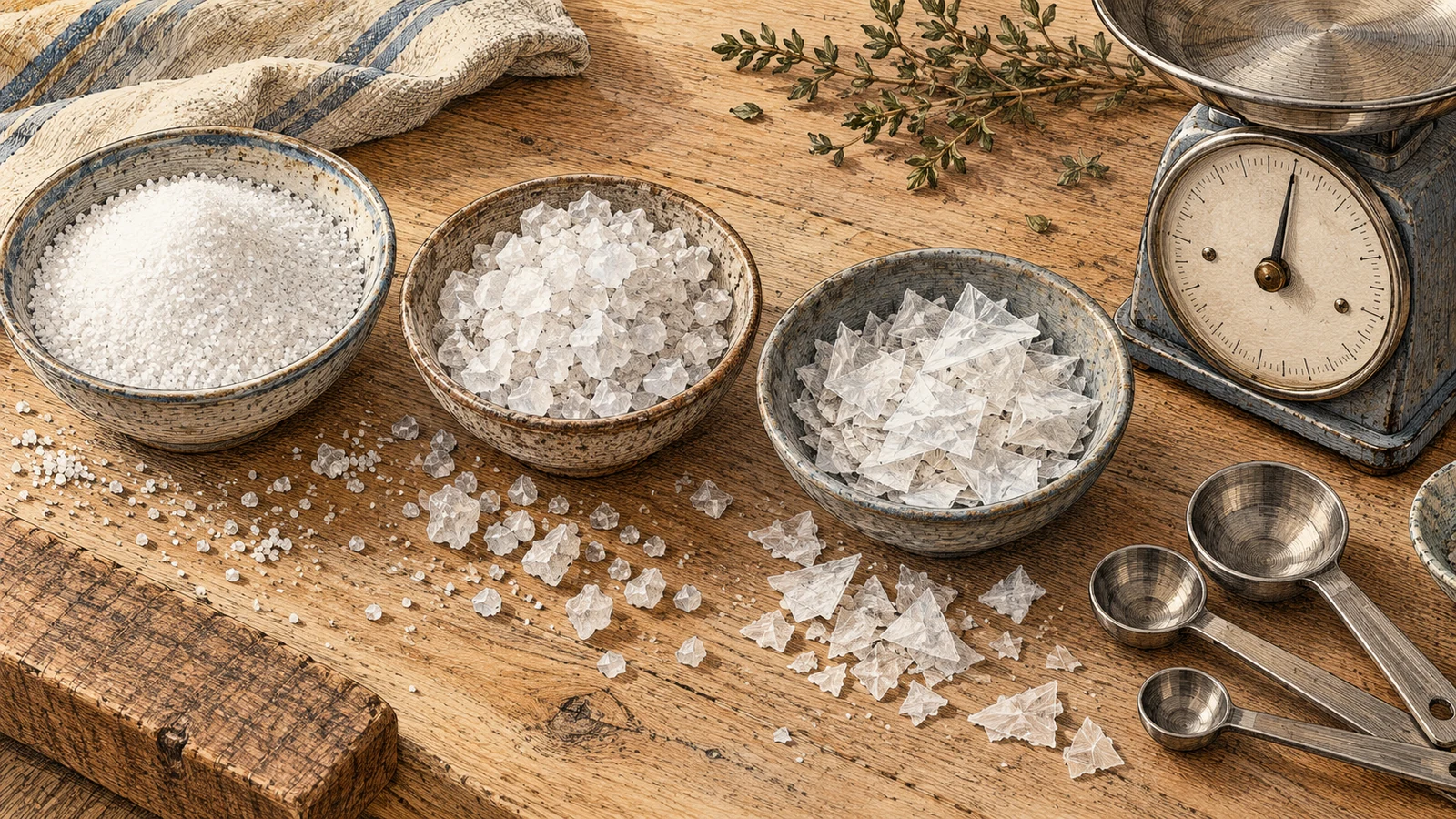
The safest salt substitution is gram for gram. Fine grains pack tightly, coarse crystals leave more air and thin flakes can occupy a large volume at very little mass. A teaspoon of each is therefore not the same amount of salt.
Why the spoon changes
All three can be mostly sodium chloride while behaving very differently in a measuring spoon. Crystal size, shape, breakage and how the spoon is filled determine the density of that volume.
| Form | How it fills a spoon | Useful role |
|---|---|---|
| Fine salt | Small grains pack closely | Doughs, batters, sauces and measured brines |
| Coarse crystals | Irregular pieces leave more space | Grinders, cooking and visible texture |
| Finishing flakes | Thin plates and hollow forms leave the most space | Final seasoning and surface crunch |
The dependable conversion
- Weigh the amount of salt named in the recipe.
- Use the same mass of the replacement salt.
- If the new salt is a finishing flake, decide whether texture rather than total salinity is the purpose. Add it at the end and taste.
- Record the brand and mass that worked. Crystal geometry varies even within labels such as kosher, coarse and flake.
For bread, fermentation, curing or a brine with a tested concentration, use a scale and follow the recipe's stated mass. Do not improvise a spoon conversion where salt percentage affects the process as well as flavor.
What if a recipe gives only teaspoons?
First look for the exact salt brand and type used by the recipe author. If the manufacturer publishes a conversion chart, use it only for the named products. Morton, for example, explicitly says its chart applies when replacing Morton salts; that is useful product data, not a universal law for every kosher or flake salt.
Without a product-specific figure, begin below the recipe's volume when replacing a low-density flake with fine salt. Season in stages when the dish allows it. For a bake or preservation recipe that does not allow tasting, find a weight-based version instead.
Choose texture after salinity
Equal weight solves the amount, but it does not make the salts interchangeable in use. Fine salt dissolves and disperses quickly. Coarse crystals persist longer. Delicate flakes are meant to remain visible and brittle on the finished surface.
The Gaucho Salt Guide records grain form and package information for individual salts. The Spice & Seasoning Guide covers composed blends, where herbs and spices make a plain-salt conversion inappropriate.
Keep reading
- Fine, Coarse and Flaky Salt — how crystal geometry changes the job
- The Gaucho Salt Guide — compare documented salts and package details
- How Much Salt Should Go in Pasta Water? — a practical percentage by water weight
The Salt Guide
We are recording the salts on the American shelf one jar at a time — label, panel, price paid, crystal on white. Browse the guide →
What Does Country of Origin Mean on a Salt Label?
A country statement, a company address and the place where salt was packed can describe three different things. Read each line for the claim it actually makes.
Read the article →
When Should You Salt Beans?
You do not have to wait until the beans are soft. Ordinary salt can go into the soak or the cooking water; bean age, acidity and calcium-rich water are more likely to explain a stubborn pot.
Read the article →
Salted vs. Unsalted Butter: How to Make the Swap
Keep the butter quantity. Adjust the salt. A practical guide to the quarter-teaspoon rule, its limits, and the other butter differences that affect a bake.
Read the article →Get the next guide
An email when we publish a new salt guide or recipe, and first word when the Patagonian salts are ready to order.
We write when there is something to say, not on a schedule.