
Salted vs. Unsalted Butter: How to Make the Swap
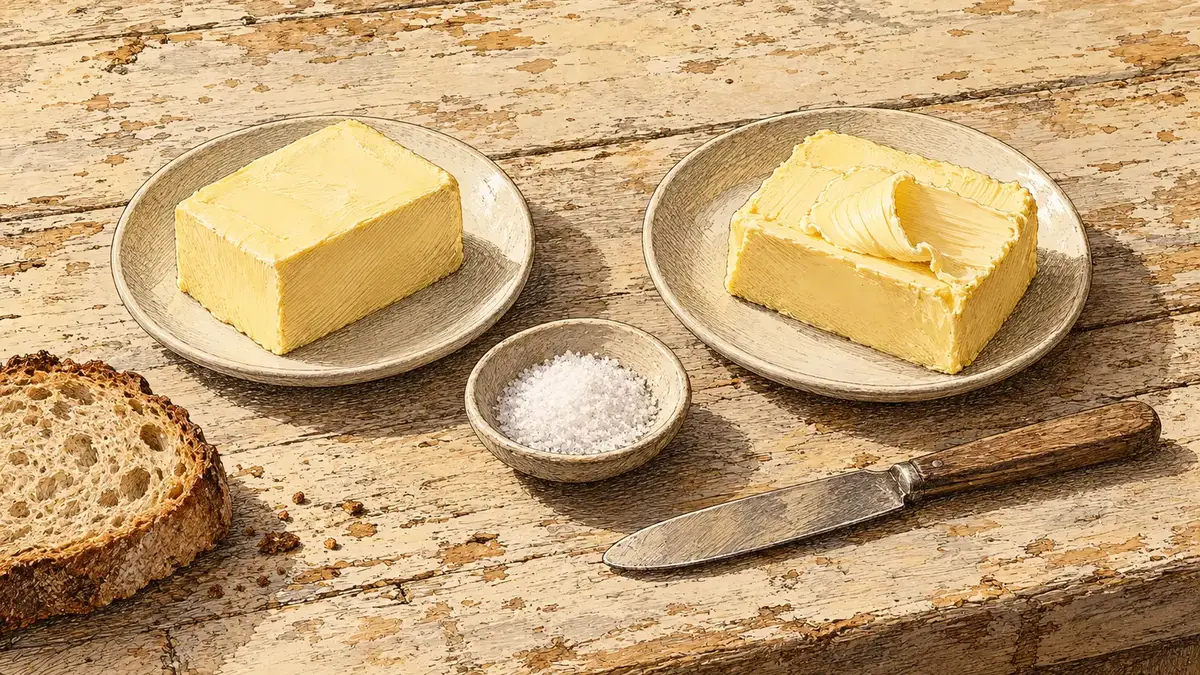
Salted and unsalted butter can often replace each other, but the salt adjustment is approximate. For a recipe that specifies unsalted butter, use it when you can. If salted butter is what you have, keep the butter quantity the same and account for the seasoning already in it.
Why do recipes ask for unsalted butter and then add salt?
Because those are two separate ingredients to control. Unsalted butter lets the recipe writer set the butter quantity for the bake and the salt quantity for the seasoning. Land O’Lakes’ test kitchen makes that distinction explicitly: its salted and unsalted sticks start with the same grade of butter; the salted version has salt added.
That does not make salted butter a poor ingredient. It is convenient on bread or vegetables, where you can taste the finished food and adjust. In a butter cookie or cake, following the specified butter gives you a clearer starting point for repeating the recipe.
How much salt should you subtract?
King Arthur Baking offers a useful rough guide: most brands add about ¼ teaspoon of salt per ½-cup stick of butter. If you replace one stick of unsalted butter with salted, that is the approximate amount to deduct from the recipe’s separate salt. For the reverse swap, add approximately that amount.
The word about matters. This is a kitchen substitution guideline, not a guaranteed specification for the butter in your refrigerator. It also should not be treated as an exact weight conversion between different salts. Use the salt named in the recipe; our sea salt versus kosher salt guide explains why changing the crystal changes what fits in a spoon.
What does the adjustment look like in a recipe?
Here is an arithmetic example, not a tested Gaucho recipe. Suppose a cookie recipe calls for two ½-cup sticks of unsalted butter and ¾ teaspoon of salt. Using the rough guide, two salted sticks contribute the equivalent of about ½ teaspoon. The separate salt would drop to approximately ¼ teaspoon.
If the same recipe called for only ¼ teaspoon to begin with, removing all of it would not fully offset the estimated salt in the butter. Use unsalted butter when matching that recipe’s seasoning matters. There is no negative quantity of salt to subtract.
Keep a note of the butter brand and the change you made. A result you like is much easier to repeat when “a little less salt” becomes an actual measurement.
Which butter fits the job?
| What you are making | Useful starting point | What to check |
|---|---|---|
| A cake or cookie with a specified butter | Follow that specification | If substituting, adjust the separate salt and record the change. |
| Toast or cooked vegetables | Either salted or unsalted | Taste before adding more seasoning. |
| A recipe with lots of butter and very little added salt | Unsalted, if requested | The salt already in salted butter may exceed the intended amount. |
| A recipe calling for a particular butter style | Match the style as well as the salt | Changing fat content or using a spread introduces another variable. |
Is salted versus unsalted the only difference?
No. King Arthur’s baking guidance also distinguishes conventional butter from higher-fat European-style butter, whipped butter and spreadable products. Replacing an unsalted stick with a salted stick is a narrower change than replacing it with a tub of butter blended with oil.
Cultured butter adds another choice: fermentation changes its flavor. King Arthur’s cultured-butter guide recommends enjoying that character on finished baked goods and notes that a different butterfat content can also affect a bake. “Cultured,” “salted” and “spreadable” describe different things; read the whole package.
Where does finishing salt belong?
A few flakes on buttered bread are a separate decision from salt mixed into dough. The first gives you a crystal at the surface; the second seasons the mixture. If you want that contrast, start with the finished food, add a small pinch and taste. A finishing garnish cannot tell you how much salt was already in the butter.
For the same reason, save the distinctive flakes for a job where you want to notice them. For measured mixing, follow the recipe’s salt specification. See fine, coarse and flaky salt for the practical differences.
Sources
- King Arthur Baking — Butter for baking: butter styles and the approximate salted-butter adjustment.
- Land O’Lakes Test Kitchen — Salted or Unsalted: Which Butter Should I Use When?: choosing butter and controlling seasoning.
- King Arthur Baking — Cultured butter: flavor and butterfat considerations.
Sources checked 30 September 2026. The substitution example is illustrative arithmetic; Gaucho has not conducted a comparative butter-baking trial. Hero artwork is an illustration.
Keep reading
- Fine, Coarse and Flaky Salt — choose the crystal for the job
- Sea Salt vs. Kosher Salt — why teaspoons do not always translate
- Salt in Bread Dough — weighing salt with baker’s percentage
The Salt Guide
We are recording the salts on the American shelf one jar at a time — label, panel, price paid, crystal on white. Browse the guide →