
How Much Salt Goes in Bread Dough? Use Baker's Percentage
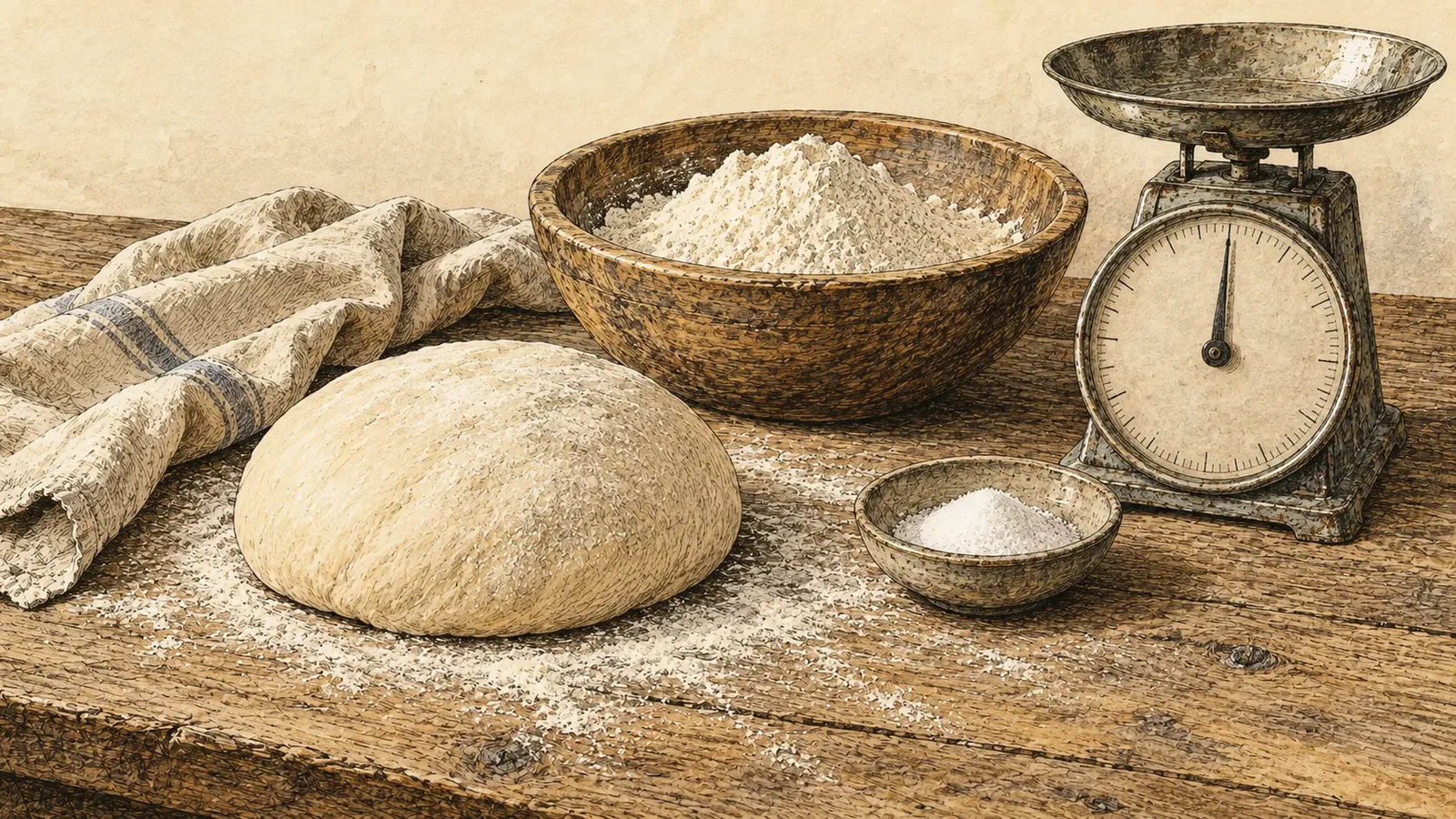
For a lean bread, 1.8 to 2% salt based on total flour weight is a useful professional baseline. With 500 grams of flour, that is 9 to 10 grams of salt. The formula, not the dough's final weight, sets the percentage.
The calculation
Baker's percentage makes flour 100%. Every other ingredient is expressed as a percentage of that flour weight.
Salt weight = total flour weight x salt percentage.
| Total flour | Salt at 1.8% | Salt at 2% |
|---|---|---|
| 300 g | 5.4 g | 6 g |
| 500 g | 9 g | 10 g |
| 750 g | 13.5 g | 15 g |
| 1,000 g | 18 g | 20 g |
King Arthur Baking's professional reference gives 1.8 to 2% as the general range and uses 2% in its basic white-bread example. This is a baseline, not a law. Enriched breads, flatbreads and regional formulas may deliberately sit elsewhere.
Count all the flour
If a formula uses a poolish, biga or sourdough starter, include the flour inside it when calculating the overall percentage. A dough with 400 grams of final-mix flour and 100 grams of flour in its starter has 500 grams total flour. At 2%, it takes 10 grams of salt.
This is the difference between an ingredient percentage written only for the final mix and the overall baker's percentage. The overall figure is the useful one for comparing formulas.
Why bread formulas use weight
Ten grams remains ten grams whether the salt is fine, cubical or flaky. A teaspoon does not. Different crystals leave different amounts of empty space in the spoon, which can quietly move a dough outside the intended formula.
Use a fine salt so it disperses readily, and use a scale capable of reading single grams. For very small doughs, a scale that reads tenths of a gram is better.
What salt changes in dough
Salt supplies flavor, strengthens dough structure and slows fermentation. King Arthur's professional reference notes that dough without salt tends to be slack and sticky, while excess salt can slow yeast enough to reduce volume.
That does not mean salt is the best lever for fixing fermentation. Dough temperature, yeast quantity, preferment and time are more direct controls. Start with the formula's salt and change the process before treating salt as a speed control.
A practical default
When building a plain lean-bread formula from scratch, 2% is easy to calculate and well established: 10 grams per 500 grams flour, or 20 grams per kilogram. When following a tested recipe, follow its number instead.
And when changing salt styles, keep the grams constant on the first bake. That lets you evaluate the new grain without changing the quantity at the same time.
This is bread-formula guidance, not dietary guidance. Nutrition calculations should use the actual salt weight and the finished loaf's yield.
Keep reading
- Sea Salt vs. Table Salt — why weight makes substitution simpler
- Fine, Coarse and Flaky Salt — choose a grain that disperses
- Does Salt Expire? — storage and clumping
The Salt Guide
We are recording the salts on the American shelf one jar at a time — label, panel, price paid, crystal on white. Browse the guide →