
Sea Salt vs. Table Salt: What Actually Changes
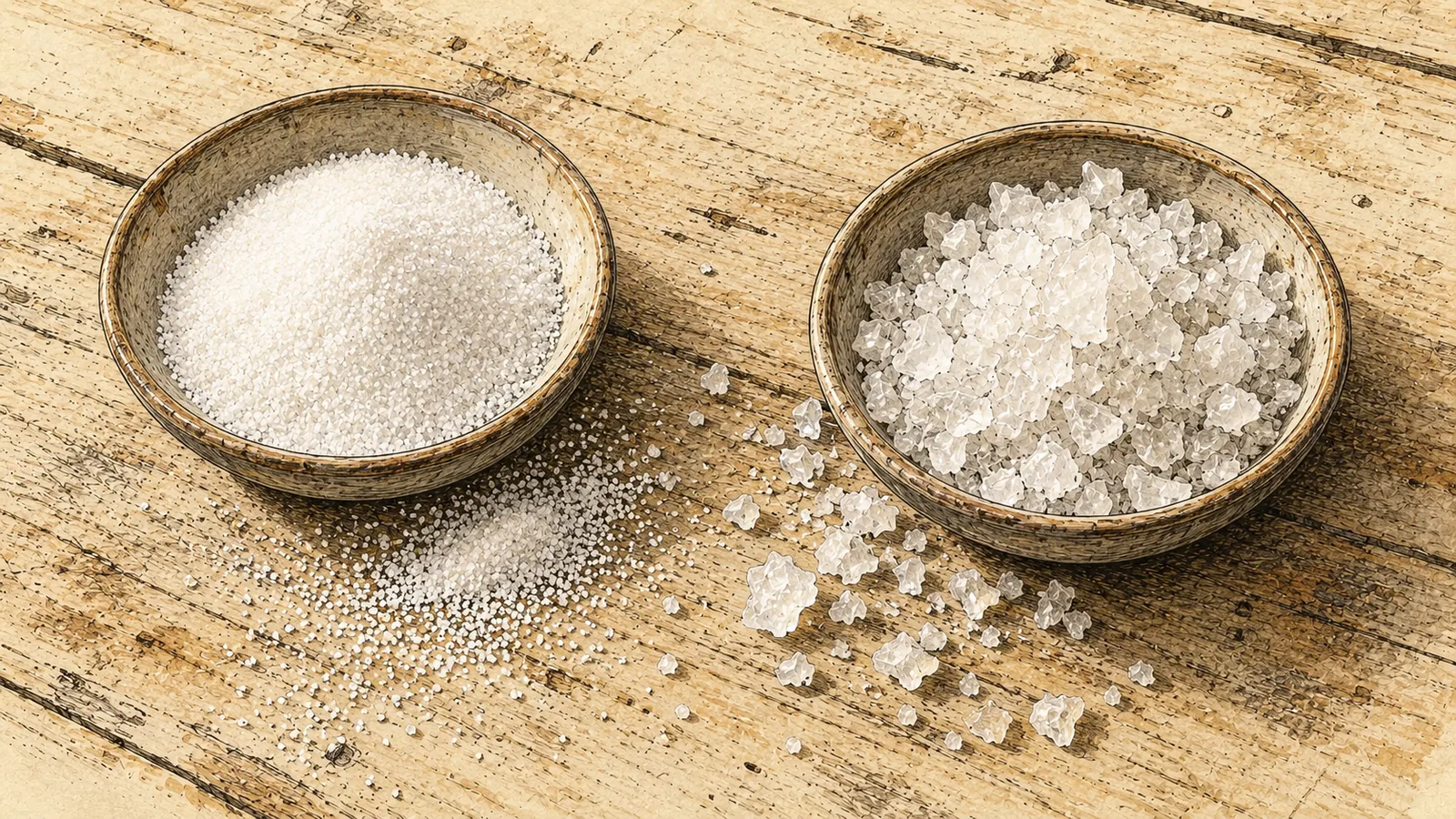
Sea salt and table salt are both principally sodium chloride. Sea salt begins with seawater; table salt usually begins with mined salt or brine and is commonly refined to a small, uniform grain. In the kitchen, the differences you can actually use are crystal shape, spoon density, iodine and any additives named on the label.
The short answer
If a recipe gives salt in grams, plain sea salt and plain table salt can usually be exchanged gram for gram. If it gives teaspoons, the substitution is less reliable. Fine cubes, coarse grains and hollow flakes do not occupy a spoon in the same way.
That is why a teaspoon of one salt can deliver a different mass from a teaspoon of another even when both ingredient panels simply say salt. Our guide to salt grain size shows the physical difference; the point here is what the names do and do not tell you.
Source is not grain size
Sea salt describes a source: seawater. It does not promise a particular crystal. Sea salt can be powdered, fine, coarse, cubical or flaky depending on how it is made and finished.
Table salt describes a use and a familiar commercial format: small, regular grains intended to pour consistently. It may be iodized or non-iodized and may contain an anti-caking ingredient. Read the panel rather than assuming.
The FDA describes table salt as sodium chloride and distinguishes salt from sodium: sodium is one element in the compound, not another name for the whole crystal. That distinction matters whenever a label reports milligrams of sodium rather than grams of salt.
Iodine and additives
In the United States, iodine may be added to salt, but it is not mandatory. FDA guidance says retail salt with added iodine is named iodized salt or iodized table salt. Salt without iodine carries the required statement that it does not supply iodide, a necessary nutrient.
Neither source decides the answer. Some table salts are non-iodized; some sea salts are iodized. Anti-caking ingredients also vary product by product. The reliable method is unglamorous and effective: read the ingredient statement.
Which one should you cook with?
| Job | Useful choice | Why |
|---|---|---|
| Dough, soup or sauce | A fine salt, weighed | It disperses readily and the weight is repeatable. |
| Finishing a cooked dish | A distinct flake or coarse crystal | The crystal remains perceptible at the surface. |
| A volume-based recipe | The salt the recipe names | Changing crystal geometry changes the mass in the spoon. |
| A weight-based recipe | Plain salt of a suitable grain | Equal grams remove most of the packing difference. |
No source makes a salt automatically better for every job. Fine Patagonian sea salt belongs in the pot; flakes belong at the last pinch. The useful question is not which name wins. It is whether the crystal matches the work.
This comparison is about culinary function and US labels. It is not a health comparison and does not claim that one salt contains less sodium than another by weight. Check the Nutrition Facts panel for the product you use.
Keep reading
- Sea Salt vs. Kosher Salt — why the spoon is the wrong comparison
- Sodium by Salt Type — weight, volume and label arithmetic
- Fine, Coarse and Flaky Salt — choose a crystal for the job
The Salt Guide
We are recording the salts on the American shelf one jar at a time — label, panel, price paid, crystal on white. Browse the guide →