
Sea Salt vs. Kosher Salt: What's the Difference?
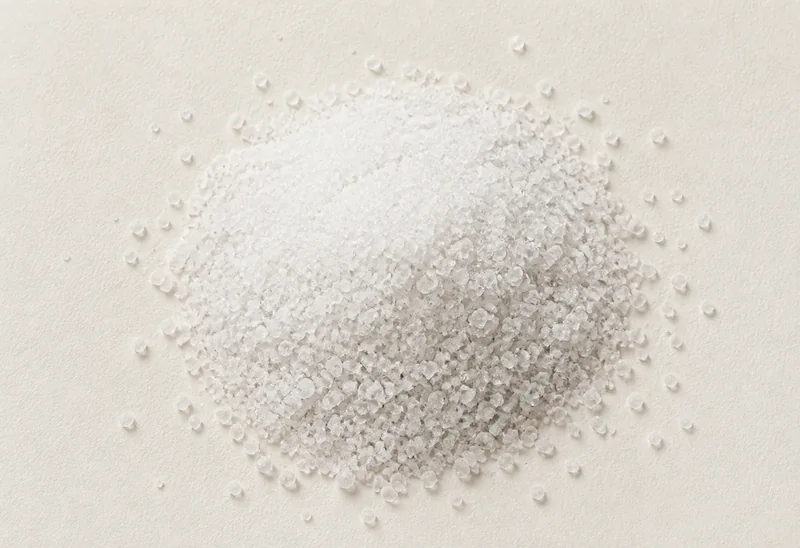
Sea salt is defined by where it comes from: evaporated seawater. Kosher salt is defined by its crystal: a coarse, quick-dissolving grain originally made for koshering meat. Both are 39–40% sodium by mass — essentially pure sodium chloride. The differences that matter in a kitchen are crystal shape, density, and how each measures by volume, not chemistry.
What kosher salt actually is
The name is short for koshering salt — the coarse grain used to draw blood from meat under kashrut, where fine salt would dissolve instead of clinging. It describes the salt’s job, not its religious status, and most kosher salt is not sea salt at all: it is made from mined rock salt or vacuum-evaporated brine.
The two dominant American brands are made by completely different processes, and they are not interchangeable:
- Diamond Crystal uses the Alberger process, which grows fragile, hollow, pyramid-shaped “hopper” crystals.
- Morton presses vacuum-pan granules through high-pressure rollers into dense, flattened flakes.
One is mostly air; the other is compacted. This is why recipes that specify a brand are not being precious.
What sea salt actually is
Salt evaporated from seawater — traditionally in open solar pans (Guérande, Trapani), and in colder climates by heated evaporation. The form varies enormously: fine grains, coarse crystals, pyramidal flakes like Maldon, moist fleur de sel. “Sea salt” tells you the origin; it tells you almost nothing about the grain in the jar.
One distinction worth keeping sharp: Himalayan pink salt is not sea salt. It is mined rock salt from an ancient buried deposit. Sea salt comes from water that is in the ocean now.
The measurement problem — the difference that actually ruins food
Because the crystals differ so much in shape and packing, equal volumes hold very different amounts of salt:
| Salt | Grams per teaspoon |
|---|---|
| Table salt | 6.0 |
| Fine sea salt | ~5.4 |
| Morton kosher | 4.8 |
| Diamond Crystal kosher | 2.8 |
| Flake sea salt (Maldon) | ~2.5 |
From manufacturers’ declared Nutrition Facts serving weights; flake salts vary ±25% with packing.
A teaspoon of table salt contains more than twice the sodium of a teaspoon of Diamond Crystal. A recipe written for one and cooked with the other is off by a factor of two in either direction.
Two corollaries worth stating plainly:
- “Sea salt has less sodium” is a myth by mass. All of these are 39–40% sodium. The “less sodium per serving” on some labels is a per-teaspoon artifact — a statement about air between crystals, not about the salt.
- “Use half as much Morton as Diamond Crystal” is wrong too. The real ratio is 1.3–1.7×, not 2×. Halving under-seasons by a fifth or more.
The permanent fix is to measure salt by weight. About 0.75–1% of the food’s weight is the well-seasoned range for meat, and it holds for any salt in the table above.
When to use which
Kosher salt is a cooking tool. The coarse grain pinches easily, distributes evenly from the hand, and dissolves fast. It is the professional default for seasoning during cooking — not because it tastes different, but because it handles well and it is cheap.
Fine sea salt behaves like table salt in recipes and dissolves into doughs, brines, and sauces. If a recipe says “salt” with no further detail, fine grain is the safest reading.
Coarse sea salt is the grilling grain — in Argentina it is sold as sal parrillera, and it earns its place on meat over fire, where a medium-coarse crystal clings to the surface and dissolves over the length of the cook.
Flake sea salt is for finishing. Its fragile crystals shatter between the teeth; dissolving them into a pot wastes exactly the property you paid for.
Does one taste better?
In food, at equal sodium: no. The most thorough blind comparison — 45 salts from around the world, published in the Journal of Sensory Studies — found no difference in salty taste at equivalent sodium levels, and concluded the direct flavor effect of trace minerals “appeared to be minimal.” America’s Test Kitchen’s cooking tests agree: dissolved into a dish, sea salt and table salt are indistinguishable.
What does differ is behavior: dissolution speed, cling, crunch, and how the salt meets the tongue. Salt applied to the surface of food in larger, slower-dissolving crystals genuinely reads differently — peer-reviewed sensory work shows smaller and hollower crystals register saltier at identical sodium. That is a texture-and-delivery effect, and it is the honest reason to own more than one salt.
Common questions
Most brands carry kosher certification, but the name refers to the salt’s use in koshering meat, not its status. Table salt can be certified kosher too.
By weight, yes — any salt substitutes for any other by weight. By volume, no: fine sea salt is nearly twice as dense as Diamond Crystal kosher.
Neither. Both are essentially pure sodium chloride, 39–40% sodium by mass. If you need to reduce sodium, reduce the amount of salt — changing the type will not do it.
Handling. The coarse grain is easy to pinch, easy to see on food, and forgiving to distribute. It is a workflow preference, not a flavor claim.
Blind tests say no. America’s Test Kitchen found tasters could not distinguish iodized from non-iodized salt in water or chicken stock, and a blinded crossover trial found no sensory effect in pickled vegetables.
Published studies have detected microplastic particles in many commercial sea salts worldwide. It is an area of active research, no regulator currently sets a limit for salt, and we are not aware of any salt producer who can honestly claim “microplastic-free” — be skeptical of any who do.
Sources
- Drake, S.L. & Drake, M.A. (2011), “Comparison of Salty Taste and Time Intensity of Sea and Land Salts from Around the World,” Journal of Sensory Studies 26(1) — Wiley
- Rama, R. et al. (2013), “Impact of Salt Crystal Size on in-Mouth Delivery of Sodium and Saltiness Perception,” Journal of Texture Studies 44(5) — doi:10.1111/jtxs.12017
- Cook’s Illustrated — Salt Types and Measurements
- America’s Test Kitchen — Iodized vs. Noniodized Salt
- Manufacturer Nutrition Facts serving weights: Morton table · Morton kosher · Diamond Crystal
- Badran, Qaraqash & Gamah (1996), Eastern Mediterranean Health Journal 2(2) — WHO EMRO
The Salt Guide
We are recording the salts on the American shelf one jar at a time — label, panel, price paid, crystal on white. Browse the guide →
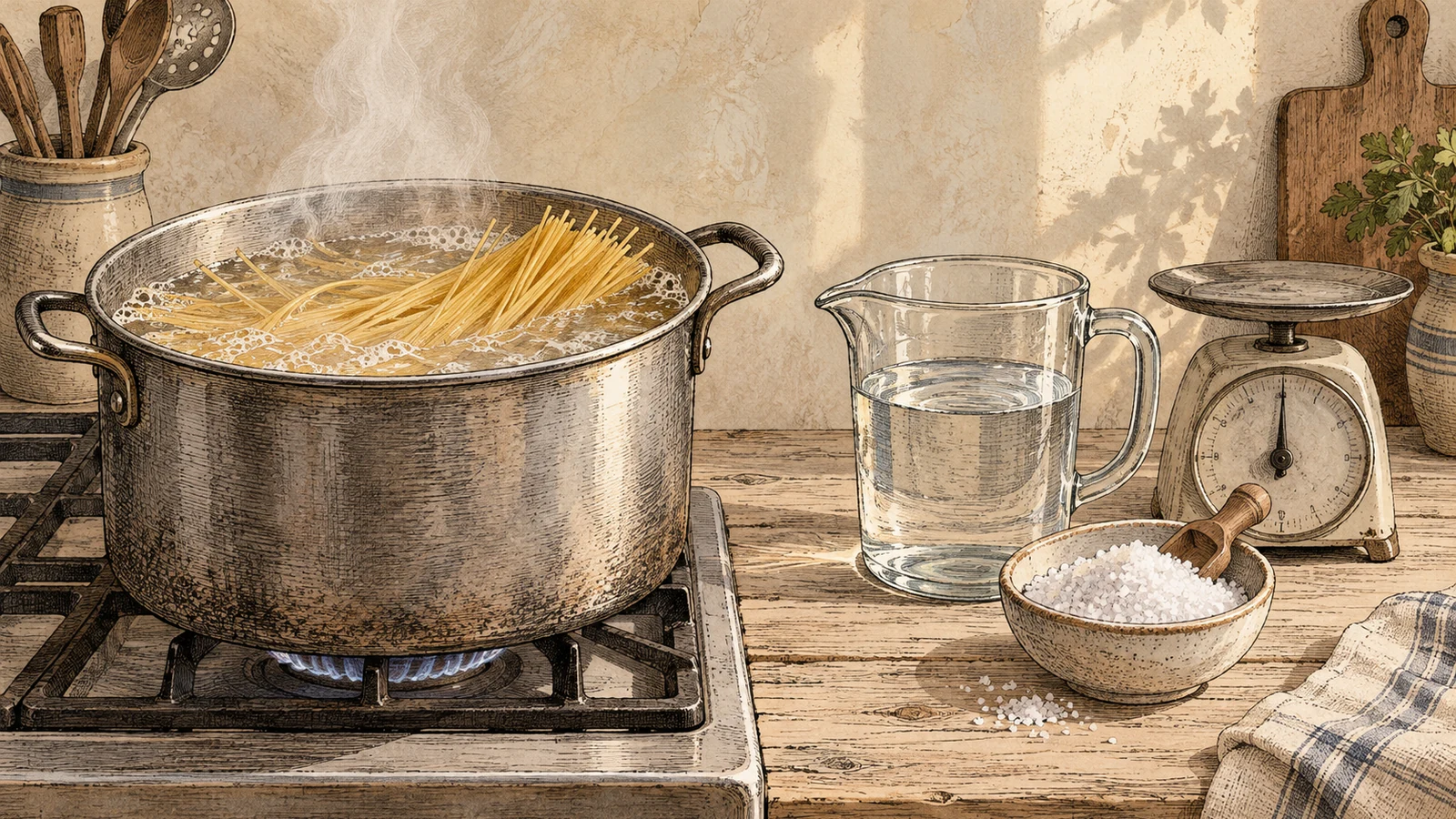
How Much Salt Should Go in Pasta Water?
The sea is far too salty. Start around 1% salt by weight of water, then adjust for the sauce, the pasta shape and how much cooking water you plan to keep.
Read the article →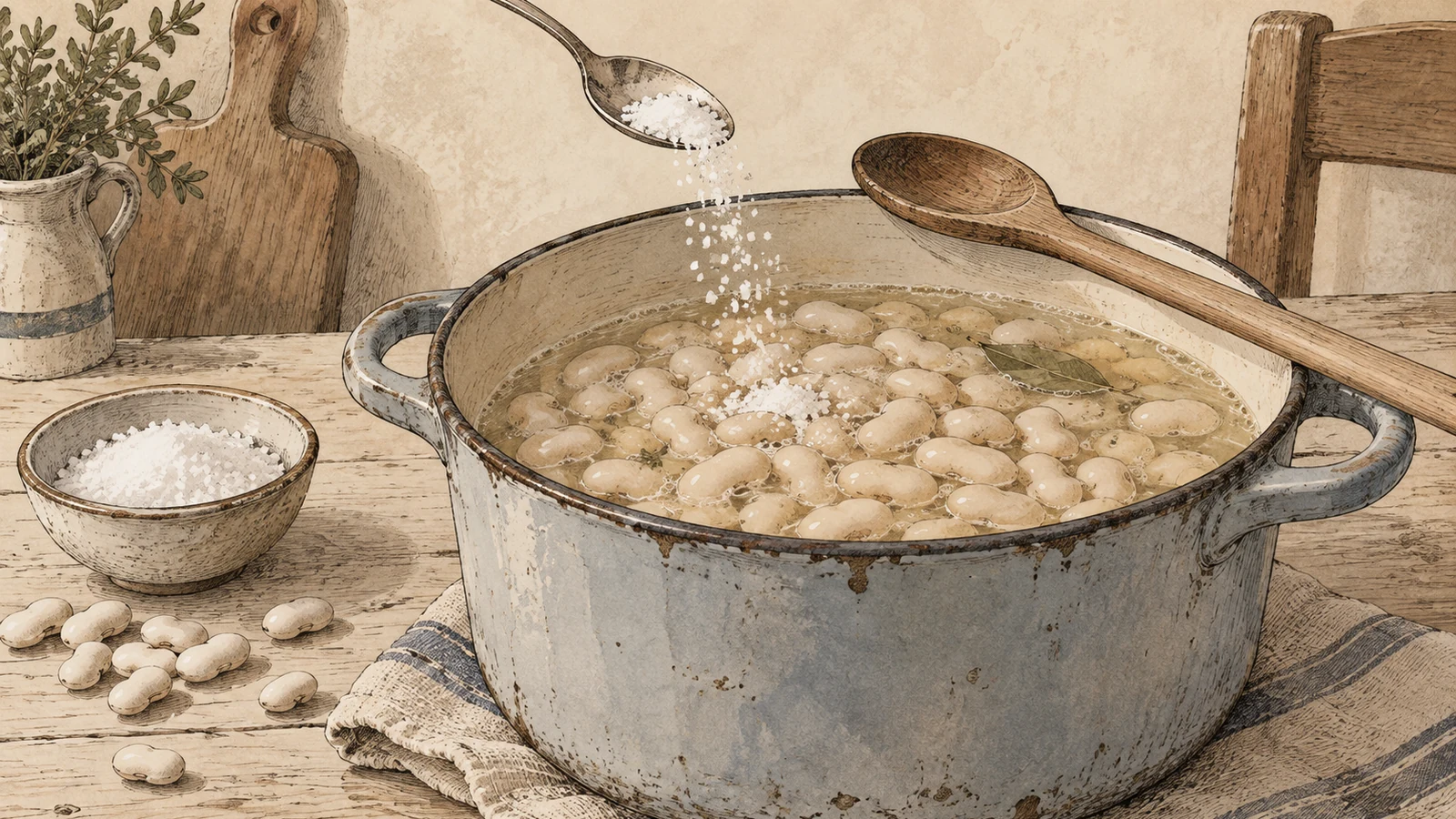
When Should You Salt Beans?
You do not have to wait until the beans are soft. Ordinary salt can go into the soak or the cooking water; bean age, acidity and calcium-rich water are more likely to explain a stubborn pot.
Read the article →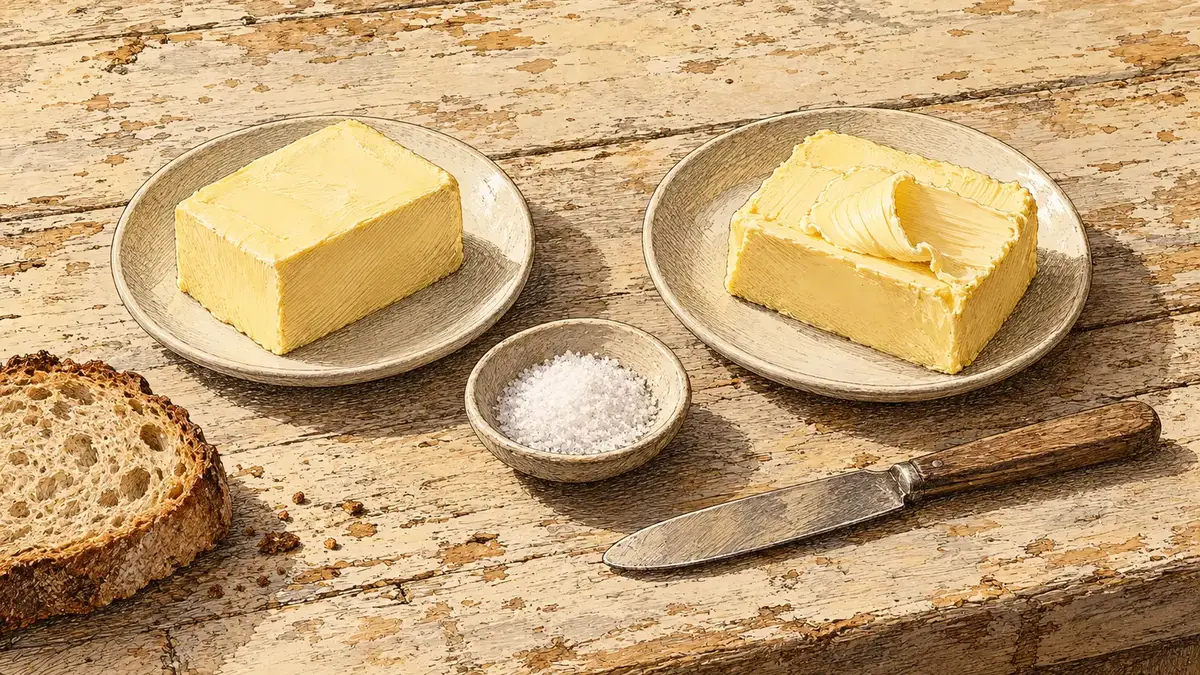
Salted vs. Unsalted Butter: How to Make the Swap
Keep the butter quantity. Adjust the salt. A practical guide to the quarter-teaspoon rule, its limits, and the other butter differences that affect a bake.
Read the article →Get the next guide
An email when we publish a new salt guide or recipe, and first word when the Patagonian salts are ready to order.
We write when there is something to say, not on a schedule.