
What Is Kosher Salt, and Why Do Recipes Name the Brand?
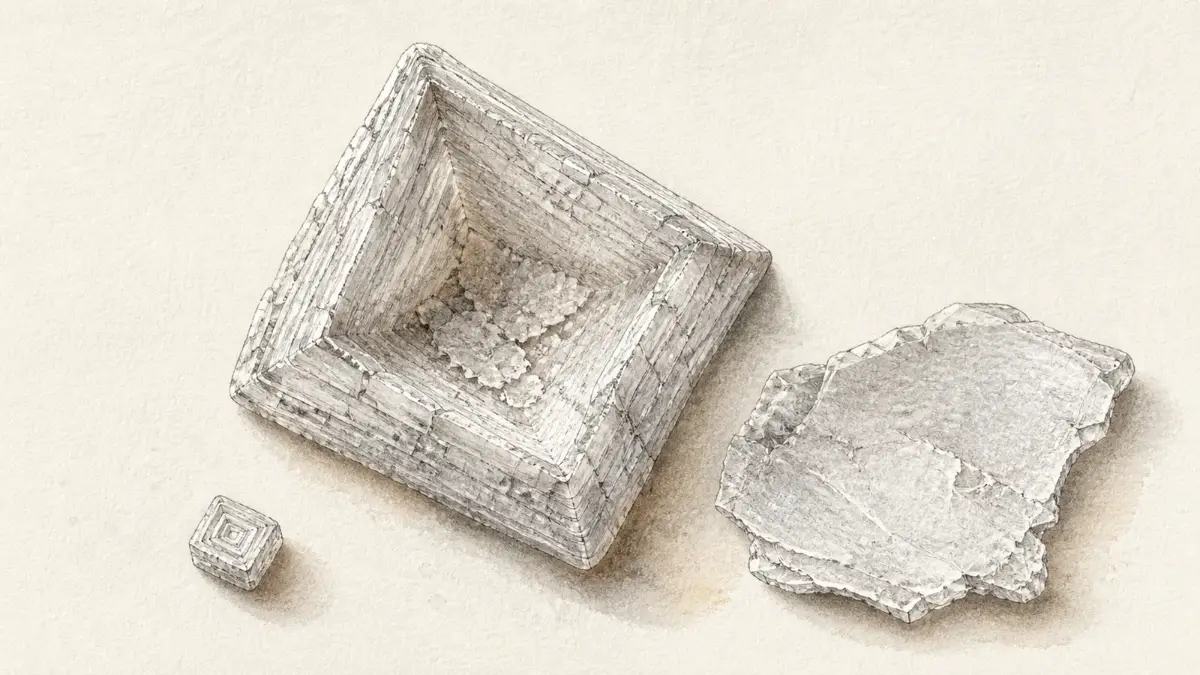
Kosher salt is not a kind of salt. It is a crystal shape, and the two American brands are so different that a teaspoon of one carries almost twice the sodium of the other.
What makes salt "kosher"?
The job, not the salt. The name is short for koshering salt — a coarse, flat crystal that sits on the surface of meat and draws blood out during kashering, rather than dissolving straight in. The Orthodox Union puts it plainly: “Kosher salt is really a misnomer: it should be called koshering salt.”
Salt is a mineral. It is inherently kosher and needs no certification to be permitted. Both major American brands happen to carry OU certification anyway, but that is not what the word on the box is describing.
Why does the brand matter so much?
Because the two brands are made by completely different processes and the crystals are not the same object.
Diamond Crystal is made by the Alberger process at St. Clair, Michigan — the only plant of its kind. Brine is flashed into an open evaporation pan and salt forms as hollow pyramids at the surface. They trap air, they crush between your fingers, and they are light.
Morton Coarse Kosher is vacuum-evaporated granular salt pressed between rollers into flat flakes. Morton's own description: “granulated salt compacted into coarse flakes.” Dense, hard, and it does not crush.
How much difference does that actually make?
A great deal. These are the manufacturers' own Nutrition Facts figures, scaled up:
| Salt | Grams per teaspoon | Sodium per teaspoon | Relative |
|---|---|---|---|
| Fine table salt | 6.0 g | 2,360 mg | 100% |
| Morton Coarse Kosher | 4.8 g | 1,890 mg | 80% |
| Diamond Crystal Kosher | 2.8 g | 1,100 mg | 47% |
A teaspoon of Diamond Crystal delivers less than half the salt of a teaspoon of table salt. Measured by weight all three are the same thing — about 393 mg of sodium per gram. Measured by the spoon they are three different ingredients.
Is the "two to one" rule correct?
For one pairing, yes. For the pairing people usually apply it to, no.
| Swap | Correct factor by weight |
|---|---|
| Table salt → Diamond Crystal | × 2.14 |
| Table salt → Morton kosher | × 1.25 |
| Diamond Crystal → Morton kosher | × 0.58 |
| Morton kosher → Diamond Crystal | × 1.71 |
Two to one is the Diamond Crystal to table salt ratio, and it is accurate to within about seven per cent. Applied to Diamond Crystal against Morton it is wrong: the real figure is 1.71, so halving a Diamond Crystal quantity under-salts by roughly fifteen per cent.
Two pieces of standard advice that contradict their own sources
America's Test Kitchen publishes the chain “1 teaspoon table salt equals 1½ teaspoons Morton kosher equals 2 teaspoons Diamond Crystal.” Their own published gram weights — 6.0, 4.8 and 2.8 — give 1.25 for the Morton step, not 1.5. Following the 1.5 over-salts by about twenty per cent.
Morton's own FAQ advises that “for general use in teaspoon amounts, use the same amount of Morton Coarse Kosher Salt as table salt.” By Morton's own label weights that under-salts by twenty per cent.
Neither is a conspiracy. Both are what happens when a volume rule of thumb outlives the measurement it came from.
What is actually in the box?
Diamond Crystal's ingredient statement is one word: Salt. No anti-caking agent, no iodide, nothing else — which is why the packaging warns that caking may occur and tells you to shake the container.
Morton Coarse Kosher lists Salt, Yellow Prussiate of Soda. That is sodium ferrocyanide, an anti-caking agent capped by regulation at 13 parts per million. It is a tightly bound iron complex, not free cyanide, and 13 ppm is the legal ceiling for the whole category.
Neither is iodized.
Common questions
You can, but weigh it. Morton advises against kosher salt in baking except as a topping, because coarse crystals do not disperse evenly in a dough or batter. A scale removes the problem entirely.
No. By weight it is the same compound and the same sodium. What differs is how much lands on your food per spoonful.
Because with a 1.71× gap between the two kosher brands, the brand name is doing the work a unit of measurement should. It is a workaround for volume measuring, not brand loyalty.
The recurring rumour is not supported by anything checkable. The Nutrition Facts serving weight is still 0.7 g per quarter teaspoon, the ingredient statement is still one word, the process is still Alberger and the plant is still St. Clair. Cargill discontinued the 13-ounce canister in 2018, which is what started the panic.
Sources
- Cargill — Diamond Crystal Kosher Salt, product and process
- Morton Salt — FAQ, product composition and iodization
- Morton Salt — Iodized Table Salt nutritional facts
- Orthodox Union — The Many Lives of Kosher Salt
- America's Test Kitchen — kosher salt tasting and conversions
- 21 CFR 172.490 — yellow prussiate of soda, 13 ppm limit in salt
- IFT, Food Technology — Viewing Salt with a Grain of Salt
The Salt Guide
We are recording the salts on the American shelf one jar at a time — label, panel, price paid, crystal on white. Browse the guide →
Get the next guide
An email when we publish a new salt guide or recipe, and first word when the Patagonian salts are ready to order.
We write when there is something to say, not on a schedule.