
Is There Plastic in Your Sea Salt?
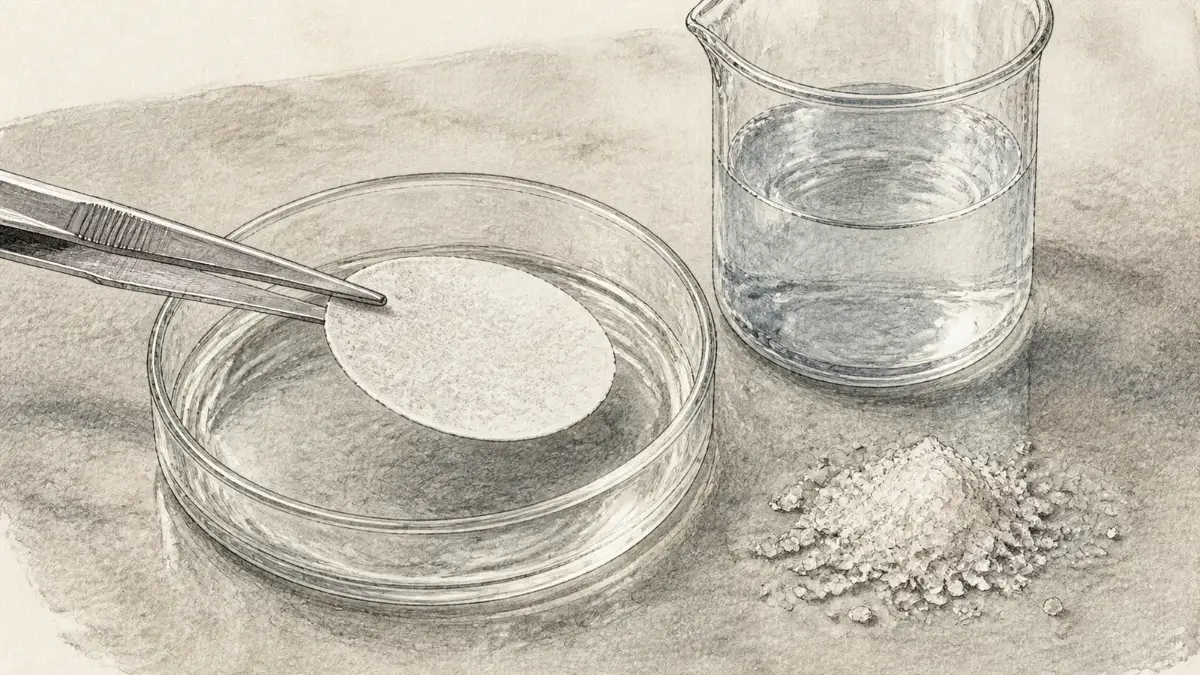
Ninety-four per cent of commercial salt products tested worldwide contained microplastics. Sea salt averages higher than rock salt. We sell sea salt, so let us go through this properly.
How much plastic is actually in salt?
A 2019 review pooling seven studies found 118 of 126 salt products tested worldwide — 94% — contained microplastics, averaging 140 particles per kilogram.
The largest single study examined 39 brands from 21 countries and found microplastics in 36 of them. Its ranges, by salt type:
| Salt type | Particles per kg |
|---|---|
| Sea salt | 0 – 1,674 |
| Lake salt | 28 – 462 |
| Rock salt | 0 – 148 |
The three brands with none detected were a refined Taiwanese sea salt, a refined Chinese rock salt, and an unrefined French solar sea salt.
Is sea salt worse than rock salt?
On the weight of evidence, yes — and we would rather say so than have you find out elsewhere.
Three studies and one review found the same ordering: sea above lake above rock. But two found otherwise. A Spanish study found no significant difference between sea salt and well salt. An Australian study found the reverse outright, with coarse Himalayan pink salt at 174 particles per kilogram against sea salt's 30.
So the honest statement is that sea salt averages higher, the ranges overlap heavily, individual brands regularly cross over, and “rock salt is the plastic-free alternative” is not supported.
Why do the numbers vary so wildly?
Because the methods do. Published concentrations run from 1 particle per kilogram to over 1,600, and much of that spread is the laboratory rather than the salt. Studies use different minimum particle sizes — 5, 30, 100, 149 micrometres — and a study that only counts particles above 149 µm will find a fraction of what a 5 µm study finds in the same sample.
One of the papers is explicit that earlier work contained procedural errors. Another concludes that method differences make cross-study comparison unreliable. Numbers from different papers are not directly comparable, and nobody has run the same brand through two laboratories.
How does salt compare to everything else you consume?
This is the part that puts it in proportion, and it is the reason we are comfortable publishing the rest.
The global study that produced the alarming per-kilogram figures also did the arithmetic on total exposure. Its conclusion: an adult ingests and inhales roughly 32,000 microplastic particles a year, about 80% of it by breathing, and salt accounts for about 6%.
A separate US study measured microplastic concentrations across the diet: bottled water at 94.4 particles per litre, seafood at 1.48 per gram, salt at 0.11 per gram, tap water at 4.23 per litre. Its authors ranked air, bottled water and seafood as the large majority of intake and named salt among the minimal contributors. Someone drinking only bottled water takes in an extra 90,000 particles a year — more than twenty times the tap water figure, and dwarfing salt.
One study that modelled how much actually crosses the gut wall rather than passing through put it at fewer than twelve particles a year, a quarter of which might come from choosing sea salt.
Is it harmful?
Nobody knows, and every serious body says so.
The FDA's position, as of July 2024: “Current scientific evidence does not demonstrate that levels of microplastics or nanoplastics detected in foods pose a risk to human health.” The European Food Safety Authority states it “cannot conclude on potential health effects” and has a full opinion scheduled for the end of 2027. The World Health Organization concluded in 2019 that microplastics in drinking water do not appear to pose a health risk at current levels, and noted that particles above 150 micrometres are unlikely to be absorbed at all.
No regulator anywhere has set a limit on microplastics in food. There is animal evidence and there are human tissue findings, some of which are contested on methodological grounds. What does not exist is a demonstrated harm at dietary levels or any threshold anyone can point to.
One of the salt papers put it in a single sentence we cannot improve on: excess salt consumption is detrimental to human health; the hazardousness of ingesting microplastics has yet to be shown.
Can production reduce it?
Partly, and the evidence is thinner than you would hope. Aggressive industrial refining eliminated microplastics in one Taiwanese product — and failed to, in a British one from the same study. Sand filtration of seawater removed over 90% of particles in a laboratory trial, but no commercial producer has published a before-and-after.
The most useful finding for anyone who makes salt: a Spanish study tracking six salt works found concentrations fell through the evaporation ponds and rose significantly when salt was stacked in open outdoor mounds, with atmospheric fallout as the main source — including at inland works where no seawater is involved. Packaging made no measurable difference. A good deal of what ends up in salt arrives from the air during handling, not from the sea.
What about Patagonian salt?
There is no published measurement. We looked.
No peer-reviewed study of commercial edible salt from Argentina, Chile, Uruguay or Peru appears in the literature. One Argentine master's thesis, reported through a university press office rather than a journal, found 5 to 20 particles per kilogram in three fine sea salt brands sold in Rosario. That is the entire published record for the region.
So we will not tell you our salt is cleaner. Nobody has tested it, and a claim without a measurement behind it is exactly the kind of thing this journal exists to point at.
Common questions
That is your call, and the honest input to it is that salt supplies roughly six per cent of your microplastic exposure while breathing supplies about eighty. If microplastics are your concern, salt is not where the leverage is.
Not at home. Once particles are embedded in crystals, rinsing dissolves the salt before it removes the plastic.
It is contested. Two peer-reviewed papers put ingested microplastic mass in the range of micrograms per week rather than grams — a difference of several orders of magnitude — and one concludes the popular figure overestimates by that margin.
It is the obvious thing to do, and it has not been done. When it is, the result goes here whatever it says.
Sources
- Kim JS et al., Environ Sci Technol 2018;52(21):12819–12828 — global pattern of microplastics in food-grade salts
- Lee H et al., Scientific Reports 2019;9:10145 — table salts from Taiwan, including a global review
- Yang D et al., Environ Sci Technol 2015;49(22):13622–13627 — microplastic pollution in table salts from China
- Iñiguez ME et al., Scientific Reports 2017;7:8620 — microplastics in Spanish table salt
- Karami A et al., Scientific Reports 2017;7:46173 — commercial salts from different countries
- Cox KD et al., Environ Sci Technol 2019;53(12):7068–7074 — human consumption of microplastics
- Cledera-Castro MM et al., Heliyon 2024;10(11):e31609 — microplastics through the stages of solar salt production
- FDA — Microplastics and Nanoplastics in Foods
- EFSA — Microplastics and nanoplastics in food
- WHO — Microplastics in drinking-water, 2019
The Salt Guide
We are recording the salts on the American shelf one jar at a time — label, panel, price paid, crystal on white. Browse the guide →
Get the next guide
An email when we publish a new salt guide or recipe, and first word when the Patagonian salts are ready to order.
We write when there is something to say, not on a schedule.