
Anti-Caking Agents in Salt, Explained
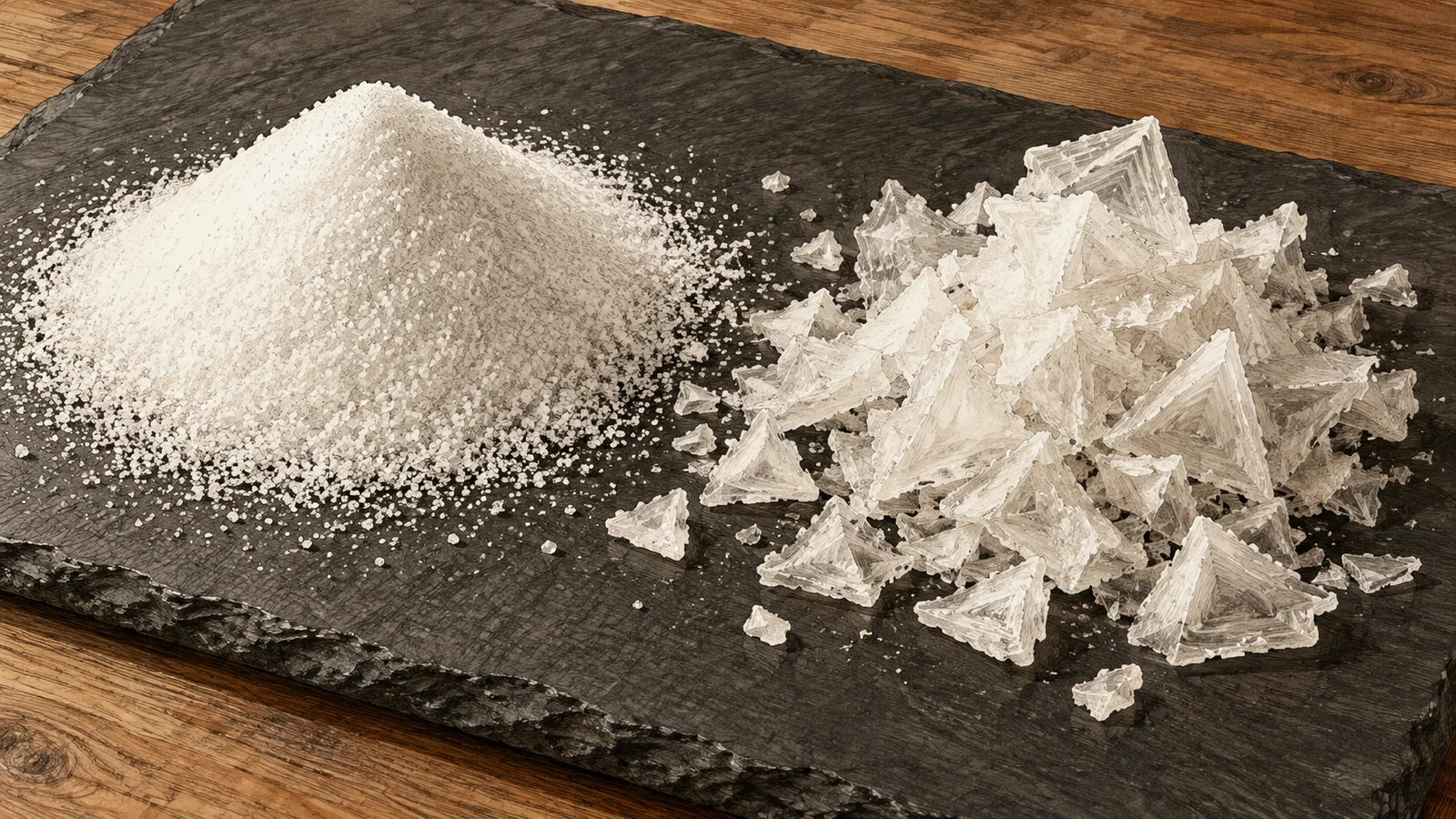
Anti-caking agents are powders or crystal modifiers added to fine salt in fractions of a per cent so it keeps pouring in damp weather. The four you meet most are silicon dioxide (E551), capped in the US at 2 per cent of the food; calcium silicate (E552), GRAS up to 2 per cent in table salt; sodium ferrocyanide, or yellow prussiate of soda (E535), capped at 13 parts per million in salt; and magnesium carbonate (E504), GRAS at good manufacturing practice. Flake salt does without because its crystals are large, touch each other at few points, and are pinched rather than poured.
What caking actually is
Salt takes on water from humid air, dissolves very slightly where grains touch, and when the air dries the dissolved salt recrystallises into a solid bridge between them. Repeat that for a few summer weeks and a box of loose grains becomes a brick. The humidity numbers behind it, and why unwashed sea salts clump earlier, are in does salt expire. This page is about what manufacturers add to stop it, and how much.
Why table salt got one first
By Morton’s own account, humidity made clumping salt “a problem for cooks and diners alike.” In 1911 the company began adding magnesium carbonate to make what it calls the first free-flowing salt, and in 1914 it introduced the Morton Salt Girl and “When It Rains It Pours”. Morton records that the agent has since been changed to calcium silicate.
That slogan is the whole brief for an anti-caking agent. The job is not flavour or preservation. It is making fine grains fall out of a small hole in a humid kitchen.
The four agents, side by side
| Agent | E-number | US status | US limit | How it works |
|---|---|---|---|---|
| Silicon dioxide | E551 | Approved food additive, 21 CFR 172.480 | Not over 2% by weight of the food | Insoluble powder between the grains |
| Calcium silicate | E552 | GRAS, 21 CFR 182.2227 | Not over 2% in table salt (5% in baking powder) | Absorbs moisture in the package before the salt does |
| Sodium ferrocyanide (yellow prussiate of soda) | E535 | Approved food additive, 21 CFR 172.490 | Not over 13 ppm in salt, as anhydrous sodium ferrocyanide | Water-soluble; changes how salt crystals grow |
| Magnesium carbonate | E504 | Affirmed GRAS, 21 CFR 184.1425 | Current good manufacturing practice; no number | Insoluble powder; Morton’s original 1911 agent |
Two of the four sit in the same subpart of the US food additive regulations, headed simply “Anticaking Agents”. The other two are on the lists of substances generally recognised as safe. That difference is administrative, not a ranking.
Calcium silicate: the table-salt agent
Morton’s iodised table salt reads salt, calcium silicate (an anticaking agent), dextrose, potassium iodide. Morton describes calcium silicate as white, odourless and tasteless, and says it works by absorbing “moisture inside the package that would otherwise be absorbed by the salt.”
On quantity, the company gives two numbers that do not quite agree. Its consumer FAQ says calcium silicate is added at less than one half-percent. A Morton product data sheet for the 26 oz iodised canister specifies 0.20 to 0.70 per cent. The FAQ is a description; the data sheet is a specification range, and a range can run past the typical figure. Either way, both are well under the federal ceiling of 2 per cent. The dextrose, incidentally, is there to stabilise the iodine, not to stop caking; Morton gives it as 0.04 per cent. Why iodine is in there at all is covered in is iodised salt necessary.
Silicon dioxide: the blend agent
Silicon dioxide is regulated for foods in general, not for salt in particular, which is why it turns up in seasoning blends. The US rule is unusually specific. It may be used only in foods in which it “has been demonstrated to have an anticaking effect”, in no more than the amount reasonably required, and never above 2 per cent by weight of the food. We looked for a manufacturer’s technical sheet giving a typical use level in salt blends that we could cite, and did not find one we could read in full. So the only number here is the legal ceiling, and that is what it is: a ceiling, not a typical dose.
Yellow prussiate of soda: the one with the alarming name
Sodium ferrocyanide is the agent readers most often ask about, because the word “cyanide” is in it. The reasonable reaction is suspicion. The useful facts are the regulatory ones. The US permits it in salt at no more than 13 parts per million, calculated as anhydrous sodium ferrocyanide. That is 0.0013 per cent, roughly one fifteen-hundredth of the 2 per cent ceiling on calcium silicate.
At 13 parts per million it cannot be soaking up water in any useful quantity, and it is not meant to. The US regulation names its two purposes: an anticaking agent in salt, and “an adjuvant in the production of dendritic crystals of salt”. In other words, it acts on the way salt crystallises rather than on the water. It is also soluble, so it leaves no powder on the crystal. Morton’s coarse kosher salt uses what the company calls “a water soluble anti-caking agent”.
Magnesium carbonate: the original
Magnesium carbonate is affirmed as GRAS for seven functions, from anticaking and free-flow agent to pH control and flour treatment, at levels no higher than good manufacturing practice requires. The regulation sets no numeric limit. It was the agent that made the first free-flowing table salt, and it is the one Morton later replaced.
How to read them on a panel
On a US salt label the agent appears in the ingredient list by name, usually with its function in parentheses, as Morton does. On European and imported packs you may see the E-number instead of, or beside, the name. Three habits help.
- Look at the order. Ingredients run in descending order by weight, so an agent used at a fraction of a per cent sits well down the list. On Morton’s table salt it is second only because salt is nearly everything else.
- Do not read absence as proof. US rules let an incidental additive stay off the label when it came in with another ingredient, served a function there, and has none in the finished food. An anti-caking agent in the garlic powder going into a blend can fall under that exemption. The only way to know is to ask the maker.
- Check the same brand’s other salts. Morton’s canning and pickling salt is, in the company’s words, pure granulated salt with no potassium iodide, dextrose or anti-caking agent. The brand is not the formula.
Why flake salt does not need one
A specification sheet for Maldon gives its salt as 97.0 per cent sodium chloride, 2.0 per cent moisture, and additives: none. Morton’s iodised data sheet caps surface moisture at 0.1 per cent. That looks backwards. The salt with twenty times the water is the one without the anti-caking agent. The figures are not strictly comparable, since one is a typical total and the other a maximum for surface water, but the direction is too wide to be an artefact.
The explanation is geometry and use, not purity.
- Grain size. Morton’s sheet allows no more than 5 per cent retained on a US No. 30 sieve and no more than 9 per cent through a No. 70, which puts at least 86 per cent of the grains between about 0.2 and 0.6 mm. Caking happens where grains touch. A gram of fine, near-cubic grains has vastly more contact points than a gram of flakes many times larger, stacked loosely with air between them.
- Handling. Flake salt is pinched from a box or jar and crushed between the fingers. A loose clump of flakes breaks under the same pressure. Nobody pours it through a shaker hole, which is the one thing an anti-caking agent is for.
Kosher salt shows the same split within one category. Diamond Crystal describes its Alberger-process flake as “additive-free”; Morton’s denser coarse kosher uses its water-soluble agent. The shapes are compared in kosher salt explained, and Maldon’s paperwork is read in full in what is actually in Maldon.
None of this makes an agent-free salt better salt. Calcium silicate at a fraction of a per cent is a sensible answer to a real problem in a fine-grained product. The absence of one in a flake is a consequence of shape and use. It is not a virtue, and we are not going to sell it as one.
The question for our blends
We are developing seasoning blends; none is on sale. Dried herbs and ground spice take on water more readily than salt, and a blend is poured more often than a flake. Whether a blend can stay usable in a humid kitchen without an anti-caking agent is one of the questions that development work is trying to answer.
A caveat on our sources: the US limits come from the current eCFR and are exact. We could not retrieve the Codex or EU maximum levels for salt in a form we could check, so this page gives E-numbers as identifiers only and no European limits. The Morton data sheet and the Maldon specification are hosted by a distributor rather than by the makers; we treat both as indicative rather than current.
Sources
- 21 CFR 172 Subpart E — anticaking agents: silicon dioxide (172.480), yellow prussiate of soda (172.490)
- 21 CFR 182.2227 — calcium silicate
- 21 CFR 184.1425 — magnesium carbonate
- 21 CFR 101.100 — incidental additives exemption
- Morton Salt — FAQ on anti-caking agents, dextrose and kosher salt
- Morton Iodized Table Salt product data sheet (distributor-hosted)
- Morton Salt — heritage, 1900–1921
- Maldon product specification sheet (distributor-hosted, undated)
- Diamond Crystal — Kosher Salt
Read next
- Does Salt Expire? — why salt clumps, in humidity figures
- Kosher Salt Explained — two kosher crystals, one with an agent
- What Is Actually in Maldon — a flake salt read from its paperwork
- Patagonian Salt Flakes — our flake
The Salt Guide
We are recording the salts on the American shelf one jar at a time — label, panel, price paid, crystal on white. Browse the guide →