
The EU Banned Smoke Flavourings. Here Is What That Means for Salt
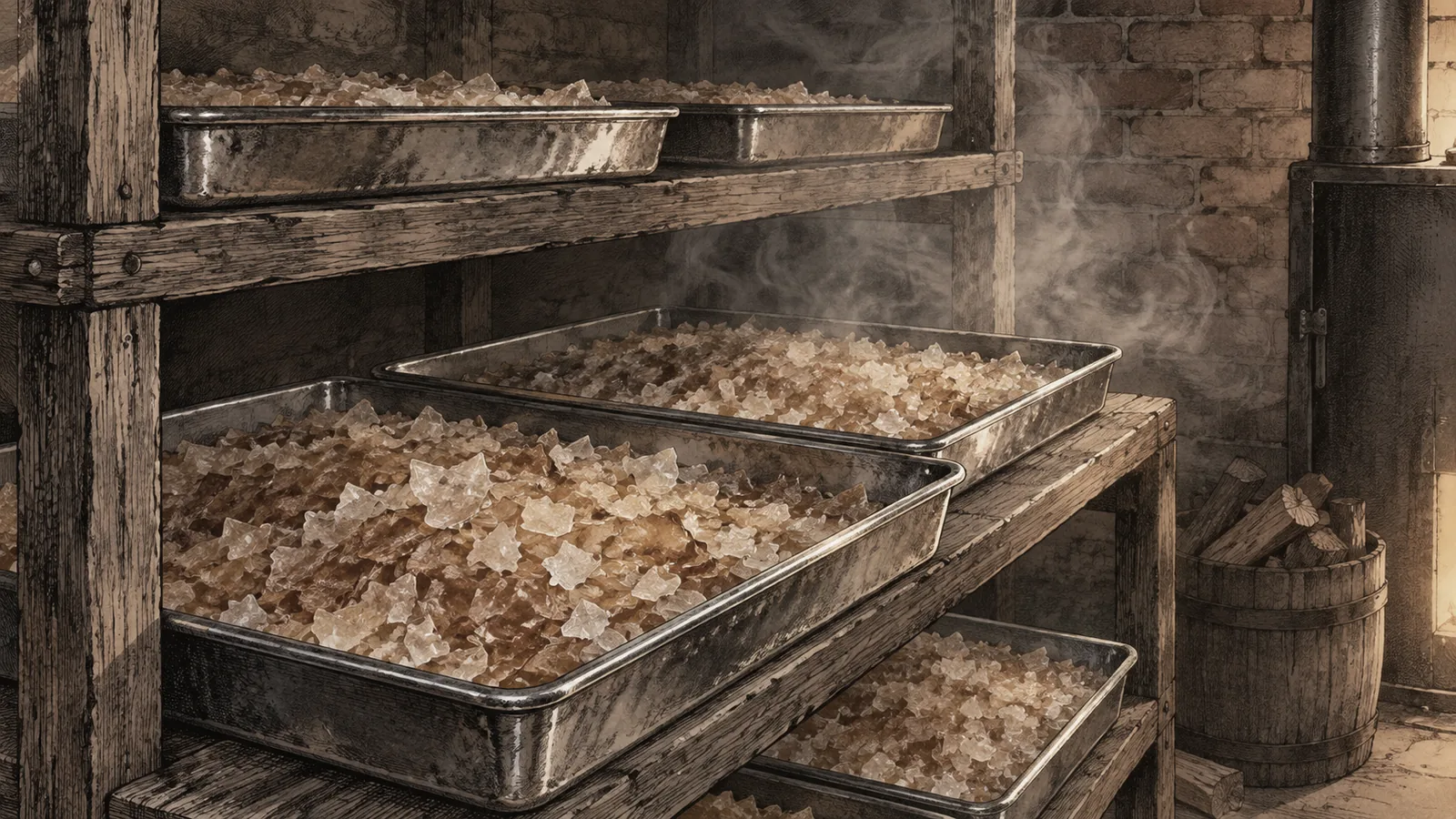
Yes. In 2024 the European Union removed all ten smoke flavourings from its list of authorised products, by Commission Implementing Regulation (EU) 2024/2067. Since 1 July 2026, foods in most categories, salt and seasonings among them, can no longer be newly placed on the EU market if they contain those flavourings. Cheese, meat, processed fish and fish roe have until 1 July 2029. As of late September 2026 none of the ten has been re-authorised and neither date has been extended, but a legal challenge is pending. Salt smoked over wood was never within the scope of this law. US rules have not changed.
What the EU actually did
Smoke flavourings have needed individual approval in the EU since Regulation (EC) No 2065/2003. The approved list, Implementing Regulation (EU) No 1321/2013, named ten “primary products”, SF-001 to SF-010. Each authorisation ran for ten years from 1 January 2014.
Two of them, SF-007 and SF-010, were not put forward for renewal and expired on 1 January 2024. The holders of the other eight applied to renew in June 2022. EFSA published its opinions on those eight on 16 November 2023. The Commission then refused all eight renewals in eight separate implementing decisions dated 31 July 2024. Regulation 2024/2067 deleted all ten entries from the list and came into force on 21 August 2024.
| Code | Product (as listed in 2013) | Outcome |
|---|---|---|
| SF-001 | Scansmoke PB 1110 | Renewal refused, Decision (EU) 2024/2071 |
| SF-002 | Zesti Smoke Code 10 | Renewal refused, Decision (EU) 2024/2066 |
| SF-003 | Smoke Concentrate 809045 | Renewal refused, Decision (EU) 2024/2073 |
| SF-004 | Scansmoke SEF 7525 | Renewal refused, Decision (EU) 2024/2072 |
| SF-005 | SmokEz C-10 | Renewal refused, Decision (EU) 2024/2079 |
| SF-006 | SmokEz Enviro-23 | Renewal refused, Decision (EU) 2024/2078 |
| SF-007 | Tradismoke A MAX | No renewal sought; expired 1 January 2024 |
| SF-008 | proFagus-Smoke R709 | Renewal refused, Decision (EU) 2024/2069 |
| SF-009 | Fumokomp | Renewal refused, Decision (EU) 2024/2077 |
| SF-010 | AM 01 | No renewal sought; expired 1 January 2024 |
Why EFSA would not clear them
EFSA’s working-group chair summarised the result this way: six of the eight “contain genotoxic substances and therefore raise safety concerns”, and for the other two EFSA “could not rule out safety concerns” because of a lack of data. The opinion on SF-003 is typical. It names two constituents, furan-2(5H)-one and benzene-1,2-diol, whose estimated intake exceeded the threshold of toxicological concern for DNA-reactive substances, 0.0025 µg per kg of body weight per day. Its conclusion is one line: “The Primary Product raises concern with respect to genotoxicity.”
It helps to be clear about what kind of number that threshold is. It is a screening threshold. It sets the intake below which a substance of that class needs no further data, and it is not a measurement of harm. EFSA said as much: the chance of harmful effects from eating foods flavoured with these products “has not been investigated by EFSA.” So the finding was that the safety case had not been made. It was not a finding that anyone had been harmed.
There is also some irony in the history. Recital 6 of the 2003 regulation says smoke flavourings are “generally considered to be of less health concern than the traditional smoking process”, because they are fractionated and purified. Twenty years later, the purified products are the ones that could not be cleared, while the smokehouse was never assessed under this regime at all.
Which date has passed, and which has not
Article 2 of Regulation 2024/2067 sets two deadlines. Both apply to foods that complied with the old list before 21 August 2024:
| Food categories | Last date to place on the market | Status, late September 2026 |
|---|---|---|
| 1.7 cheese and cheese products; 8 meat; 9.2 processed fish and fishery products; 9.3 fish roe; and their sub-categories | 1 July 2029 | Transition running |
| All other food categories, including salt and seasonings | 1 July 2026 | Passed |
There are two qualifications. Food placed on the market before the deadline “may continue to be placed on the market and remain on the market until their date of minimum durability or use by date.” Salt is a very stable product, so smoke-flavoured stock that was already in circulation before July could lawfully stay on shelves for some time. Second, “preparations”, meaning mixtures of smoke flavourings with carriers or other ingredients that are “not intended to be consumed as such”, follow the date of the food they are intended for.
The longer transition has a stated reason: in meat, cheese and fish, these products “replace traditional smoking processes” and switching may need “significant investment”. Everything else got two years to change recipes.
Where salt sits in all this
The 2013 list never authorised any of the ten for category 12.1, salt. The string does not appear in its conditions of use. The nearest lawful route was category 12.2, herbs, spices and seasonings. For example, SF-001 was permitted there at up to 2.3 g/kg and SF-003 at up to 3.0 g/kg. We assume that is how smoke-flavoured salts were classified in the EU, but we have not seen a regulator confirm it. Either way the result is the same: salt and seasonings are “all other food categories”, and their date was 1 July 2026.
There is one complication the brief versions of this story leave out. Suppose a smoke-flavoured salt is sold to a sausage maker rather than to a cook. It could be argued that it is a “preparation” intended for category 8, meat, which would move its date to 2029. We have seen no guidance on the point, and we would not risk a shipment on either reading.
Directly smoked salt is a separate matter. Regulation 2065/2003 applies to smoke flavourings, and it describes their manufacture as beginning with condensed smoke that is then separated and purified. A salt that sat in a smokehouse was not made that way. It remains subject to general food law, but the smoke-flavouring list does not apply to it. We explain how to tell the two apart on a label elsewhere.
Smoked water is less clear. Water that smoke has passed through is not obviously a product of fractionating and purifying condensed smoke, so on the text it looks outside the regulation. That is our reading of the definition. We have not seen a regulator state it.
What has not changed since July
We checked the primary sources in late September 2026 and found no re-authorisation of any of the ten products, no extension of either transitional date, and no amending act after 2024/2067 in the amendment history EUR-Lex gave us. The consolidated text of the list, as it stood after that amendment, contains no authorised entries at all.
The decision is being challenged, though. In Case T-523/24, lodged on 10 October 2024, Kerry Inc and Kerry Ingredients (UK) Ltd ask the General Court to annul the refusals for SF-002, SF-005 and SF-006, and to annul 2024/2067 as it applies to their products. They argue “manifest errors of assessment” and six further pleas. Irish press reported a hearing in March 2026. We could not find a judgment, and we found no sign that the regulation has been suspended while the case continues.
The United Kingdom has gone its own way. Great Britain’s register of authorised smoke flavourings still lists the same eight products, SF-001 to SF-006, SF-008 and SF-009, as authorised in England, Scotland and Wales. The register is dated 1 April 2025. Across the Channel, a product that is authorised on one side is not on the other.
What this means in the United States
We found no comparable FDA action. Smoke flavourings are still labelled in the US under 21 CFR 101.22, as they were before. The gap in that rule is also unchanged: it forbids implying that a food with artificial smoke flavour was smoked, but it says nothing on the point about natural smoke flavour. The EU decision binds only the EU market.
So it gives a US buyer a question to ask rather than a rule to follow. For a jar marked “natural smoke flavor”:
- Is the salt directly smoked, or flavoured? If the answer is “both”, ask for the proportion.
- Which smoke flavouring, and from whom? A supplier should be able to give a trade name and maker.
- Is it one of the ten deleted EU products? If so, ask whether the EU version of the product was reformulated after July 2026, and why the US version was not. There may be a good answer. It is still worth hearing.
- Is the product sold in the EU today? A product sold in both markets under one name may no longer be the same product in both.
We are not saying smoke-flavoured salt is unsafe. The regulator did not say that either. It said the evidence was not good enough to keep the products on the list. That is a narrower finding, and a buyer is entitled to know which of the two they are reading.
On our own sourcing: the legal texts are quoted from EUR-Lex. We were unable to get the Court of Justice’s case register to display, so the hearing date comes from Irish press reports, and the absence of a judgment means only that we could not find one. The statement that no amending act exists is based on the amendment history EUR-Lex showed us and the Commission’s own renewals page. If a later act exists that we missed, please tell us.
Sources
- Commission Implementing Regulation (EU) 2024/2067 — deletion of SF-001 to SF-010
- Implementing Regulation (EU) No 1321/2013 — the Union list and conditions of use
- Regulation (EC) No 2065/2003 — smoke flavourings
- EFSA — Smoke flavourings: Q&A with the working group chair, November 2023
- EFSA Journal — opinion on renewal of Smoke Concentrate 809045 (SF-003), 2023
- Case T-523/24, Kerry and Kerry Ingredients (UK) v Commission — action notice
- RTÉ — Kerry subsidiaries in legal action over flavourings ban, March 2026
- Food Standards Agency — GB register of authorised smoke flavourings
Read next
- Three Things Sold as Smoked Salt — how to tell them apart
- How Can You Tell If Smoked Salt Was Actually Smoked? — the US rule and the sodium test
- What Is Smoked Salt and How Is It Made? — the smokehouse route
- Patagonian Sea Salt — the salt underneath
The Salt Guide
We are recording the salts on the American shelf one jar at a time — label, panel, price paid, crystal on white. Browse the guide →