
How Can You Tell If Smoked Salt Was Actually Smoked?
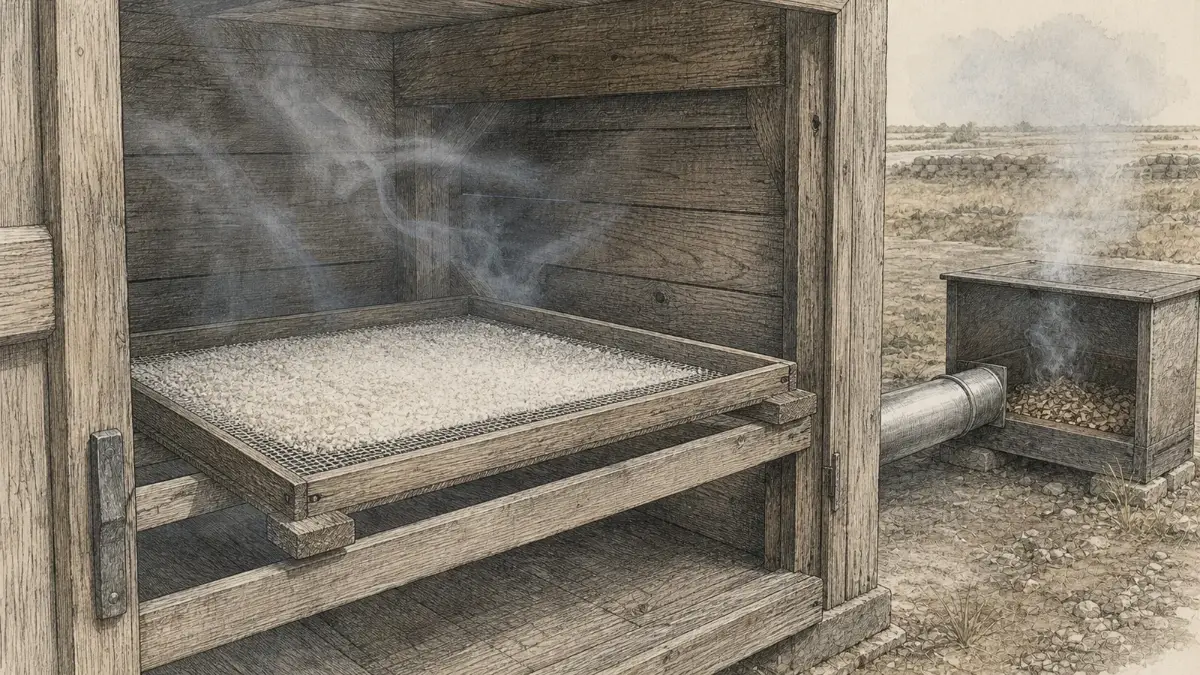
Some smoked salt spends a day over smouldering wood. Some spends ninety seconds in a blender with a flavouring. The label may not distinguish them, but the Nutrition Facts panel usually does.
What actually happens when salt is smoked?
Wood is heated with limited oxygen at roughly 300 to 600 °C and its three main polymers break down along different paths. Lignin gives the phenols — guaiacol, syringol, eugenol, creosol — which are the compounds your nose reads as smoke. Cellulose gives furans, sweet and bready. Hemicellulose gives the acidic, caramel notes.
Those compounds condense and adhere onto whatever is in the chamber. On salt, over hours, they build up on the crystal surface. Cold smoking keeps the chamber low — the flavour is deposited, nothing is cooked.
Different woods give genuinely different results: hickory reads bacon-like, mesquite earthy and aggressive, apple and cherry mild and fruity, oak and alder somewhere in between. Hardwoods are used rather than softwoods, which carry too much resin.
One honest gap: there is no FDA or USDA definition of “cold smoking” with a temperature threshold. We looked. Producers set their own.
What is liquid smoke?
Real smoke, condensed and cleaned up. Wood is pyrolysed, the smoke is condensed into water, and the mixture separates into three layers: an aqueous phase, an oily phase, and a tar phase that carries most of the polycyclic aromatic hydrocarbons. The aqueous phase is the product. It is then filtered, distilled and treated with activated carbon specifically to strip PAHs out.
To make salt with it, the concentrate is sprayed onto or absorbed into the crystals, usually with a carrier such as maltodextrin, propylene glycol or silicon dioxide. Minutes, not hours.
Can that be sold as "smoked salt"?
This is the interesting part.
There is a rule that appears to forbid it. 21 CFR 101.22(h)(6) states that “no representation may be made, either directly or implied, that a food flavored with pyroligneous acid or other artificial smoke flavor has been smoked or has a true smoked flavor.”
Read the word we bolded. The prohibition attaches to artificial smoke flavour. Modern purified liquid smoke is usually declared as natural smoke flavour, on the reading that the regulation defining natural flavour covers products of roasting and heating derived from bark and similar plant material. USDA’s meat-labelling policy memos of 1982 and 1983 speak of “natural liquid smoke”. FDA has never confirmed that reading: its only published guidance on the point, Compliance Policy Guide 525.650 from 1980, says wood distillates (pyroligneous acid) “should be declared as ‘artificial flavor’ or ‘artificial smoke flavor’.” If the smoke flavour is natural, the prohibition does not reach it. That it is natural rests on label convention, not on an FDA ruling.
The result is visible on real American labels. One national brand's product is named “Smoked Salt” and lists: salt, natural smoke flavor, propylene glycol. Another brand's smoked salt lists one thing: smoked sea salt.
Both are sold openly. Only one was in a smokehouse.
The test: check the sodium
You can catch this on the panel, and the arithmetic is simple.
Pure sodium chloride is 39.34% sodium by weight — 393 mg per gram. Salt that has been smoked and nothing else still is. Salt cut with carriers and anti-caking agents is not, because those ingredients contain no sodium and take up space.
| Product | Serving | Sodium | mg Na per gram |
|---|---|---|---|
| Plain table salt | 1.5 g | 590 mg | 393 |
| Smoked sea salt, one ingredient | 1.5 g | 590 mg | 393 |
| “Smoked salt” with natural smoke flavour | 1.6 g | 560 mg | 350 |
The third one is eleven per cent short of what that weight of salt should deliver. That missing eleven per cent is the carrier and the flow agent. Divide the sodium by the serving weight in grams; if the answer is near 390, you have salt. If it is meaningfully below, something else is in the jar.
Other ways to tell
The ingredient list is decisive. One ingredient means smoke and salt. “Natural smoke flavor,” propylene glycol, maltodextrin or silicon dioxide mean a flavouring was applied.
Price is suggestive but we found no matched comparison worth publishing a ratio for.
Colour and aroma are what everyone recommends and what we can least support — we found no published measurement showing that uneven colour indicates real smoke. It sounds right. It is not evidence.
Is smoked food a health question?
Smoking deposits polycyclic aromatic hydrocarbons, and the European Union caps them in smoked meat and fish at 2 µg/kg for benzo[a]pyrene and 12 µg/kg for the group of four. Smoked salt is not a listed category, so no specific limit applies to it. The one official survey we found is Austrian: in 2017 the food agency AGES tested 22 smoked salts (action A-004-17) for benzo[a]pyrene and the group of four, and reported every sample “in compliance with food regulations with regard to composition and PAH content.” It published no measured values, so we still cannot tell you how much PAH a smoked salt carries.
Worth knowing: liquid smoke is not PAH-free either. A published analysis found commercial liquid smoke preparations carrying 6.3 to 43.7 µg/kg of total PAHs — a range that overlaps smoked meats. The processing removes most of the tar. It does not remove all of it.
And the quantities involved are small. A pinch of finishing salt is not a portion of smoked fish.
Common questions
Legally, it is unsettled. Labels call it natural, but FDA’s only guidance, from 1980, says wood distillates should be declared artificial. Chemically, it is condensed wood smoke that has been cleaned up. What it is not is a smokehouse, and the label may not tell you which one you bought.
It is a different tool. Smoked salt puts a smoke note exactly where you sprinkle it, at the end, without cooking anything. That is worth something a smoker cannot do.
Depends on what it is going on. Hickory and mesquite are assertive and suit beef and pork. Apple, cherry and alder are gentler and do not bury fish or vegetables. Oak sits in the middle.
The phenols are volatile, so an open jar fades. Keep it closed. Nobody has published a decay curve for smoked salt, so we cannot tell you how fast.
Sources
- 21 CFR 101.22 — foods; labeling of spices, flavorings, colorings and chemical preservatives
- Regulation (EC) No 2065/2003 — smoke flavourings, pyrolysis and PAH limits
- Commission Regulation (EU) 2023/915 — PAH maximum levels in smoked foods
- Gomaa EA et al., Food Additives & Contaminants 1993;10(5):503–521 — PAHs in smoked foods and commercial liquid smoke flavourings
- Perfumer & Flavorist — smoking-specific flavour compounds in smoked foods
- EFSA — smoke flavourings
- AGES — PAH in smoked salt, focus action A-004-17 (2017)
- FDA — CPG Sec. 525.650, Labeling of seasonings (1980)
- USDA FSIS — Directive 7220.1, incl. policy memos 040 (1982) and 058A (1983) on liquid smoke
In the Salt Guide
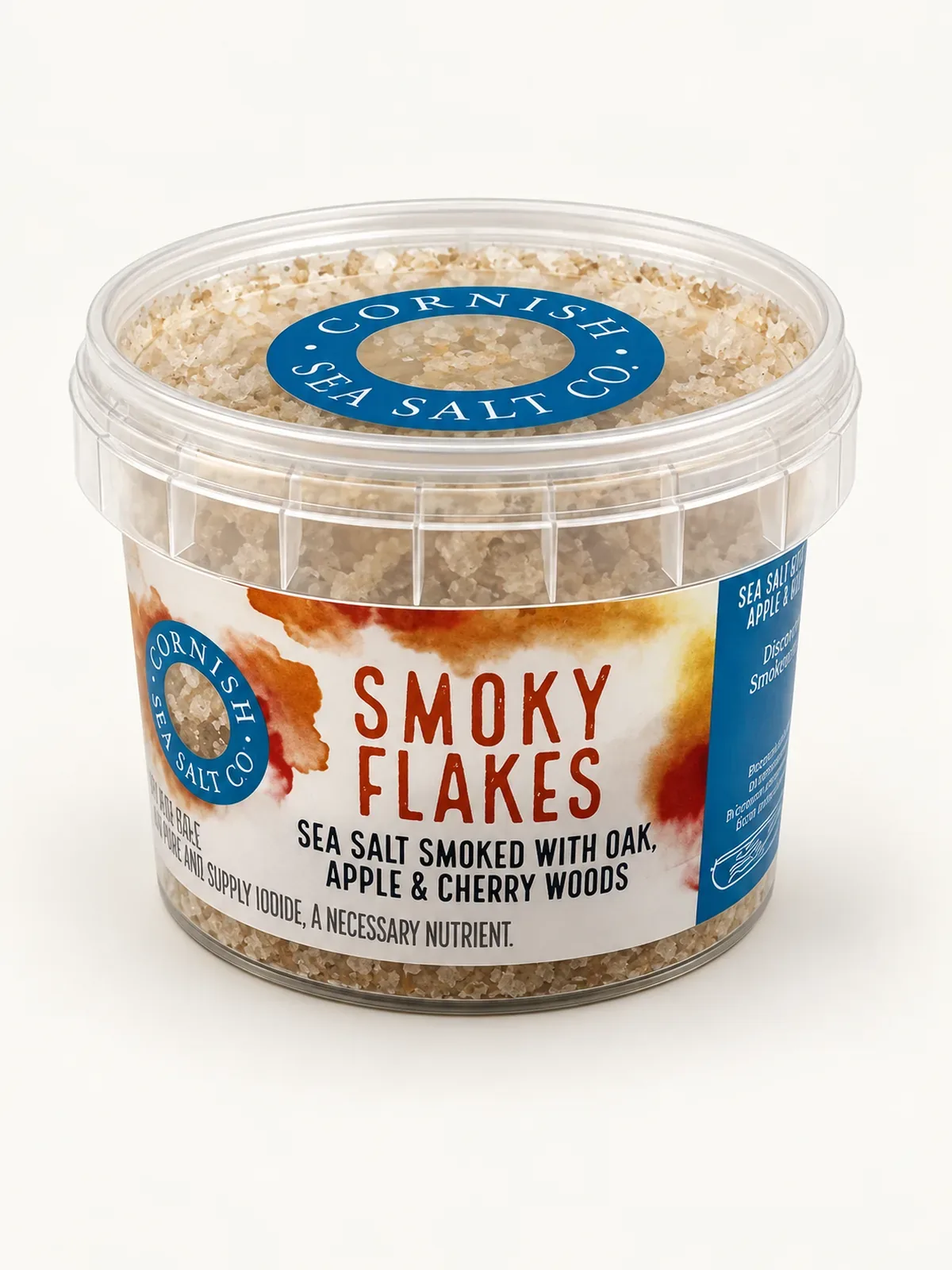
Cornish Sea Salt Co. — Smoky Flakes
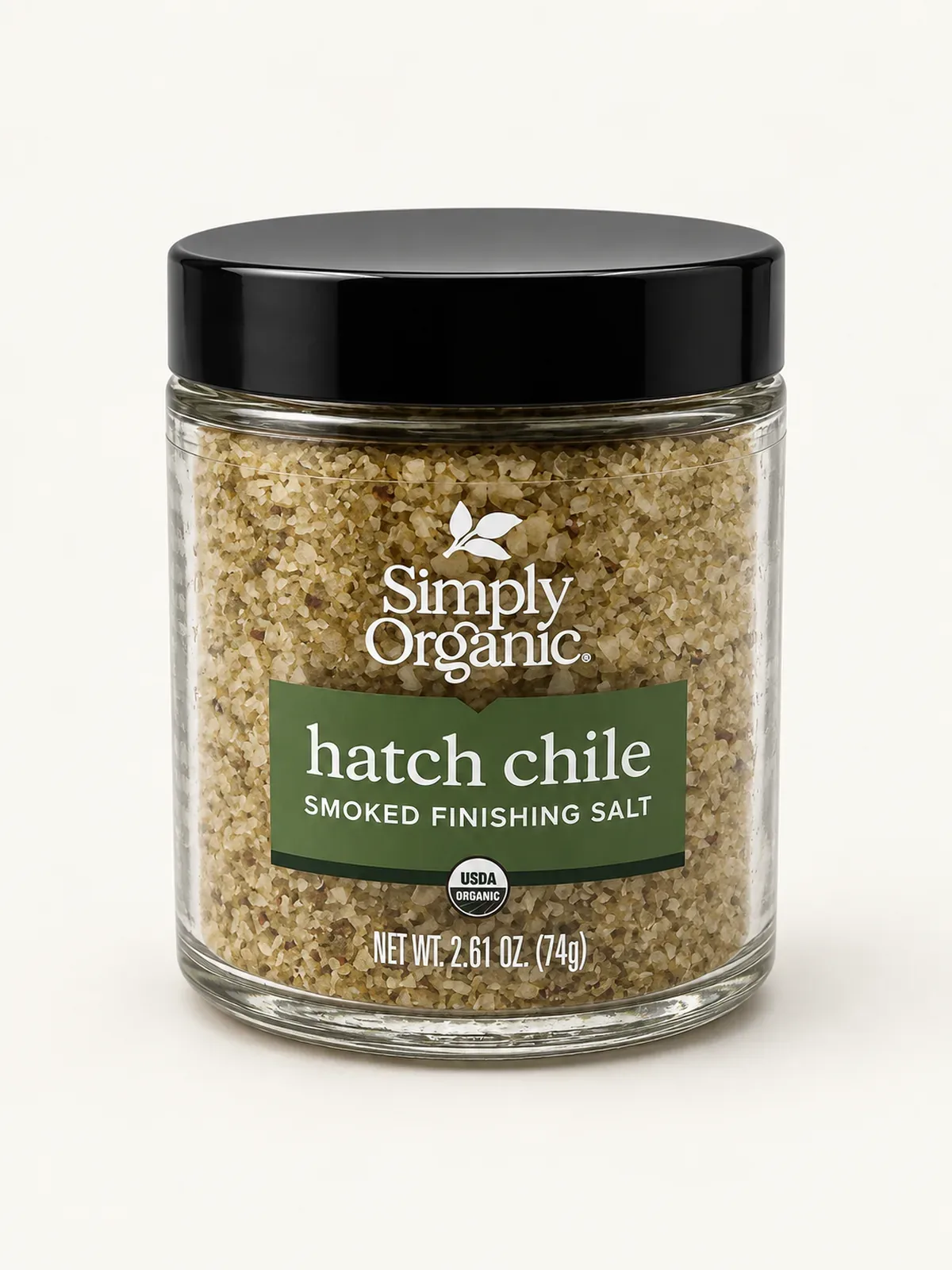
Simply Organic — Hatch Chile Smoked Finishing Salt
Retail salts, one entry each: label, panel, price paid, and the crystal on white. Browse the guide →
Get the next guide
An email when we publish a new salt guide or recipe, and first word when the Patagonian salts are ready to order.
We write when there is something to say, not on a schedule.