
Cold Smoke, Hot Smoke and Why Salt Is Not Meat
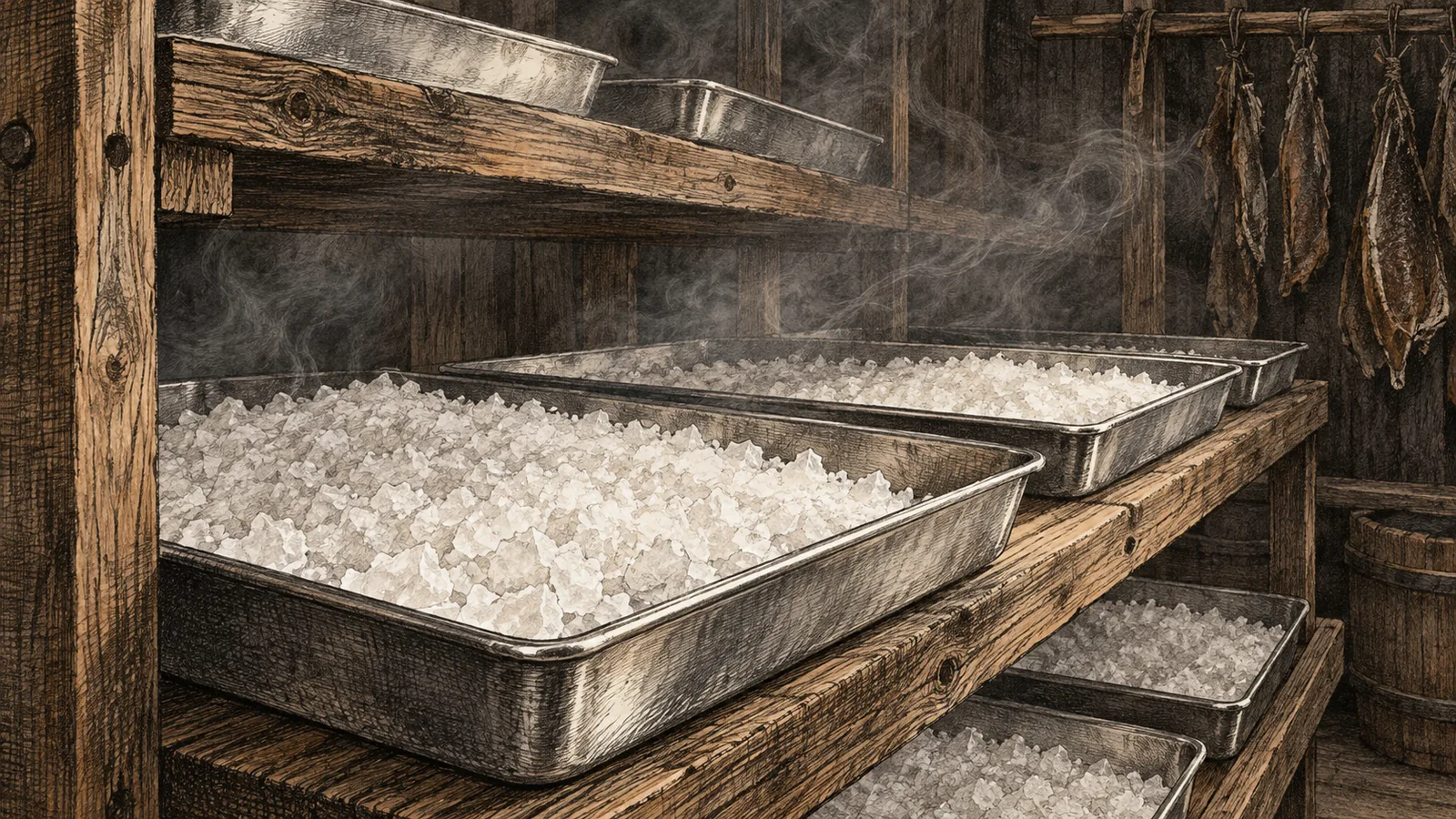
Salt does not take up smoke the way meat does. Meat is wet, fatty and full of protein; salt is a dry crystal, so smoke compounds settle on the crystal surfaces and in whatever thin film of moisture is there. That makes crystal size, humidity, exposure and time the variables that matter. “Cold smoked” has no legal definition for salt that we could find: the only official line between cold and hot smoking in US guidance, 90 °F, was written for fish.
Why the meat vocabulary does not transfer
Cold and hot smoking are words from the smokehouse, and in the smokehouse they describe two different jobs. Hot smoking cooks. A 2023 review of smoking technology puts it at 50 to 85 °C and describes it as drying, smoking and surface roasting in one pass. Cold smoking flavours without cooking, at 15 to 25 °C and around 95 per cent relative humidity, figures the review draws from earlier published work. The basics of the salt smokehouse are in what is smoked salt; this piece is about the physics underneath.
Much of what makes smoked meat look and taste smoked is chemistry between smoke and food. The same review describes the crust on smoked meat as a Maillard reaction between carbonyl compounds in the smoke and proteins in the product. Salt has no protein and no fat. It has nothing to cook and very little to react with.
So most readers carry over an assumption that is reasonable and wrong: that cold-smoked salt is a gentle version of the same process, and hot-smoked salt a stronger one. On salt, temperature is not deciding whether anything gets cooked. It is changing how readily smoke vapour condenses on a surface, and how much moisture is around to hold it.
Where the line actually sits
The only official numbers we found come from the US Food and Drug Administration’s seafood hazards guidance. For cold-smoked fish, the smoker must not exceed 90 °F (32.2 °C). For hot-smoked fish, the inside of the fish must be held at 145 °F or above for at least 30 minutes. Those are food-safety controls against bacteria. They are not labelling rules, and they say nothing about salt.
Here is what the salt makers themselves publish:
| Who | Word used | Time published | Temperature published |
|---|---|---|---|
| Maldon | “gently smoking over oak” | Not published | Not published |
| Cornish Sea Salt | “cold smoking” | Not published | Not published |
| Olsson’s | “cold-smoked” | 72 hours | Not published |
| SaltWorks (Salish) | “cold smoked” | 48 hours | Not published |
| Redmond | “blue smoke”; the word cold is not used | 30 to 42 hours | 130 °F (54 °C) |
| Reference: FDA, cold-smoked fish | cold smoking | — | Smoker no higher than 90 °F (32.2 °C) |
| Reference: FDA, hot-smoked fish | hot smoking | At least 30 minutes | 145 °F (62.8 °C) inside the fish |
| Reference: 2023 review, cold | cold smoking | — | 15–25 °C, about 95% humidity |
| Reference: 2023 review, hot | hot smoking | — | 50–85 °C |
Four makers use a word for temperature; one publishes a number. Redmond’s 130 °F is above the FDA’s cold ceiling for fish and inside the review’s hot range. Redmond does not call it cold smoking. It does not use the word at all, which is the more accurate choice. The others may run cooler, and probably do, but a reader cannot check a word.
That is not an accusation. It is a gap in what is written down, and it is the reason “cold smoked” on a salt jar should be read as a description of intent rather than a specification.
Humidity matters more than the thermometer
Salt has a humidity threshold that meat does not. At 25 °C, air in contact with a saturated salt solution sits at 75.3 per cent relative humidity, a reference value compiled by the US National Bureau of Standards as a reference point for calibrating humidity instruments. Above roughly that humidity, salt draws water out of the air and begins dissolving at its own surface. Below it, the surface stays dry.
Now set that beside the published cold-smoking figure of about 95 per cent humidity. A salt smoker who copied a conventional cold smokehouse would be running well above the point where salt starts to wet. Smoke compounds that are soluble in water would then have a thin brine film to dissolve into. A drier chamber would leave only what sticks to a dry crystal.
We should be plain about the status of that argument. It is an inference from two published numbers, not a measurement of anyone’s process, and none of the salt makers above publishes its chamber humidity. It does explain why the same wood and the same hours could give two quite different salts.
It also explains caking. Crystalline solids typically cake when a liquid bridge forms between grains and then dries into a solid one. Salt that has been wetted in the chamber has to be dried again, and the drying is where the lumps come from. Sea salt already carries some moisture of its own; Maldon’s specification, which we read in what is actually in Maldon, gives about 2 per cent.
Crystal size sets how much surface there is to coat
If smoke sits on the surface, the amount of surface per gram decides how much smoke a gram can carry. This is arithmetic. For a roughly cubic grain, surface per unit volume is six divided by the edge length. A 0.3 mm grain has ten times the surface per gram of a 3 mm crystal. A thin flake behaves like a small grain in one dimension and a large one in the other two.
The 2023 review lists the surface-area-to-mass ratio among the factors that govern how much a smoked food absorbs, alongside fat content, structure and porosity. For salt, fat and porosity drop out, and surface is most of what is left. What this means in the cup is not settled by arithmetic: a fine grain may carry more smoke per gram and also lose it faster. We explain grain sizes in fine, coarse or crystal.
Exposure and airflow decide uniformity
A tray of salt is smoked from the top down. Whatever is at the surface meets the smoke first; whatever is underneath sees less unless the layer is thin or turned. None of the makers above says how it handles that.
Cornish Sea Salt says the most. Building its smoker took eight months with a barbecue specialist, and the hard part was air intake: “too much smoke and the taste becomes bitter and acidic, too little and it’ll be too flat.” That is a maker describing intensity as a control problem rather than a matter of hours, which is the correct description.
Colour, strength and how long the smoke lasts
Colour comes from the surface. The review attributes the colour of smoked foods to deposited smoke particles and phenols polymerising on the surface. Maldon describes its smoked flakes as taking on a “slightly brown/beige” colour. But colour does not prove smoking: one salt in our register of smoked salts is golden brown from a declared smoke flavouring.
Strength is not a function of time alone. Olsson’s smokes for 72 hours and SaltWorks’ Salish for 48, but without temperature, humidity, smoke density and layer depth, the two numbers do not compare.
Shelf life is the question nobody answers. Salt itself keeps, but the aroma sits on the outside of each crystal, exposed to every opening of the jar. None of the pages we read says how long the smoke lasts. A sealed jar, kept dry and below salt’s humidity threshold, is the sensible default; that is storage, not a claim.
What to ask instead of “cold or hot”
- What is the chamber temperature, and is it the air or the salt?
- What humidity does the chamber run at, and is the salt dried afterwards?
- How deep is the layer, and is it turned?
- What grain is smoked, and is it ground or graded after smoking?
- What wood, for how long, and is there a reference lot for intensity?
A producer who can answer those has a process. A producer who can only say “cold smoked” has a label. The first is not guaranteed to make better salt. It is guaranteed to make the same salt twice.
Our own position: we are developing smoked salts from the first development shipment of our Patagonian salt, and none is on sale. We have not settled a method, and we will not publish times or temperatures until we can stand behind them. The humidity argument above is our inference from a cold-smoking figure published for foods in general and a laboratory constant; we have not yet measured it in a salt chamber ourselves.
Sources
- US FDA: Fish and Fishery Products Hazards and Controls Guidance, Chapter 13
- Nizio, Czwartkowski and Niedbała (2023), Impact of Smoking Technology on the Quality of Food Products, Sustainability 15(24)
- Greenspan (1977), Humidity Fixed Points of Binary Saturated Aqueous Solutions, NBS Journal of Research
- Redmond: what process is used to smoke Smoked Real Salt
- SaltWorks: Salish Alderwood Smoked Sea Salt
- Olsson’s: Red Gum Smoked Salt
- Cornish Sea Salt Co.: the secret weapon behind smoked Cornish sea salt
- Maldon Salt: what is smoked salt and how best to use it
Read next
- What Is Smoked Salt — the smokehouse, and why smoke stays on the surface
- How Can You Tell If Smoked Salt Was Actually Smoked? — liquid smoke and the sodium test
- Every Smoked Salt We Could Verify — who smokes what, and where
- Patagonian Sea Salt — the base salt we are developing from
The Salt Guide
We are recording the salts on the American shelf one jar at a time — label, panel, price paid, crystal on white. Browse the guide →