
Where Smoked Salt Works and Where It Is Wasted
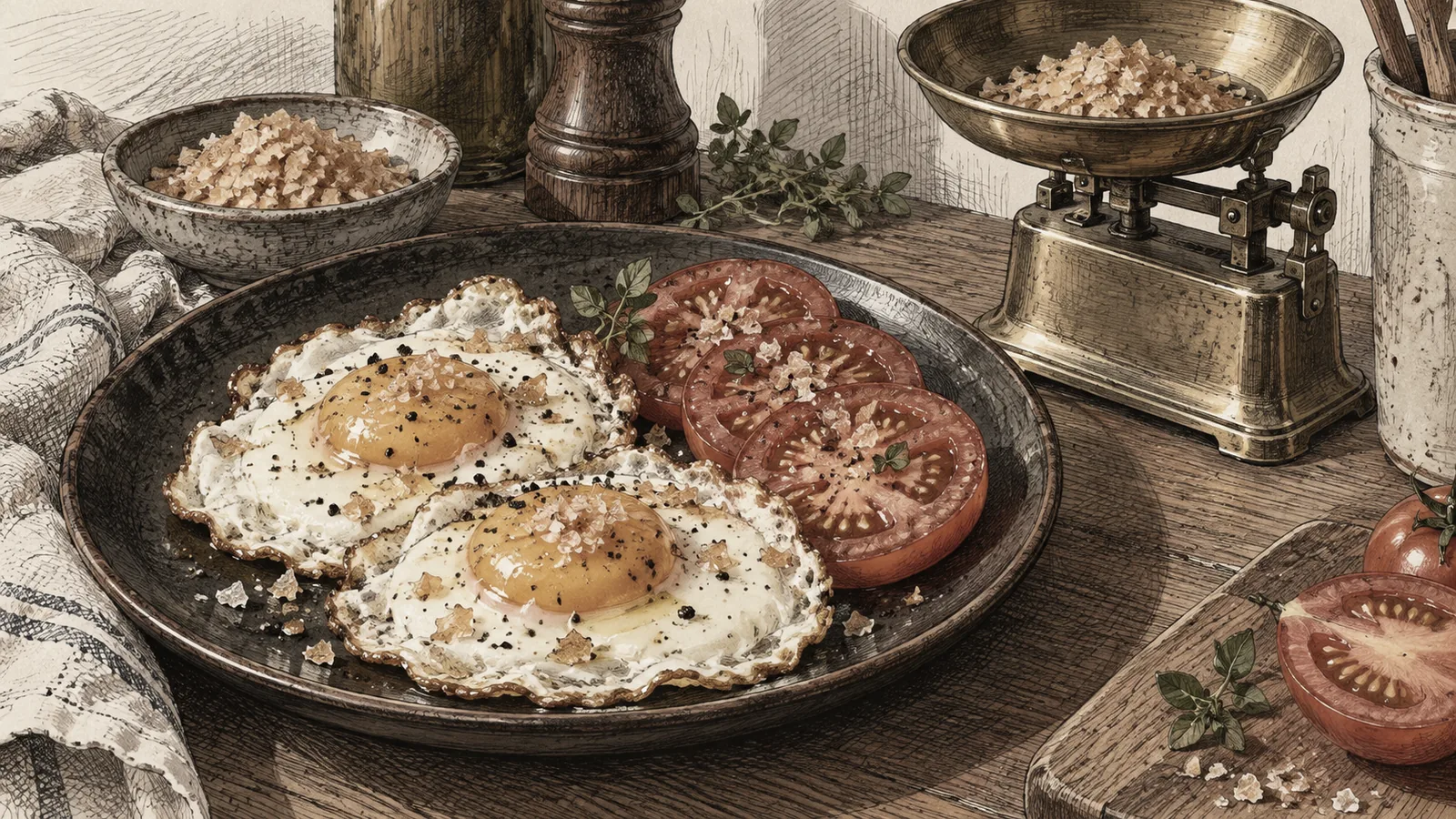
Smoked salt is a finishing ingredient. The smoke is a thin coat on the outside of each crystal, so it works where the crystal is eaten intact or in a small volume you eat all of: eggs, tomatoes, grilled vegetables, chocolate, caramel, a rub that goes on late. It is wasted in anything that dissolves it into a large volume — pasta water, a wet brine, bread dough — and mostly wasted under a strong sauce. Dose it by weight: 0.2 to 0.5 g per plate is our starting range, and a pinch of flake holds about a third of the salt in a pinch of fine.
Why the smoke is only on the outside
We have covered this in what smoked salt is, so briefly: a salt crystal has no fat, no protein and no water phase for smoke compounds to move into. In a smokehouse they condense on the surface of the crystal and stay there. Smoked salt is a coated crystal, not an infused one.
That has one practical consequence that decides everything else on this page. Each gram of smoked salt carries a fixed, small quantity of smoke. How small, nobody publishes. We looked for a figure for smoke compounds per gram of any commercial smoked salt and did not find one. What we can say is that the quantity is set at the smokehouse and does not grow in your kitchen. Everything you do with the salt either delivers that smoke to your mouth or spreads it so thin you cannot find it.
Heat is the lesser worry. Guaiacol, one of the main smoke phenols, boils at 204–206 °C. Volatile compounds do escape over a long cook, but the idea that smoke “cooks off” the moment it meets a pan is overstated. The two things that actually waste smoked salt are dilution and competition.
Where smoked salt is wasted
Pasta water
Serious Eats’ average for pasta water, as reported by Tasting Table, is 1½ teaspoons of table salt per litre. America’s Test Kitchen weighs a tablespoon of table salt at 19 g, which puts that at about 9.5 g per litre, or close to 40 g for a four-litre pot. The salt’s job there is to season the pasta. The smoke dissolves into the water — guaiacol’s solubility is 23.3 g per litre, so it has no difficulty — and most of that water goes down the sink. You have paid for smoke and poured it away.
Wet brines
The same arithmetic, with more water and a longer wait. A brine is tipped out after use. Whatever smoke the meat picks up from a dilute solution is a small share of what was on the crystals, and the rest leaves with the liquid.
Bread dough
King Arthur gives the usual salt level in bread as 1.8 to 2 per cent of flour weight. For a loaf made with 500 g of flour that is 9 to 10 g of salt, dissolved and distributed through the whole dough, then baked. The smoke from those 10 g is spread across something like 800 g of bread. Put the smoked salt on the crust instead, where it stays concentrated and visible.
Long braises and loud sauces
This one is a judgement rather than a measurement, which is why it gets its own paragraph. A tomato, chilli and wine braise has a great deal going on. Whatever smoke survives a few hours in it is competing with flavours far louder than a surface coat on a few grams of salt. We found no study of smoked salt specifically being masked in a sauce. We would still not spend it there.
Some producers suggest exactly these uses. Cornish Sea Salt recommends its smoked flakes for winter stews and soups. Maldon suggests adding its smoked salt to gingerbread mixture and to brownie batter. None of that is wrong: it adds some smoke. It is simply the least efficient place to spend it, and Maldon’s own suggestion to use it on top of the brownies as well is the half of the advice doing most of the work.
Where smoked salt works
The rule that falls out of the physics is short. Smoked salt works where the crystal lands on a surface and is eaten more or less intact, or where it dissolves into a small volume that is eaten entirely.
- Eggs. Mild, fatty, eaten immediately. The smoke has nothing to compete with.
- Tomatoes, avocado, cucumber. A wet cut surface holds the crystals in place long enough to eat them.
- Grilled and roasted vegetables, after cooking. On anything from the grill it doubles down; on anything from the oven it stands in for the grill.
- Rested steak and chops. As a finish over meat already salted with plain salt, not instead of it.
- Chocolate, caramel, butter. Fat carries aroma well, and smoke against sugar is the crossover producers agree on. Halen Môn suggests caramel-based puddings and chocolate chip cookies; Maldon suggests brownies.
Caramel looks like an exception to the dissolving rule. It is not. The salt dissolves, but into a few hundred grams of sauce that ends up on a plate rather than in a sink. Dilution is a matter of volume and destination, not of whether the crystal survives.
Rubs: late, not overnight
A rub that sits on meat for hours is doing what salt does to meat: pulling water to the surface, dissolving into it and travelling back in, as when to salt a steak sets out. That is good for the meat and indifferent for the smoke, which is now in a thin brine on a surface that is about to be cooked for a long time.
The better division of labour is plain salt early and smoked salt late. Season ahead with ordinary salt for the texture, then use smoked salt in a finishing rub in the last minutes over the fire, or as a dusting after resting. If you are cooking over wood already, smoked salt is a second coat of the same paint. It is most useful where there is no fire at all.
Dose it in grams, not pinches
A pinch is not a quantity. One common US convention puts it at a sixteenth of a teaspoon; other sources say an eighth or a twenty-fourth. And a teaspoon of salt varies by a factor of three depending on the crystal. America’s Test Kitchen found that matching the 19 g in a tablespoon of table salt took three full tablespoons of Maldon flake.
| Measure | Fine salt | Flake salt |
|---|---|---|
| 1 tablespoon | 19 g | about 6.3 g |
| 1 teaspoon | about 6.3 g | about 2.1 g |
| 1 pinch (1/16 tsp) | about 0.4 g | about 0.13 g |
| 1 gram looks like | about 1/6 tsp | about ½ tsp |
The tablespoon figures are America’s Test Kitchen’s. The rest is division, and flake salt varies with how the spoon is filled, so read the flake column as approximate. The point survives the rounding: the same pinch of fine smoked salt delivers roughly three times the salt of a pinch of flake. If a recipe says “a pinch of smoked salt” and does not say which, it has not told you anything.
Two further points. Smoked salt is salt, so count it in the seasoning of the dish: replace part of the plain salt with it rather than adding it on top. And smoke intensity varies by brand in ways no label discloses, so a gram of one smoked salt is not a gram of another. Weigh it once, taste it, and adjust.
Where to use it, and how much
| Use | Smoked salt? | Why | Starting dose |
|---|---|---|---|
| Two fried or scrambled eggs | Yes, at the end | Surface, mild food, eaten at once | 0.2 g |
| One large sliced tomato | Yes | Wet surface holds the crystals | 0.3 g |
| Grilled or roasted vegetables, per 200 g | Yes, after cooking | Finishing, not seasoning | 0.3–0.5 g |
| Rested steak, per 250 g | Yes, over plain-salted meat | Replaces part of the finishing salt | 0.3–0.5 g |
| Chocolate bark or brownies, per 100 g | Yes, on top | Smoke against sugar and fat | 0.3–0.5 g |
| Caramel sauce, per 250 g | Yes, off the heat | Small volume, all of it eaten | 1–2 g |
| Popcorn, per bowl of about 30 g | Yes, fine grain | Fine grain clings where flakes fall off | 0.5 g |
| Dry rub for a long cook | Partly | Plain salt early, smoked salt late | Finish only |
| Pasta water, wet brine | No | The liquid is poured away | Use plain salt |
| Bread dough | No, top instead | Dispersed through the whole loaf | Crust only |
| Long tomato or chilli braise | Rarely | Masked by louder flavours | Finish the plate, if at all |
The doses are ours: starting points worked out from the weights above and from tasting, not measured optima from a study. Nobody has published one. Treat them as the place to begin and move in tenths of a gram.
Which grain for which job
Flake is the default for finishing because the crunch is part of the point and flakes sit on a surface. Fine smoked salt is better where you want the smoke to disappear into a coating — popcorn, nuts, a finishing rub — because it clings where a flake bounces off. Coarse smoked salt belongs in a grinder, which turns it into fine salt at the table. Our guide to grain size covers why; whether the grains also take smoke differently at the smokehouse is a separate and less settled question, and we have written it up on its own.
What this page is not doing is telling you smoked salt is a better salt. It is ordinary salt with a surface coat of wood smoke, and the smoke is the only thing you are paying extra for. Use it where the smoke reaches you. Everywhere else, plain salt does the job for a fraction of the cost. That is not a reservation about the product. It is the instruction for using it.
Two caveats. First, the dose table rests on America’s Test Kitchen’s weights for table salt and Maldon flake; other flakes and other fine salts will differ, and none of it accounts for how much smoke a particular brand puts on a gram, which no producer we checked discloses. Second, Gaucho Provisions does not sell a smoked salt. We are developing one, and nothing on this page is written for a particular product, ours or anyone else’s.
Sources
- America’s Test Kitchen — Substituting gourmet salt in cooking and baking
- Maldon Salt — What is smoked salt and how best to use it
- Halen Môn — Pure Smoked Sea Salt over Oak
- Cornish Sea Salt Co. — Smoked Sea Salt
- Tasting Table — pasta water salt, citing Serious Eats and Marcella Hazan
- King Arthur Baking — Salt (professional reference)
- Guaiacol — boiling point and water solubility
- Pinch (unit) — US and UK conventions
Read next
- What Is Smoked Salt and How Is It Made? — why the smoke stays on the surface
- Fine, Coarse or Crystal? — grain size and the teaspoon problem
- Oak vs. Applewood vs. Mesquite — which wood for which food
- Patagonian Salt Flakes — the plain flake, unsmoked
The Salt Guide
We are recording the salts on the American shelf one jar at a time — label, panel, price paid, crystal on white. Browse the guide →