
When Should You Salt a Steak?
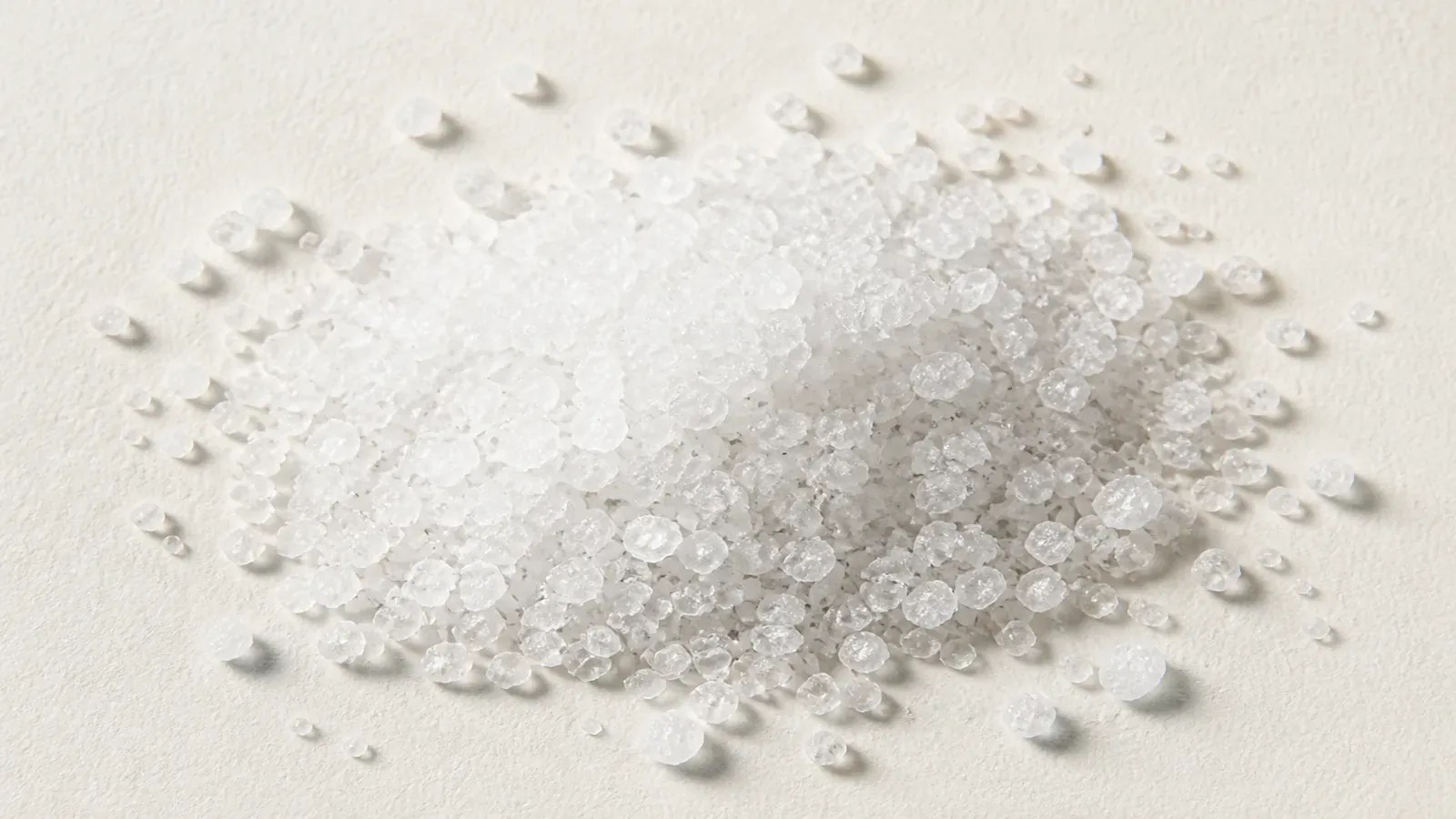
Salt your steak immediately before it hits the heat, or at least 45 minutes ahead — and if you have the time, several hours ahead, uncovered, on a rack in the refrigerator.
That is the short answer, and it is worth understanding why, because the reason is not the one usually given. What makes a salted-ahead steak better is not that the salt has travelled deep into the meat. Over an hour, it has barely travelled at all. It is that the surface has had time to dry.
What salt actually does to raw beef
Put salt on a steak and three things happen in sequence.
First, water comes out. Salt is hygroscopic; it pulls moisture from the muscle to the surface, where it dissolves the salt crystals into a concentrated brine. Within a few minutes the steak looks wet.
Second, the brine goes back in. Cook’s Illustrated describes the cycle plainly: juices are drawn to the surface, the salt dissolves in them, and the resulting brine “is eventually reabsorbed by the meat.”
Third — and this is the part that matters for texture — the salt changes the proteins. Salt ions partially unfold the myofibrillar proteins that make up muscle fibre, and dissolve some of them into a gel. Unfolded proteins hold water better than folded ones. This is the mechanism behind the standard claim that salting ahead makes meat juicier, and it is well established in meat science; the canonical reference is Offer and Trinick’s 1983 work on myofibril swelling in Meat Science.
We should be honest about the limit of the evidence here. The mechanism is established. A published, controlled measurement showing that a dry-brined beef steak loses measurably less water during cooking than an unsalted one is something we could not locate. Every serious cooking authority says juicier. The chemistry supports it. But if someone tells you there is a definitive beef trial behind it, ask them for the citation.
Salt travels more slowly than you think
Here is the number that reframes the whole question.
A 2025 peer-reviewed study in Applied Sciences measured the salt diffusion coefficient during dry salting at 4.22 × 10⁻¹⁰ m²/s. Run that through the standard diffusion-length approximation and salt penetrates roughly:
| Time | Depth |
|---|---|
| 1 hour | ~1.7 mm |
| 6 hours | ~4 mm |
| 24 hours | ~8.5 mm |
Two caveats before anyone builds a religion on this: it was measured on pork loin at 20 °C, and refrigeration slows diffusion considerably. Treat it as an order of magnitude, not gospel.
But the order of magnitude is the point. A one-inch steak salted 40 minutes ago is not “seasoned through.” The salt has moved less than two millimetres. What forty minutes buys you is not depth. It is a surface that has stopped weeping.
The 40-minute rule, examined
The most-repeated piece of steak advice on the internet holds that you must salt immediately before cooking or at least 40 minutes ahead, and that the window between three and forty minutes is actively harmful — the steak is wet with brine, and a wet steak will not sear.
The observation behind this is real. The rule as stated is overbuilt.
It originates with J. Kenji López-Alt’s Food Lab testing at Serious Eats, and the timeline he describes — salt undissolved at zero minutes, moisture beading by three or four, brine forming and breaking down muscle structure by ten to fifteen, most liquid reabsorbed by forty — is a fair account of what you can watch happen on a plate.
What has happened since is that a careful observation became a prohibition. Three things are worth noting:
No other major authority endorses the forbidden window. Cook’s Illustrated recommends one hour for steaks and chops, with no warning about intermediate times. America’s Test Kitchen recommends anywhere from 45 minutes to 24 hours. Neither describes a penalty zone.
There is no published test of it. We could find no peer-reviewed work examining the 3-to-40-minute window. It is one cook’s observation on one thickness of steak, widely repeated and never replicated.
And it has an obvious workaround that the popular version never mentions: dry the steak. The problem in that window is surface moisture. Every competent source tells you to pat the surface dry before searing regardless of when you salted. Do that, and the window largely stops existing.
So the honest version of the rule is: if you salt somewhere between five and thirty minutes ahead, pat the surface dry before it hits the pan. Which is what you should have been doing anyway.
Why surface dryness is the whole game
Browning is the Maillard reaction, and Maillard is throttled by water.
Modernist Cuisine puts the useful range at 140–165 °C (280–330 °F) for rapid browning, with pyrolysis — burning — above about 180 °C. And here is the mechanism that explains everything above: as long as the surface is wet, its temperature cannot climb past the boiling point of water. All the energy goes into evaporation. The steak steams instead of searing.
Worth correcting a common misstatement while we are here: you will often read that Maillard “requires 300 °F” or “cannot occur below the boiling point of water.” That is not right. Modernist Cuisine is explicit that drying the surface first “will allow the reaction to proceed slowly at temperatures below the boiling point of water.” Maillard is slow when cold and inhibited by water. It has no hard threshold.
This is why the overnight, uncovered, refrigerated dry brine works so well. It is not mainly about seasoning depth. It is a dehydrator. The cold dry air pulls surface moisture away, so when the steak meets the grate it arrives at browning temperature almost immediately.
One documented exception, because it is under-reported: America’s Test Kitchen found that for lean roasts destined for a reverse sear, overnight uncovered drying plus a second drying before searing can overshoot into “a leathery crust.” For that specific case they recommend wrapping. For steaks on a hot fire, uncovered is right — it also minimises the grey band under the crust.
How much salt
The recommendations look wildly inconsistent until you convert them.
| Source | Recommendation |
|---|---|
| Cook’s Illustrated | ¾ tsp Diamond Crystal per 8 oz (= 1.5 tsp/lb) |
| America’s Test Kitchen | 1½ tsp kosher salt per lb |
| Meathead Goldwyn (AmazingRibs) | ½ tsp kosher salt per lb |
| Samin Nosrat | ½–¾ tsp per lb |
That is a threefold spread, and the reason is not disagreement about seasoning — it is that “a teaspoon of kosher salt” is not a fixed quantity. Diamond Crystal weighs 2.8 g per teaspoon; Morton kosher weighs 4.8 g; table salt weighs 6.0 g. The same recipe line means very different amounts of salt depending on the box.
So work in weight percentage. These recommendations collapse to roughly 0.75–1% of the meat’s weight for a well-seasoned steak. For a 12-ounce steak that is about 3 grams.
There is a nice convergence here worth flagging: the Argentine parrilla convention is about one tablespoon of sal entrefina per kilogram of meat — roughly 9–10 g/kg, or 0.9–1.0%. An Argentine grilling tradition and an American test kitchen arrived at the same number from opposite directions.
Practical guidance
If you have five minutes: salt right before the steak goes on. Pat it dry first. This is a perfectly good steak.
If you have an hour: salt, leave it at cool room temperature, and pat the surface dry before cooking. Do not leave meat out longer than that — USDA guidance is that perishable food should not sit between 40 °F and 140 °F for more than two hours, and an hour is the sensible ceiling.
If you have overnight: salt, set on a rack over a tray, and refrigerate uncovered. This is the version that produces a visibly better crust, and the difference is not subtle.
Whatever you do, dry the surface before it meets the heat. If you remember one thing, remember that one.
Where the salt itself comes in
Grain size matters here, and not for the reason people assume. A medium grain — what Argentines call entrefina or parrillera — clings to a wet meat surface and dissolves over roughly the time a steak spends over the coals. Very fine salt dissolves instantly and can season unevenly if you are heavy-handed. Very coarse crystals may not fully dissolve at all, which is fine if that is your intention and a problem if it is not.
We make a coarse Patagonian sea salt for exactly this job, and a fine one for the cases where you want the salt gone the moment it lands. But the timing above works with whatever is in your cupboard. Salt behaviour is physics, not branding.
Common questions
The surface, yes — deliberately, and that is what gives you a better crust. The interior should not; the mechanism by which salt increases the water-holding capacity of muscle proteins is well established. The honest caveat is that we could not find a published cook-loss measurement on beef steaks specifically confirming the interior effect.
For thick roasts, 24–48 hours is standard practice. For a steak it is more than you need — the surface will be dry long before then, and you risk a leathery exterior on lean cuts.
Salt after thawing. Salt on a frozen surface has nothing to dissolve in and simply falls off.
For the brine itself, no — it is all sodium chloride. It matters enormously for measuring, because a teaspoon of Diamond Crystal is less than half the salt of a teaspoon of table salt. Weigh it if you can.
Ground pepper on a long, hot sear can turn acrid. If you are cooking hot and fast, pepper after. If you are cooking gently, before is fine.
No. It has been absorbed. Rinsing undoes the work and re-wets the surface you spent hours drying.
Sources
- Cook’s Illustrated — Salting Meat
- America’s Test Kitchen — The Easiest Way to Make Steak Taste Even Better: Salt Twice
- America’s Test Kitchen — Should You Wrap Meat That You’re Salting Overnight?
- AmazingRibs — Dry Brining
- Friedrich, L. et al. (2025), “Investigation of Salt and Water Diffusion During Dry Salting, Wet Curing, and Ultrasonic Wet Curing,” Applied Sciences 15(11):5939 — doi:10.3390/app15115939
- Offer, G. & Trinick, J. (1983), “On the mechanism of water holding in meat,” Meat Science 8(4) — PubMed 22055626
- Modernist Cuisine — The Maillard Reaction
- J. Kenji López-Alt, “The Food Lab: More Tips For Perfect Steaks,” Serious Eats (2011)
- USDA FSIS — Danger Zone (40 °F–140 °F)
- parrillasparaasado.com — Cuándo salar la carne para el asado
The Salt Guide
We are recording the salts on the American shelf one jar at a time — label, panel, price paid, crystal on white. Browse the guide →
Get the next guide
An email when we publish a new salt guide or recipe, and first word when the Patagonian salts are ready to order.
We write when there is something to say, not on a schedule.