
Flake, Fine or Coarse: Which Grain Takes Smoke Best?
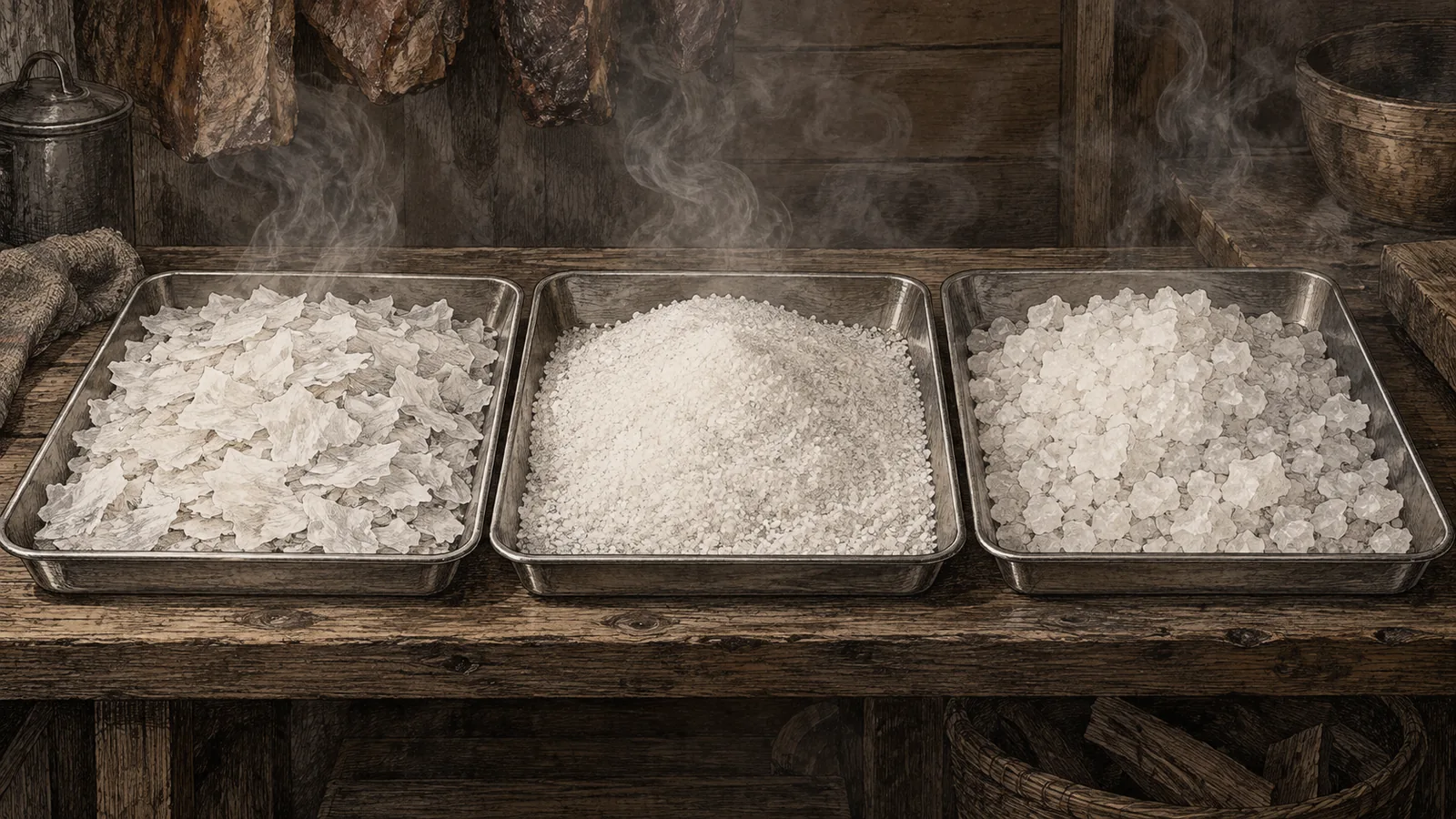
Nobody has published a controlled comparison of how flake, fine and coarse salt take smoke, so the honest answer is that it is not settled. What is settled is the physics that should decide it: smoke deposits on the surface of a crystal, so surface area per gram, surface moisture and how evenly smoke reaches each crystal set the result. By that arithmetic, fine salt and thin flakes should carry more smoke per gram than coarse grain. Which of those two does it better is an open question, and it is the one our first shipment is being used to test.
Why grain should matter at all
Salt does not absorb smoke the way meat or cheese does. There is no fat for smoke compounds to dissolve into and no water phase for them to diffuse through, so they condense on the outside of the crystal and stay there. We set this out in what smoked salt is. Smoked salt is a coated crystal.
If the smoke sits on the surface, then three things about a grain should matter more than anything about the wood: how much surface a gram of it has, whether that surface is dry or damp, and whether the smoke can actually reach it in a tray of salt. Each one points in a slightly different direction, which is why the question is interesting.
How much surface does a gram of salt have?
This part is arithmetic. Sodium chloride has a density of about 2.17 g/cm³. For an idealised cube of edge d, surface area per gram is 6 divided by density times d. Halve the grain and you double the surface per gram. For a thin plate, which is closer to what a flake is, the figure depends almost entirely on thickness.
| Grain | Size used | Surface per gram |
|---|---|---|
| Fine cube | 0.5 mm edge | about 55 cm² |
| Fine to medium cube | 1 mm edge | about 28 cm² |
| Medium to coarse cube | 2 mm edge | about 14 cm² |
| Coarse cube | 3 mm edge | about 9 cm² |
| Thin flake (illustrative) | 0.2 mm thick | about 46 cm² |
| Thick flake (illustrative) | 0.5 mm thick | about 18 cm² |
Read that as geometry, not as data. The cube sizes sit inside the grain bands SaltWorks publishes for its smoked Salish salt — fine 0–1.0 mm, medium 1.0–3.0 mm, coarse 2.0–4.0 mm. The flake thicknesses are ours, chosen to show the range; we could not find a published measurement of flake wall thickness for any commercial salt. Real grains are irregular and have more surface than a perfect cube. The ratios hold. The decimals do not.
Two things follow. A 0.5 mm grain has about six times the surface per gram of a 3 mm one. And a thin flake can match fine salt on surface area while being as large as coarse salt in the hand. A flake has the surface of a fine grain in the body of a coarse one. That is probably why people assume flakes take smoke best.
More surface per gram means more smoke per gram only if the smoke reaches that surface. That is the part the arithmetic cannot tell you.
Can the smoke reach it?
Salt is smoked in a layer, and a layer has a top and a bottom. The crystals on top see the smoke first. Everything below depends on how easily smoke moves through the gaps between grains, and on how often the layer is turned.
Here the grains behave very differently. America’s Test Kitchen found it took three tablespoons of Maldon flake to match the 19 g in one tablespoon of table salt. A spoon of flake is mostly air, and so is a tray of it. Fine salt packs close, with small gaps. It is reasonable to expect smoke to move through an open bed of flakes more freely than through a packed bed of fine salt. Reasonable is not measured, and we found no measurement.
Turning the layer evens things out, and it costs the grains differently. Fine and coarse cubes tolerate stirring. Flakes do not: they are hollow and fragile, which is the whole reason they crunch, as our guide to grain size explains. Every flake that breaks during turning exposes faces that were inside the flake and never saw smoke. The same happens when a cook crushes a smoked flake between finger and thumb. The smoke on it does not change. The share of its surface that carries smoke does.
Moisture: the variable the evidence argues about
The third factor is whether the crystal surface is dry or damp, and on this the smoking literature disagrees with itself — about fish, not salt.
A Virginia Tech bulletin hosted by Oregon State’s seafood programme says most smoke components in smoked fish are absorbed by surface and interstitial water, and reports that phenol absorption in pre-dried fish is only 5 per cent of that in wet fish. The Culinary Institute of America’s teaching notes on smoking say the opposite about the surface: “A wet surface will not readily absorb smoke,” which is why meat and fish are dried to a tacky skin, a pellicle, before they go in. The usual reconciliation is that smoke wants a surface that is tacky, neither bone dry nor dripping. That is a smokehouse rule of thumb. It is not a measurement, and nobody has tested it on salt.
What salt adds is that its surface moisture depends on the air and on what else is in the crystal. Greenspan’s 1977 table for the US National Bureau of Standards, compiled from 21 earlier studies rather than measured afresh, gives a saturated sodium chloride solution an equilibrium of 75.47 per cent relative humidity at 20 °C, and a saturated magnesium chloride solution 33.07 per cent. Both dip slightly as air warms; at 25 °C our cold-smoking article uses 75.3 per cent. In plain terms: pure salt stays dry until the air is very humid, while a salt carrying a film of magnesium-rich brine holds on to moisture in much drier air. Unwashed sea salts carry exactly that film. Work on sodium chloride caking has also shown that cycling humidity dissolves and recrystallises crystal surfaces, which is how salt clumps.
So grain and moisture are tangled. Fine salt has more surface for a film to cover; flakes and damp coarse salt may carry more film per crystal. Whether that film helps smoke settle or only helps the jar clump afterwards, we could not find anyone who has measured.
What producers disclose about grain
Here is what the producers themselves say about the grain they smoke and how. These are company descriptions from their own current product pages, not independent measurements, and the times are as each producer publishes them. All ten describe real wood smoke; a smoke-flavoured salt is a different product, and the sodium test is how to tell them apart.
| Product | Grain as sold | What the producer says about the smoking |
|---|---|---|
| Maldon Smoked Sea Salt | Pyramid flake | “Gently smoking over oak”; no time published |
| Halen Môn Pure Smoked Sea Salt over Oak | Flake | “We smoke our award-winning Pure Sea Salt slowly over oak chippings until it turns beautifully golden” |
| Saltverk Birch Smoked Salt | Flake | Smoked with Icelandic birch “for over 48 hours” |
| Jacobsen Infused Cherrywood Smoked Salt | Flake | “Cold-smoked with Cherrywood”; ingredients “Sea Salt, Smoke” |
| Alaska Pure Alder Smoked Flake Sea Salt | Flake | Flakes smoked “over burning Alder wood” |
| Cornish Sea Salt Smoked Sea Salt | Flake | “Gently smoked over oak, apple and cherry wood” in its own cold-smoking machine on site |
| Cornish TekSalt Smoked Fine | Fine, 15 kg, for food manufacturers | “Infused with cold smoke from oak, cherry, and applewood”; crystals “coated in a mineral-rich brine” |
| SaltWorks Salish Alderwood | Fine, medium and coarse | “Cold smoked for 48 hours over Northwest alder”; bark-free red alder |
| SaltWorks Yakima Applewood | Flake, 0–2.5 mm | “Cold smoked” over “aged apple wood” with the company’s “exclusive” smoking technology; no time on the page |
| Redmond Smoked Real Salt | Shaker; grain not stated | 30 hours for hickory and cherry, each with alder; 42 hours for the five-wood blend |
Two patterns stand out. Retail smoked salt is overwhelmingly flake. And of the producers in this table, two smoke more than one grain. Cornish sells its fine grade as a 15 kg pack for food manufacturing; SaltWorks sells fine Salish from 4 oz pouches to 55 lb bags. Cornish’s fine product is not a plain fine salt either: by the company’s own description its crystals are coated in a mineral-rich brine.
What none of them says is why. Not one page we read explains its grain choice in terms of how well that grain takes smoke. The grain appears to be chosen for the job the salt does afterwards — crunch on a plate, or flow through a hopper — and the smoking is fitted to it.
The thing most people have backwards
The common assumption is that flakes are used for smoked salt because flakes take smoke best. It is a reasonable assumption. Flakes are what the famous smoked salts are, and they do have a great deal of surface per gram.
But the evidence we could find supports a duller explanation. Smoked salt is sold as a finishing salt, and finishing salt is sold as flake. The grain choice follows the shelf. That does not mean flakes take smoke badly. It means nobody has shown that they take it better, and the physics offers arguments on both sides: more open bed and high surface for flakes, more robust crystals and more even turning for fine salt, less of everything for coarse.
The question we are asking
Gaucho Provisions does not sell a smoked salt. The first shipment of salt from the Patagonian producer we buy from arrived in September for product development, and part of it is going into a smoke trial to learn which grain takes smoke best. We do not have the answer.
The questions a trial like this has to settle are the ones above. How much smoke does a gram of each grain carry after the same exposure? How evenly, from the top of the layer to the bottom? Do flakes survive the turning that fine salt needs? Does the finished salt stay free-flowing in a jar, or does a damp grain that took the smoke well also clump? A grain that wins on one of those can lose on another.
It would be easy to say flakes, because flakes are what the category sells and a flake would be the convenient answer for us too. That would be a guess dressed as a conclusion. When the trial has an answer, it will be published here, including if it is not the answer we would prefer.
A caveat on everything above. The surface-area figures are arithmetic on idealised cubes and on flake thicknesses we chose ourselves, not measurements of any product. The moisture evidence comes from fish, not salt. The producer table is self-description. We found no published measurement, by anyone, of smoke deposited per gram of salt by grain size, and until one exists this page is a map of the question rather than an answer to it.
Sources
- SaltWorks — Salish Alderwood Smoked Sea Salt (grain bands, 48-hour process)
- SaltWorks — Yakima Applewood Smoked Sea Salt (flake, 0–2.5 mm)
- Cornish Sea Salt Co. — TekSalt Smoked Fine
- Maldon Salt — What is smoked salt and how best to use it
- Greenspan (1977), Humidity fixed points of binary saturated aqueous solutions, Journal of Research of the NBS 81A
- Virginia Tech / Oregon State Seafood Network — smoked fish processing (PDF)
- Culinary Institute of America — The Smoking Process (PDF)
- Langlet et al. (2013), Caking of sodium chloride: role of ambient relative humidity, Chemical Engineering Science 86
Read next
- Fine, Coarse or Crystal? — what grain size changes, and what it does not
- What Is Smoked Salt and How Is It Made? — the coated crystal
- How Can You Tell If Smoked Salt Was Actually Smoked? — the sodium test
- Patagonian Sea Salt — the salt, unsmoked
The Salt Guide
We are recording the salts on the American shelf one jar at a time — label, panel, price paid, crystal on white. Browse the guide →