
What Is Actually in Maldon
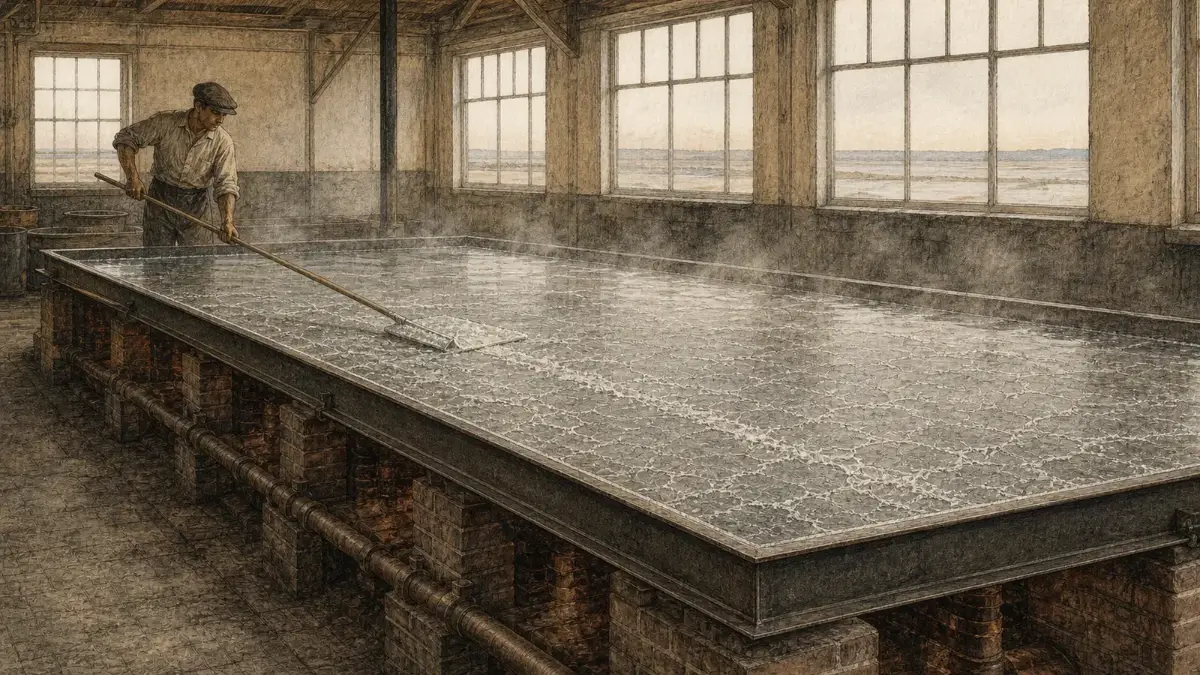
Maldon is the best-known finishing salt in the world and a genuinely good product. It also holds no protected designation, evaporates its brine over gas-fired flues, and carries about a hundredth of the magnesium of an unwashed sea salt. All three facts come from its own paperwork and the public registers, and none of them is a criticism.
What Maldon actually is
Seawater is drawn from the Blackwater estuary in Essex on spring tides, when salinity is highest. The brine is filtered, concentrated, and then evaporated in open pans set over gas-fired brick flues. As it evaporates, crystals nucleate at the surface and grow downward into hollow inverted pyramids, which are hand-raked off. That pyramid is the thing you are paying for: it crushes cleanly between finger and thumb and dissolves fast on the tongue.
The company has made salt on that site since 1882. The exact temperature and timing, by their own account, are a family secret. Anyone quoting you a specific Maldon pan temperature is not quoting Maldon.
It has no protected name
Search the UK register of protected food names for salt and you get three entries: Anglesey Sea Salt / Halen Môn, a PDO since 2014. Oriel Sea Salt, an Irish PDO. And Sel de Guérande / Fleur de Sel de Guérande, a PGI registered in 2012.
Maldon is not on it. Neither is Cyprus flake salt, and neither is anything from Patagonia. The absence is worth understanding rather than scoring points with: Maldon’s reputation was built by being everywhere and being consistent, not by a registry. It simply means the name protects the maker rather than the method, and anyone can sell a pyramid flake salt.
The composition
A manufacturer specification sheet gives Maldon as 97.0 per cent sodium chloride, 2.0 per cent moisture, 1.0 per cent non-saline salts, with calcium at 85 mg per 100 g and magnesium at 19 mg per 100 g — 0.019 per cent. Additives: none.
Set that against the only two comparable published figures. Halen Môn’s PDO specification sets a minimum of 0.2 per cent magnesium, ten times higher. The Patagonian producer we buy from publishes 1.78 per cent, which is roughly ninety times Maldon’s figure.
Read that carefully. Maldon’s is a typical analysis, Halen Môn’s is a regulatory floor, and the Patagonian number is a producer data sheet whose own note says values vary between lots. They are not strictly like for like. The gap is wide enough to survive that, but the correct conclusion is directional, not decimal.
Why the number is so different
Because magnesium is what gets removed. Magnesium chloride is bitter in quantity and hygroscopic, so it draws damp and makes salt cake. Producers who want a clean-tasting, free-flowing crystal wash it out or dry it hard. Jacobsen runs its seawater through reverse osmosis and boils it before evaporating, then rinses the crystals. Halen Môn rinses in concentrated brine and oven-dries at 85 °C.
Maldon says plainly that low magnesium is why its salt has no bitter aftertaste. That is a deliberate design choice and a defensible one. It is not an accident and it is not a shortcoming.
What this article is not saying
That Maldon is bad. It is excellent, it is reliable, and if you want a clean bright crunch with nothing else going on, it is the correct choice.
What it is saying is that “sea salt” is not a description of anything. Two products with that phrase on the front can differ in origin, in whether they were heated and by what, in whether they were washed, and by two orders of magnitude in composition. The word tells you where the water came from. Everything that matters happened afterwards, and most of it is not on the label.
One caveat on our own source: the Maldon composition figures come from a specification sheet carrying the company’s address and internal document references, hosted by a distributor rather than by Maldon. It is undated. We would treat the 97.0 per cent as indicative rather than current until the company confirms it.
Related
- Patagonian Sea Salt — the comparison table in full
- Patagonian Salt Flakes — our flake, for what it is worth
- Fine, Coarse or Crystal? — what grain size does and does not change
The Salt Guide
We are recording the salts on the American shelf one jar at a time — label, panel, price paid, crystal on white. Browse the guide →
Get the next guide
An email when we publish a new salt guide or recipe, and first word when the Patagonian salts are ready to order.
We write when there is something to say, not on a schedule.