
Three Things Sold as Smoked Salt
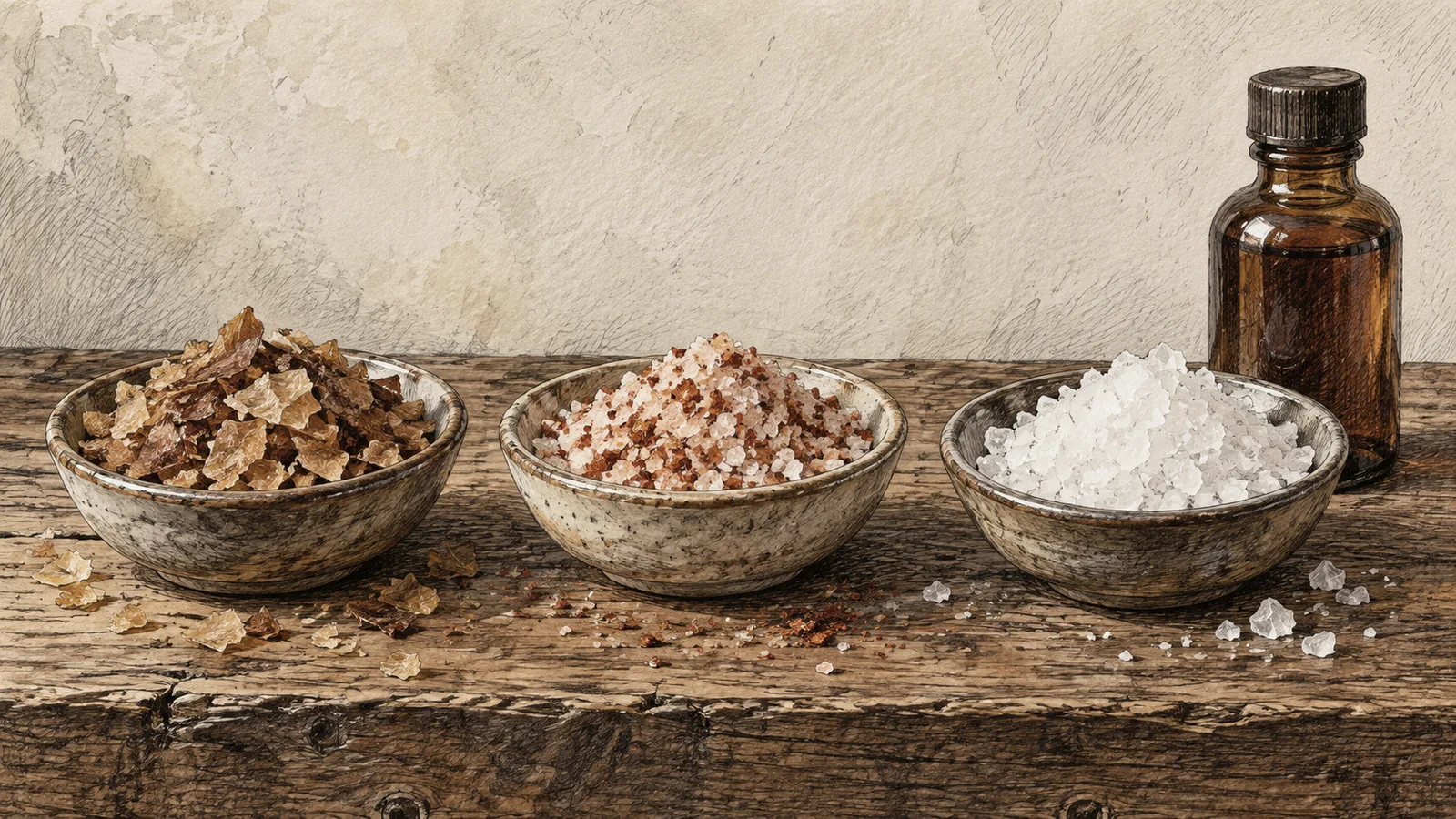
“Smoked salt” on a shelf can mean three different products. Direct wood-smoked salt is finished salt that sat in wood smoke. Smoke-flavoured salt is salt with a smoke flavouring — condensed, purified smoke — applied to it. A smoky blend is salt mixed with something else that was smoked, such as smoked paprika or chipotle. The ingredient list usually tells them apart. The main exception is a US rule that lets a natural smoke flavouring be declared as just “natural flavor”.
Why one label covers three products
No regulator in the US or the EU defines “smoked salt”. The words describe a taste, and a smoky taste can come from any of three places: from smoke that settled on the crystal, from a flavouring made out of smoke, or from another ingredient that was smoked before it went into the jar. You get a different product each way. The process is different, the ingredient list is different, the legal position is different, and since July 2026 the EU treats them differently too.
What most buyers get wrong is thinking the choice is between “real” and “fake”. That is understandable, because the marketing is written that way. It is not quite right. A smoke flavouring is made from real smoke, and a blend with smoked paprika is not trying to fool anyone. The useful question is narrower: what was actually smoked, and how did the smoke get into the jar?
Direct wood-smoked salt
Finished salt is spread out in a chamber and exposed to smoke from a named wood. The smoke compounds settle on the crystal surface, and nothing is added apart from what the smoke leaves behind. We have covered how the smokehouse process works separately. The part that matters here is the label, and it is less standard than you would expect. Three producers who say they do the smoking themselves put it three different ways:
- Jacobsen Salt Co, Infused Cherrywood Smoked Salt: “Sea Salt, Smoke”
- Halen Môn, Pure Smoked Sea Salt over Oak: “Halen Môn Pure Sea Salt PDO, Smoke from Oak Chippings”
- SaltWorks, Salish Alderwood Smoked Sea Salt: “Smoked Sea Salt”
All three describe the same kind of process. None of them is required by a specific US rule. FDA regulations say how smoke flavourings are declared, but they say nothing about how to write down that a food sat in smoke. So “smoke” on these labels is the producer describing what happened, and the producer chose the wording. It is useful information, but you cannot check it by reading the jar.
Smoke-flavoured salt
A smoke flavouring is smoke that has been condensed, separated and cleaned up. EU law defines it as a product “obtained by fractionation and purification of a condensed smoke”. American retail liquid smoke is the same idea in a bottle. Wright’s Hickory Liquid Smoke lists “Water, Natural Hickory Smoke Concentrate” and describes itself as made from the condensed smoke of hickory wood.
To make smoke-flavoured salt, the flavouring is sprayed onto the salt, mixed through it or plated onto it. That takes minutes, not a chamber day. An honestly labelled example is Falksalt’s smoke-flavoured flakes. The company’s product data sheet (version 1.0, dated May 2020) names the product “Smoke Flavoured Sea Salt Flakes”, gives the ingredients as “Sea salt flakes, Smoke flavour 7%”, and does not say the salt was ever in a smokehouse. The name tells you what it is.
US labels are less consistent. FDA’s flavour-labelling rule, 21 CFR 101.22, lets spices, natural flavours and artificial flavours be declared simply as “spice”, “natural flavor” or “artificial flavor”. Its definition of natural flavour includes “any product of roasting, heating” derived from “bark” and similar plant material. Taken literally, those two clauses mean a smoke flavouring that qualifies as natural could appear on a salt label as “natural flavor”, without the word smoke. That is our reading of the rule, not an FDA statement, and the labels we have read usually say “natural smoke flavor”. It does mean that an ingredient line without the word “smoke” in it has not ruled out smoke flavouring.
The rule that stops artificial smoke flavour being passed off as smoked, 101.22(h)(6), is covered in our piece on how to tell whether smoked salt was actually smoked, along with the sodium-per-gram arithmetic that catches carriers. We will not repeat either here.
Smoky-ingredient blends
In this third product the salt was never near smoke. The smoke arrived with something else: smoked paprika, chipotle (a jalapeño dried over smoke), lapsang souchong tea (smoked over pinewood), a bacon flavouring, or a smoke flavouring included as one ingredient among several. These are seasoning blends, and the seasoning salt rules apply to them. Every ingredient is declared in order of weight, and allergens are declared as for any blend.
One US detail matters here. Most spices can be declared simply as “spice”, but 101.22 says paprika, turmeric, saffron “or other spices which are also colors” must be declared as “spice and coloring” unless they are named. So a blend that gets its smoke from smoked paprika has to show it, either by name or as a colouring. A blend that gets its smoke from something the rule does not treat as a colour may say only “spices”, and the source of the smoke is then not visible on the label.
These blends are legitimate products. The only thing wrong with them is a front label suggesting the salt itself was smoked when it was not.
The fourth route: smoked water and other carriers
There is a fourth route that does not fit neatly into the other three. Smoke can be put into a carrier other than salt, most often water, and the carrier is then added separately. Halen Môn sells an Oak Smoked Water described as “water slowly infused with smoke from sustainable oak chippings”, with the ingredients “Water, Smoke from Oak Chippings”.
This matters for salt because it separates two doses that smoked salt ties together. With smoked salt, every pinch of smoke brings a fixed amount of sodium with it. With a smoked carrier, a cook or a factory can add as much smoke as they want and salt the food separately. The research we work from puts the legal status of these carriers down as “depends on process and jurisdiction”. That is accurate, and we have not seen anyone give a firmer answer.
The four routes side by side
| Route | What happened to the salt | Ingredient line looks like | What the jar cannot tell you | Ask the seller |
|---|---|---|---|---|
| Direct wood-smoked | Exposed to wood smoke in a chamber | “Sea salt, smoke” or “smoked sea salt” | Wood, time, chamber conditions, whether smoke was topped up with flavouring | Which wood, how long, and is any smoke flavouring used on any lot? |
| Smoke-flavoured | Coated with condensed, purified smoke | “Salt, natural smoke flavor” — or possibly “natural flavor” | Which flavouring, from which supplier, on what carrier | Name the flavouring and its maker; is it sold in the EU? |
| Smoky blend | Nothing; another ingredient was smoked | Salt plus the named ingredients, in weight order | Which ingredient carries the smoke, if hidden in “spices” | What is smoked in this, and was the salt? |
| Smoked carrier | Nothing, or dosed with smoked water | Water or other carrier “smoke”, as the producer writes it | How it was classified where it is sold | How is the carrier smoked, and how is it declared? |
How to tell from the panel
In order of reliability:
- Look for the word “flavor” in any form. “Smoke flavor”, “natural smoke flavor” or plain “natural flavor” on a salt means a flavouring was applied. If you see it, you have the second product, or a blend.
- Count the ingredients. One or two, with smoke named as a process, is consistent with direct smoking. More than two means a blend or a carried flavouring.
- Look for carriers. Propylene glycol, maltodextrin and silicon dioxide are there to spread or hold something. On a smoked salt that is usually a flavouring.
- Do the sodium arithmetic. This is explained in full here. It catches added mass, but it cannot tell you where the smoke came from.
- Read the front of the pack last. “Smoked”, “smoke flavoured” and “smoky” are three different claims, and the ingredient list is the better witness.
One trap needs its own sentence: a named wood does not prove direct smoking. Liquid smoke is sold as hickory, mesquite and applewood. EU labelling law provides a designation, “smoke flavouring produced from beech”, for exactly this case. A wood on the label tells you what was burned. It does not tell you whether the salt was in the room. What the woods actually do is a separate question.
The EU has already separated them
The line between the first two products is now a legal one in Europe. The EU removed every authorised smoke flavouring from its approved list in 2024, and for foods outside meat, cheese and processed fish, the last date for placing new product containing them on the market was 1 July 2026. Salt made in a smokehouse was never in scope of that regulation. We have set out what that change does and does not cover. It changes nothing on a US label, but it does mean the three products are no longer interchangeable in the EU.
Which one we are making
We are developing a smoked salt. It is not a product yet. The one decision already made is the category: direct smoke, with salt and smoke as the only ingredients. What development has to answer is how much smoke our crystal holds, and for how long, when nothing else is added. We are not publishing process figures until we can stand behind them.
We could have made this easier with a flavouring. That would have been a legal product, and some honest producers make that choice. We did not, because we want the ingredient list to be something we can explain.
Two weaknesses in our sourcing. The Falksalt ingredient line comes from a data sheet dated May 2020 that is still linked from the product page. We have not seen a current pack and cannot say whether the formulation has changed. The point that a natural smoke flavouring could be declared as plain “natural flavor” is our reading of 21 CFR 101.22 as written. We found no FDA guidance on it either way, and we have not surveyed the US shelf systematically to see how often it happens.
Sources
- Jacobsen Salt Co — Infused Cherrywood Smoked Salt, ingredients
- Halen Môn — Pure Smoked Sea Salt over Oak, ingredients
- SaltWorks — Salish Alderwood Smoked Sea Salt, ingredients and process
- Falksalt — Smoke Flavoured Sea Salt Flakes product data sheet (v1.0, 2020)
- Halen Môn — Oak Smoked Water, ingredients
- Wright’s — Hickory Liquid Smoke, ingredients
- 21 CFR 101.22 — labeling of spices, flavorings, colorings and chemical preservatives
- Regulation (EC) No 1334/2008 — flavourings, definition and labelling of smoke flavouring
Read next
- How Can You Tell If Smoked Salt Was Actually Smoked? — the sodium test
- The EU Banned Smoke Flavourings. Here Is What That Means for Salt — where Europe drew the line
- What Is Smoked Salt and How Is It Made? — the smokehouse, explained
- Patagonian Sea Salt — the salt underneath
The Salt Guide
We are recording the salts on the American shelf one jar at a time — label, panel, price paid, crystal on white. Browse the guide →