
Is Pink Curing Salt the Same as Himalayan Pink Salt?
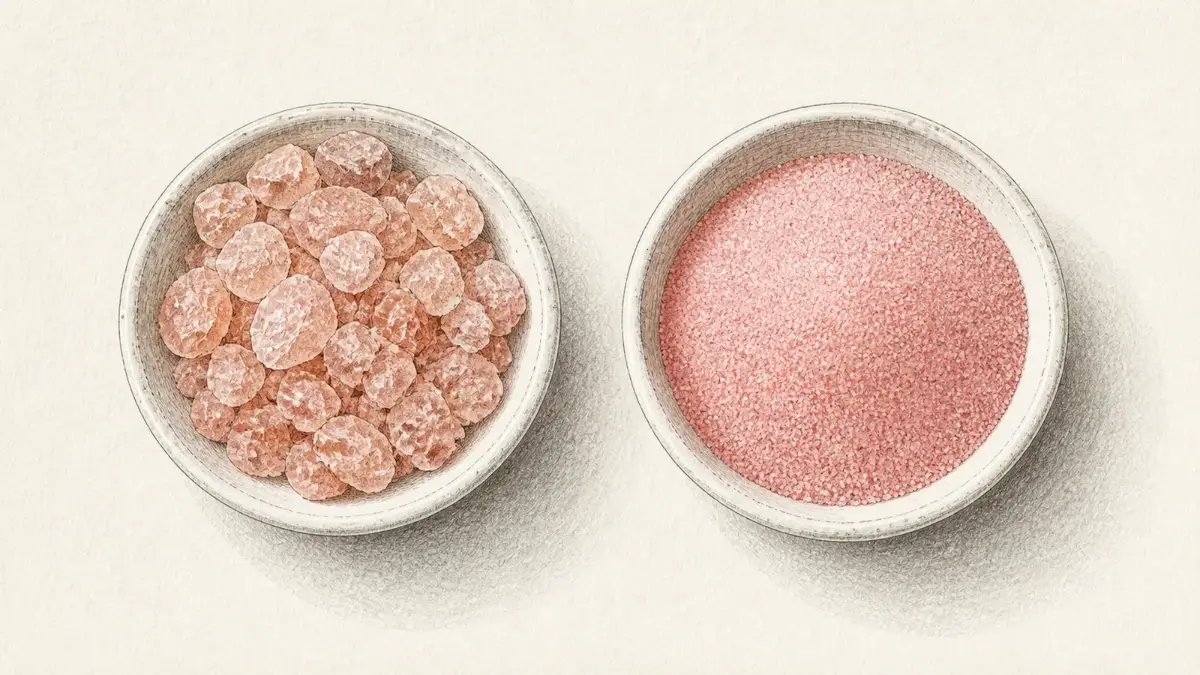
Two pink salts sit on the same shelf in the same kind of bag. One is mined rock. The other contains sodium nitrite at 62,500 parts per million — 6.25 per cent by weight — and a tablespoon of it can kill an adult.
What is pink curing salt?
It is table salt with sodium nitrite blended into it, dyed pink so nobody mistakes it for the ordinary kind. Sold as Prague Powder #1, Insta Cure #1, or simply cure #1, the standard formulation is 6.25% sodium nitrite and 93.75% sodium chloride.
That 6.25% is not arbitrary. The standard usage rate is one ounce per twenty-five pounds of meat, and at 6.25% that arithmetic lands on 156 parts per million of nitrite going in. That is an ingoing limit, not a finished-product one. Under 9 CFR 424.21(c) the permitted amount for comminuted product is a quarter ounce of sodium nitrite to a hundred pounds of chopped meat, which is where 156 ppm comes from. The same regulation sets a separate ceiling: the use of nitrites or nitrates shall not result in more than 200 ppm of nitrite, calculated as sodium nitrite, in the finished product, with bacon governed by its own rule at 9 CFR 424.22. Most of the ingoing nitrite is consumed during curing, so the residual in what reaches the table is far below either number. The 6.25% concentration exists so that a simple kitchen measurement lands on the ingoing limit instead of past it.
Prague Powder #2 adds sodium nitrate for long dry cures — salami, country ham, anything hanging for weeks — where the nitrate slowly converts to nitrite over the cure.
And Himalayan pink salt?
Mined rock halite from Pakistan, one ingredient, pink because of traces of iron oxide — rust. A peer-reviewed analysis of 31 pink salt samples found sodium averaging 394,718 mg/kg and iron averaging 63.75 mg/kg. It contains no nitrite and is not a curing agent; only sodium and potassium nitrite and nitrate are permitted curing agents under US regulation.
The two products are not related in any way except colour.
How dangerous is the confusion?
Documented and lethal. In 2002 the CDC reported a New York household where a plastic bag labelled “Refined Iodized Table Salt” in fact contained 100% sodium nitrite, left behind by a previous tenant who had used it for curing meat. Five of six people ate a meal cooked with it.
Onset was almost immediate: dizziness, cyanosis, vomiting, and in two of them respiratory distress and seizures. Methaemoglobin levels ran from 21.1% to 87.0%, against a normal 1 to 3%. The rice measured 18,792 parts per million of nitrite.
A 2019 case from Serbia records a 70-year-old man who died about seven hours after eating homemade sausage containing roughly 3.5 g of sodium nitrite per kilogram of meat. That is 3,500 parts per million, which the authors describe as almost thirty times the amount allowed where the sausage was made; measured against the US ingoing limit for comminuted meat it is more than twenty times over. Two others survived.
How much is a dangerous amount?
Published estimates of a lethal adult dose range from about 1 g to 9.5 g of sodium nitrite, with doses as low as 60 to 500 mg capable of causing methaemoglobinaemia. At the nominal 6.25%, a tablespoon of cure #1 contains roughly 1.1 g of sodium nitrite; a teaspoon around 0.37 g.
That is the entire safety case for keeping it in a labelled container, away from the salt you cook with.
Why is it pink, and is that changing?
The colour is a warning, and it is long-standing industry practice rather than a legal requirement — we looked for a federal rule mandating it and could not find one.
It is changing regardless. The dye traditionally used is FD&C Red No. 3, and the FDA revoked its listing for use in food on 15 January 2025, with a compliance date of 15 January 2027. Reformulated products are already on sale, coloured with annatto instead. If you buy curing salt in the next two years, do not assume the shade tells you what it is. Read the label.
What about "uncured" bacon?
It is cured. The nitrite is generated from celery juice powder, a concentrated nitrate source at around 27,000 ppm nitrate, reduced to nitrite by starter cultures. The nitrite ion that results is chemically identical to the nitrite from a jar of cure #1.
There is a regulatory oddity here worth knowing: because celery powder is treated as a flavouring rather than a curing agent, the ingoing limits that cap conventional cure do not bind it. USDA labelling rules still require these products to say “Uncured” and “No Nitrate or Nitrite Added.”
The USDA agrees this misleads. In December 2020 it partially granted a petition to prohibit both phrases on products processed with any nitrate or nitrite source, celery powder included. As of this writing the rule has not published.
What we will not tell you is the popular version — that uncured bacon contains more nitrite than cured. The best controlled comparison found the opposite: lower in salami, below detection in cooked ham. Not zero. Just not worse.
Common questions
No. It contains no nitrite and will not cure anything. Using it in place of cure #1 in a recipe intended for cured meat leaves the food unprotected.
Absolutely not, and this is the direction that kills people. Morton's own warning on Tender Quick reads: curing salts cannot be substituted for regular salt in other food recipes.
At regulated ingoing levels the residual in finished product is small — a US market survey of 1,132 conventional processed meats found residual nitrite averaging 13.7 ppm. Dietary nitrate from vegetables exceeds the contribution from cured meat by roughly ten to a hundred times. The debate about processed meat and health is real and is not settled by that number, but it is not a debate about accidental poisoning.
In its original labelled container, not decanted into an unmarked bag, and not next to the cooking salt. The 2002 CDC case is what happens otherwise.
Sources
- CDC, MMWR 2002;51(29):639–642 — methemoglobinemia following unintentional ingestion of sodium nitrite
- 9 CFR 424.21 — curing agents and ingoing nitrite limits
- 9 CFR 424.22 — bacon-specific nitrite limits
- FDA — revocation of FD&C Red No. 3, January 2025
- Fayet-Moore F et al., Foods 2020;9(10):1490 — mineral composition of pink salt
- Cvetković D et al., Forensic Sci Med Pathol 2019;15(1):102–105 — sodium nitrite food poisoning in one family
- FSIS — final response to Petition 19-03 on “uncured” labelling, December 2020
- Sheng S et al., Scientific Reports 2025;15:3269 — residual nitrite and nitrate in US processed meats
The Salt Guide
We are recording the salts on the American shelf one jar at a time — label, panel, price paid, crystal on white. Browse the guide →
Get the next guide
An email when we publish a new salt guide or recipe, and first word when the Patagonian salts are ready to order.
We write when there is something to say, not on a schedule.