
What Is Patagonian Sea Salt?
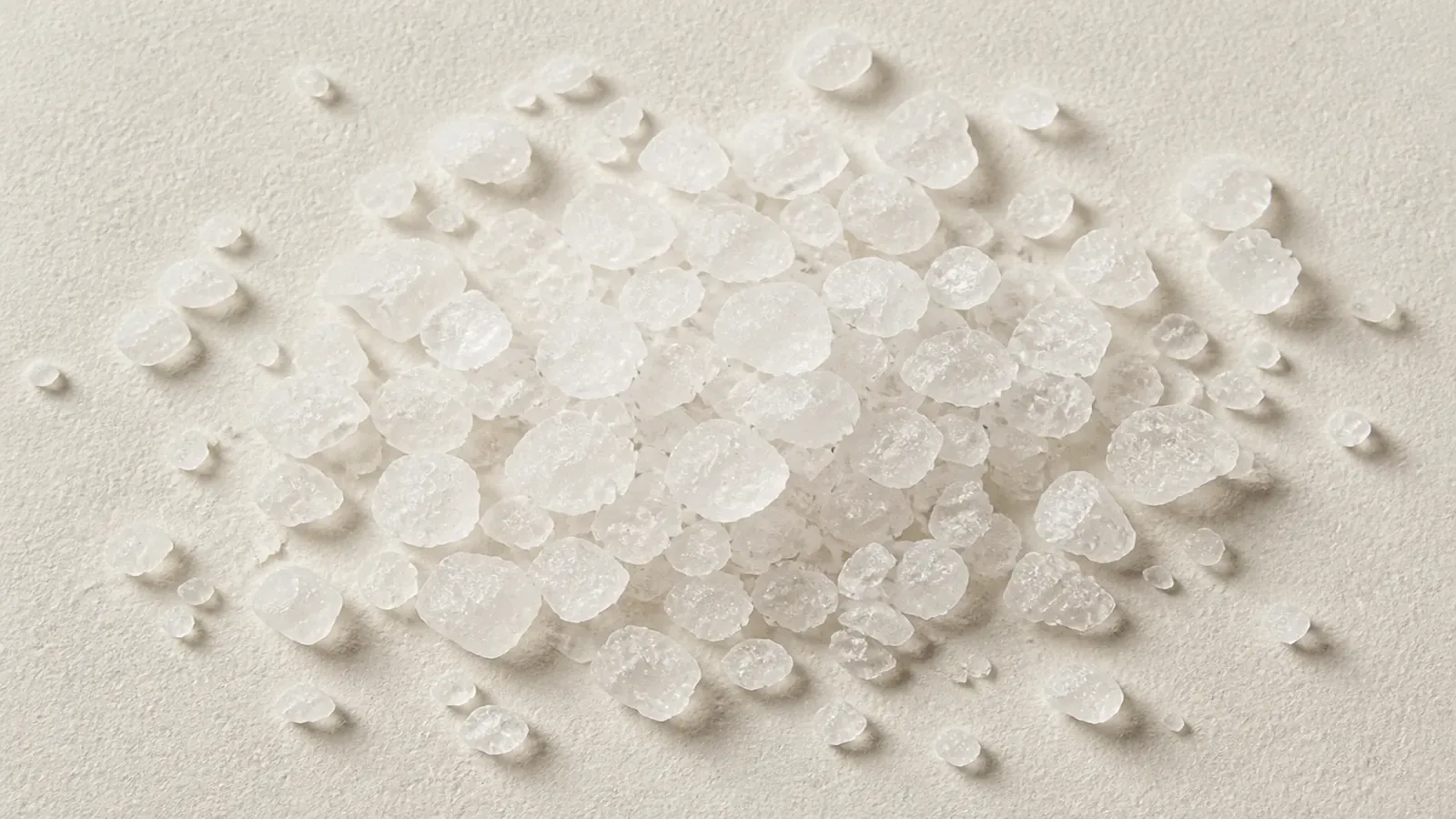
Patagonian sea salt is salt evaporated from present-day Atlantic seawater collected off the coast of Argentine Patagonia — principally Chubut province. It is a very small, very new category. Argentina produces roughly 1.4 million tonnes of salt a year, and almost none of it is this.
Correction, 18 September 2026. An earlier version of this piece said that a laboratory analysis had established the sodium chloride content of the salt we import, and drew a comparison of sodium by weight from that figure. Both have been withdrawn, and we are not restating the number. No such analysis exists: there is no certificate of analysis behind it, and the figure appears to have come from a misreading of a marketing line about the count of minerals present, which is not a composition measurement at all.
We are not replacing it with a different number. The withdrawn figure would also have put the product below the Codex food-grade salt minimum of 97 per cent sodium chloride on a dry basis, which should have been the first thing anyone noticed. Until an analysis of our own lot exists, this article says nothing about the sodium chloride content of the salt we import and nothing about how its sodium compares to anyone else’s. A salt is not worth buying for its sodium figure in any case.
That last sentence is the one nobody selling Patagonian salt wants to lead with. We are leading with it, because the category is worth building honestly or not at all.
Most Argentine salt has never seen the ocean
Argentina’s salt comes from three places, and the sea is not really one of them.
Inland playas. Closed basins where groundwater and runoff evaporate, leaving halite behind. The Salina del Gualicho in Río Negro sits in a depression below sea level and supplies chemical industry at enormous scale. Salinas Grandes de Hidalgo in La Pampa feeds Dos Anclas, one of the two national brands.
Relict lake beds. The Salinas del Bebedero in San Luis is a Pleistocene lake that filled during glacial floods and desiccated as the climate dried. It has been under concession since 1917.
Brine wells. Celusal — the other national brand, and the one whose sal parrillera Argentines actually grill with — pumps brine from wells a hundred metres down in Burruyacú, Tucumán, in the subtropical northwest. That brine is ancient trapped seawater, buried and concentrated over geological time.
Roughly half of all Argentine salt goes to chemical industry rather than food.
So when you see “Argentine salt,” the overwhelming likelihood is that it came out of the ground, a long way from any coast.
The ancient-sea problem
Here is a distinction that matters more than it sounds like it should.
Sea salt comes from evaporating seawater that is in the ocean now. Rock salt — including Himalayan pink salt — comes from mining deposits left by seas that dried up and were buried, often hundreds of millions of years ago.
Both are sodium chloride. Neither is superior. But they are different products with different textures, different moisture, different crystal habits, and different stories, and conflating them is where most salt marketing goes wrong.
It is also where the most-marketed “Patagonian sea salt” on the market runs into trouble. There is a salina on a peninsula in northern Chubut — Salina Grande — that sits in a closed depression 42 metres below sea level. It is a spectacular place. Salt was extracted there commercially from about 1901, served by a 34-kilometre narrow-gauge railway from Puerto Pirámides, until the operation closed in 1920.
It is not fed by the sea. A doctoral thesis in geohydrology at the Universidad Nacional de La Plata analysed the isotopic signature of the groundwater beneath the southern part of that peninsula and found meteoric recharge — rainfall — not marine intrusion. The salt there is a relict evaporite: an ancient trapped body of water that dried out over millennia, roughly 40 km from the shore.
Salt from that salina is sold internationally labelled Sal Marina Patagónica. Argentina’s own food code, amended in 2023, defines sal marina as “el producto procedente de la evaporación del agua del mar” — the product proceeding from the evaporation of seawater. A relict deposit 42 metres below sea level is not that.
We are not interested in litigating another company’s label. We are interested in the category surviving contact with an informed reader, and that means saying: “Patagonian” and “sea salt” are two claims, and plenty of products only earn one of them.
What is actually being made on the coast
Genuine Patagonian sea salt exists. There is just very little of it.
As best we can establish, there are two producers, both in Chubut, both artisanal, with combined output in the low single-digit tonnes per month. For scale: a single mechanised solar saltworks in Rio Grande do Norte, Brazil, can exceed 150,000 tonnes a year.
Ours comes from a small producer on the Chubut coast — a family operation that has been evaporating seawater there for over a decade. The seawater is collected from a beach chosen for having no history of contamination, filtered, and evaporated indoors at controlled low temperature, which is how the producer describes the process and as far as we are willing to put it. We are not naming the producer while the commercial relationship is still being settled.
The process is filtration, then controlled evaporation at low temperature, kept low deliberately to preserve the crystal structure and the residual minerals. That is the whole of it. The producer describes a low-temperature process and has never confirmed a temperature, a duration or a yield to us in writing, and the figures that circulate for this salt trace back to a single local newspaper interview from 2020 rather than to the plant. We are not going to launder a reporter’s paraphrase into a specification.
There is a check available here, and it is worth naming even though we cannot run it. Surface seawater on the Patagonian shelf carries around 33.7 grams of dissolved salts per kilogram, so a genuine seawater salt has to come out at roughly that rate; a yield much above it means something was added, and one far below it means something was lost. We would publish our producer’s yield against that benchmark the day we have it in writing. We do not have it, so the paragraph stops here.
The salt carries a Certificado de Origen Chubut and is certified free of gluten. No anti-caking agents, no preservatives.
Why nobody makes solar salt here
The classic sea salts — Guérande, Trapani, the great saltworks of Rio Grande do Norte — are made in shallow open pans where sun and still air do the work over a warm season.
Patagonia has one of the three conditions and not the other two.
Aridity: yes. The coast north of Trelew receives about 246 mm of rain a year. Trelew gets 218 mm. This is cold semi-desert bordering on true desert.
Warmth: no. Summer runs 15–35 °C and winter 0–15 °C, with twelve to twenty frost days. The evaporating season is short.
Still air: emphatically no. The Patagonian westerlies are relentless, and open pans of brine and constant wind are a poor combination — you get contamination and you get your product redistributed across the steppe.
Which is why both Chubut producers evaporate indoors under controlled heat rather than in open pans, and why neither of them uses the word “solar” anywhere on their website. It would be the easier story to tell. It would also be false, and anyone who visits the plant would know within a minute.
So this is not a sun-and-wind salt. It is a low-temperature evaporated salt, which is a different and less romantic sentence, and it happens to be the true one.
Two things that are the opposite of the marketing
Patagonian seawater is not unusually salty. It is less salty than average. Subantarctic Shelf Water along this coast runs about 33.7 practical salinity, against a global ocean mean near 34.7, because the shelf takes in low-salinity water of subantarctic and Magellanic origin. Anyone telling you Patagonian salt is more concentrated or more mineral-rich because of the water has it backwards.
The trace minerals are not why it tastes good. Sea salt is overwhelmingly sodium chloride. In the most thorough comparison we know of — 45 salts from around the world, published in the Journal of Sensory Studies — there was no difference in salty taste at equivalent sodium levels, and the researchers concluded the direct flavour effect of trace minerals “appeared to be minimal.” What sea salts did show was a different time-intensity profile and some mineral and astringent character, mostly detectable in isolation rather than in food.
If a salt is worth buying, it is worth buying for crystal structure, moisture, dissolution behaviour, how it sits on food, and who made it. Not for a mineral list.
What Argentina now says officially
Two amendments to the Código Alimentario Argentino did something genuinely useful and almost nobody has noticed.
Article 1264 bis (2023) defines Sal Marina as the product of evaporating seawater, sold ready to consume.
Article 1264 tris (2024) goes further and creates Sal Marina Argentina: a crystalline product, predominantly sodium chloride, obtained from the evaporation of Argentine seawater, with the sum of calcium, magnesium and potassium chlorides above 2% of dry residue, moisture at or below 10%, and stated limits for arsenic, copper, lead, cadmium and mercury.
That is a real, enforceable, national origin-and-composition standard for sea salt — something France has for Guérande and England does not have for Maldon. It came into existence in the last two years, which is roughly how old this category is.
So what is Patagonian salt, honestly?
It is a small quantity of genuine sea salt, evaporated at low temperature from cold, clean, slightly-less-saline-than-average South Atlantic water, on an arid and violently windy coast, by two families, under a national standard that is younger than most people’s phones.
It is not ancient. It is not a tradition. Argentine asado does not have a history of it — asadores grill with brine-well salt from Tucumán and playa salt from La Pampa, and always have.
What it is is a place that has never been on the salt shelf, doing something small and specific and verifiable. Himalayan salt and fleur de sel each began as a regional product nobody outside had heard of. Categories are not discovered. They are built, by people willing to say what a thing actually is.
That is the version we would rather sell.
Common questions
No. Sea salt is 39 to 40 per cent sodium by mass, near enough to table salt to make no difference, and that is the honest answer for this salt as much as any other. We previously published a figure here putting our salt well below the category norm for sodium chloride, and a sodium comparison drawn from it. Both have been withdrawn: we have no certificate of analysis to stand behind and will not publish an estimate in place of one. If we have our own lot analysed we will publish the result, whatever it says. Until then this page makes no claim about the composition of the salt we import beyond the fact that it is sea salt. Buy it for texture and origin, not for health.
No — opposite ends of the category. Himalayan is mined rock salt from an ancient buried deposit. Patagonian sea salt is evaporated from present-day seawater.
Not by any producer we can document. The Chubut producers evaporate under controlled low heat indoors. Be sceptical of anyone claiming solar pans on this coast.
It is a defined category in Argentina’s food code since 2024, requiring evaporation from Argentine seawater and calcium + magnesium + potassium above 2% of dry residue.
Mostly not. The standard Argentine grilling salt is sal parrillera, and the two dominant brands source from a brine well in Tucumán and inland playas — neither marine, neither Patagonian.
There are reports of a small annual harvest from the salina. The peninsula is a UNESCO World Heritage property that IUCN rates “Significant Concern,” and IUCN’s 2025 assessment states there are no mining projects in the area. We could find no published extraction permit. We do not source from there.
Sources
- Resolución Conjunta 4/2023 — CAA Art. 1264 bis, Sal Marina
- Resolución Conjunta 6/2024 — CAA Art. 1264 tris, Sal Marina Argentina
- SEDICI / UNLP — Investigación geohidrológica de una península costera del norte de Chubut
- UNESCO — World Heritage nomination dossier 937, Chubut coast (PDF)
- IUCN World Heritage Outlook — the Chubut coastal World Heritage property
- El Chubut — La sal marina: condimento sano y muy buscado
- Wikipedia — the narrow-gauge salt railway from Puerto Pirámides
- Guerrero, R. et al. — Salinity of the SW Atlantic shelf — PMC4508963
- Drake, S.L. & Drake, M.A. (2011), Journal of Sensory Studies 26(1) — Wiley
- Compilación técnica — Sal y salinas argentinas (PDF)
- Contexto Tucumán — Celusal, Burruyacú
The Salt Guide
We are recording the salts on the American shelf one jar at a time — label, panel, price paid, crystal on white. Browse the guide →
Get the next guide
An email when we publish a new salt guide or recipe, and first word when the Patagonian salts are ready to order.
We write when there is something to say, not on a schedule.