
What Is Actually in Tony Chachere's
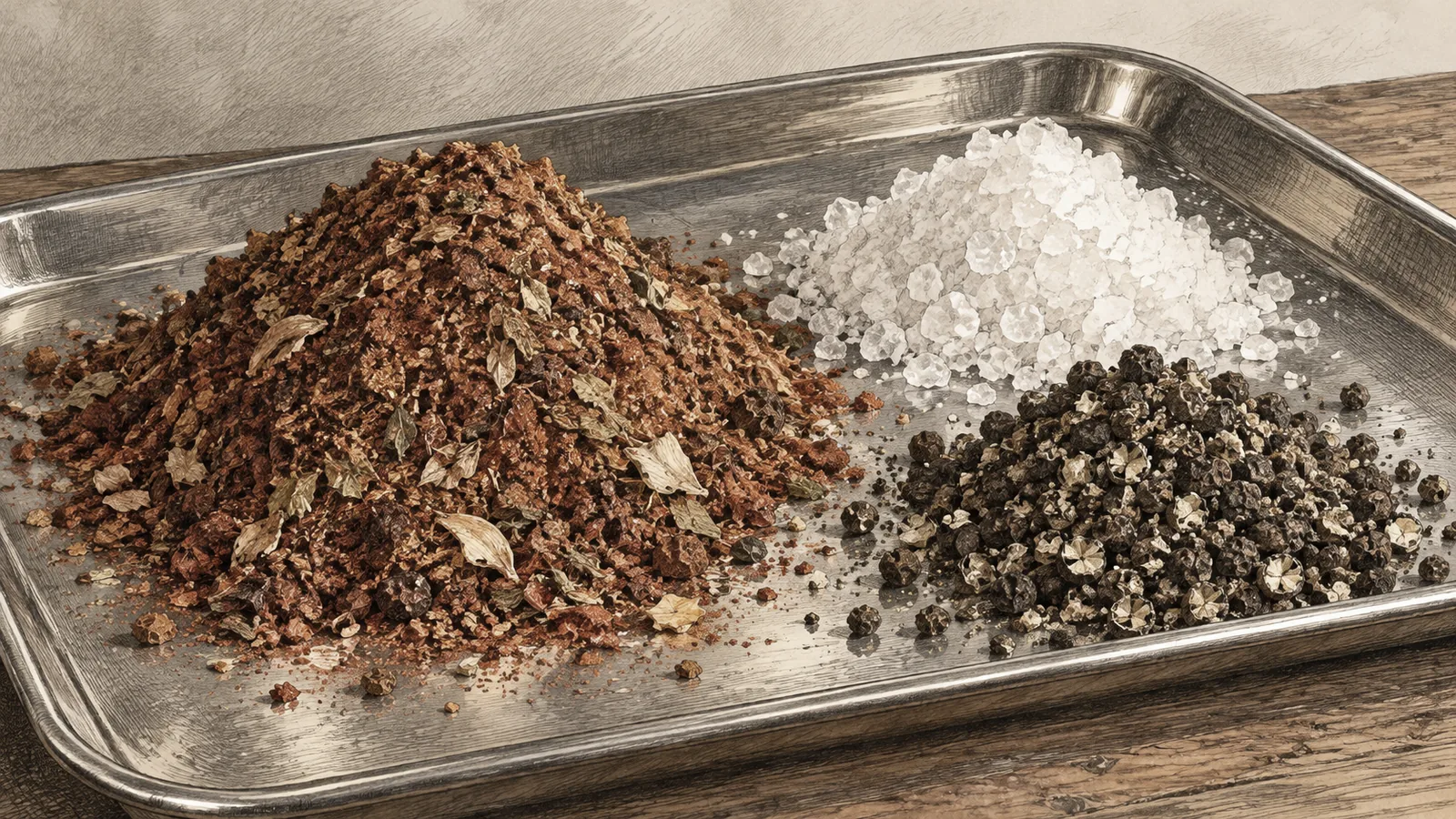
Tony Chachere’s Original Creole Seasoning is salt first, and salt again inside its chili powder. The maker’s own ingredient statement reads: “Salt, red pepper, black pepper, chili powder (chili pepper, spices, salt, garlic powder), dehydrated garlic, silicon dioxide (anti-caking agent).” A quarter-teaspoon serving of 1.1 g carries 340 mg of sodium, which puts the blend at roughly three-quarters salt by weight. Tony Chachere, a cook from the country around Opelousas, Louisiana, began manufacturing it in 1972.
What the label actually says
The product page on the company’s website shows a nutrition panel and nothing else. The ingredient statement lives in the company’s 2024 trade catalogue, which it hosts on the same site. For the Original it is six ingredients, one of which is itself a blend:
- Salt
- Red pepper
- Black pepper
- Chili powder (chili pepper, spices, salt, garlic powder)
- Dehydrated garlic
- Silicon dioxide (anti-caking agent)
US labels list ingredients in descending order of weight, so salt is the largest single component and red pepper the second. What the order cannot tell you is by how much. Salt could be 40 per cent of the can or 90 per cent and the list would read identically.
Two details are worth noticing. The first is that salt appears twice: once at the top, and again inside the chili powder, because American chili powder is not ground chile but a seasoning blend of its own. The second is the word spices inside that bracket. It is a legal catch-all, and it tells you nothing about which spices. The catalogue also says the Original is manufactured on equipment that also handles milk, soy and wheat.
How much of it is salt
The label does not say, but the nutrition panel lets you work it out. The Original gives 340 mg of sodium in 1.1 g, which is about 309 mg of sodium per gram. Sodium makes up about 39 per cent of sodium chloride by weight. If all of that sodium comes from salt, and in a blend of pepper, garlic and chile it very nearly must, the Original is somewhere around three-quarters to four-fifths salt.
Be clear about what kind of number that is. It is not an analysis. It is arithmetic on two rounded figures. Federal rules round sodium to the nearest 10 mg once a serving passes 140 mg, and state small serving weights to the nearest 0.1 g. Either rounding can move the answer by several points. The range is honest. A single decimal would not be.
None of this is a criticism. A Creole seasoning is supposed to salt the food it seasons; that is its job. It simply means that when you shake it on, you are mostly salting, and seasoning second. The same is true of many shaker blends, which is the point of our piece on what seasoning salt is.
Five products, one company
The seasoning range on the company’s site runs from the Original to a salt-free blend. Here is what each panel says, with sodium per gram worked out from the printed figures.
| Product | First ingredient | Serving as printed | Sodium per serving | Sodium per gram (calculated) |
|---|---|---|---|---|
| Original Creole Seasoning | Salt | 1/4 tsp (1.1 g) | 340 mg (15% DV) | about 309 mg |
| More Spice Seasoning | Salt | 1/4 tsp (1 g) | 290 mg (13% DV) | about 290 mg |
| BOLD Creole Seasoning | Salt | 1/4 tsp (1 g) | 290 mg (13% DV) | about 290 mg |
| Lite Creole Seasoning | Salt, then potassium chloride | 1/4 tsp (1 g) | 170 mg (7% DV) | about 170 mg |
| No Salt Seasoning | Brown sugar | 1/4 tsp (.8 g) | 0 mg | 0 |
Serving sizes and sodium are as printed on the nutrition panels on each product page. Ingredient order is from the 2024 catalogue. The last column is ours.
More Spice has exactly the same ingredients
This is the part most people get wrong, and the mistake is reasonable. A product called More Spice sounds like it has something the Original lacks. It does not. Its ingredient statement in the catalogue is word for word the Original’s: salt, red pepper, black pepper, chili powder, dehydrated garlic, silicon dioxide. BOLD, which the catalogue describes as spicier than More Spice, carries the same statement a third time.
What changes is the proportion, which no ingredient list can show. The catalogue describes More Spice as developed for people who want “a little less salt and a little more spice”, and states that it has “14% less sodium per serving than our Original blend.” The panels agree: 290 mg against 340 mg is 14.7 per cent less.
But look at the serving sizes. The Original’s quarter-teaspoon weighs 1.1 g. More Spice’s weighs 1 g. Per gram, the two panels give about 309 mg against 290 mg, a difference of roughly 6 per cent. Much of the per-serving gap comes from the spoon holding less, which is what you would expect if pepper has displaced some of the denser salt. Label rounding is coarse enough that the true per-gram figure could sit a few points either side.
Neither number is wrong. Per serving is how US labels compare products, and if you season by the spoon it is the fair comparison. If you season by weight, it overstates the difference. For scale, the Food and Drug Administration requires at least 25 per cent less sodium than a reference food before a label may say “reduced sodium”. The company does not use that phrase for More Spice; its catalogue gives the comparison as a plain number.
Lite and No Salt are different products
Lite Creole Seasoning changes the formula rather than the proportions. Its catalogue statement reads: “Salt, potassium chloride, red pepper, black pepper, maltodextrin, dehydrated garlic, chili powder (chili pepper, spices, salt, garlic powder), paprika, silicon dioxide (anti-caking agent).” Potassium chloride replaces part of the salt, and maltodextrin, a starch-derived bulking agent, fills some of the volume. The catalogue says “you won’t even realize there is a third less sodium in each can”, which is a claim about the can, not the serving. The panels, per quarter-teaspoon, give 170 mg against the Original’s 340 mg, which is half; per gram it is about 45 per cent. We do not know which comparison the “third” is built on. What potassium chloride is and how it tastes is covered in our pieces on potassium chloride against sodium chloride and lite salt and salt substitutes; we will not repeat it here.
No Salt Seasoning is a different animal altogether. Its first ingredient is brown sugar, followed by dehydrated onion, dehydrated garlic, red pepper, dehydrated bell pepper, and lemon powder, which the catalogue itemises as maltodextrin, lemon puree, citric acid, sugar and lemon juice. Paprika, basil, thyme, oregano and silicon dioxide finish the list. The panel gives 0 mg sodium and 5 calories per 0.8 g serving, the only product in the table with calories to declare. The company’s own description is for people who “can’t have or don’t want salt (or any sodium substitutes)”. Whether it tastes like the Original without the salt is a matter for your palate. On paper, sugar and citric acid are doing work that salt does in the others.
Where it comes from
The company’s own history is short and specific. Tony Chachere was born in 1905. He ran a fishing and hunting camp in the Atchafalaya Swamp near Opelousas, which the company describes as a gourmet haven. He retired in 1970 and soon published the Cajun Country Cookbook, which included the recipe for his homemade seasoning blend. Demand followed, and in 1972 he began to manufacture it. In March 1995 he was the first inductee into the Louisiana Chefs Hall of Fame, and he died a week later, just short of 90.
The company’s business address today is on the I-49 service road in Opelousas. Its history page does not say where the first cans were filled, so we will say only what it does: a recipe from near Opelousas, a company in Opelousas now.
One small oddity. The recipe came out of a book with Cajun in its title, and the product is sold as a Creole seasoning. The distinction matters a great deal in Louisiana and very little on the label. We are reporting the name, not ruling on it.
What the label cannot tell you
It cannot tell you the ratio of salt to pepper, which is the whole difference between three of the five products. It cannot tell you which spices are in the chili powder. It cannot tell you what kind of salt it is, where it was made, or how fine it was ground. And it cannot tell you why a quarter-teaspoon of one blend weighs a tenth of a gram more than a quarter-teaspoon of another, though grain size and density are the likely reasons. On why grain size changes how salty a spoonful is, see sodium by salt type.
What it does tell you, read carefully, is that this is a salt with pepper in it rather than pepper with salt in it. That is a deliberate design choice and a defensible one. It has been made for more than fifty years, and it does exactly what its maker says. The panel is just more candid about it than the name.
A caveat on our own sourcing. The ingredient statements come from the company’s trade catalogue dated April 2024, not from a can bought this month; the nutrition panels are images on the product pages, uploaded in 2020 by their file paths. They agree with each other, and the Original’s statement matches what grocery listings carry today, but a formula can change without a website changing. If you have a can in front of you that reads differently, the can wins.
Sources
- Tony Chachere’s — Original Creole Seasoning, product page and nutrition panel
- Tony Chachere’s — More Spice Seasoning, product page and nutrition panel
- Tony Chachere’s — No Salt Seasoning, product page and nutrition panel
- Tony Chachere’s — digital catalogue, April 2024 (ingredient statements)
- Tony Chachere’s — Our Roots, company history
- Tony Chachere’s — contact and business address, Opelousas
- eCFR — 21 CFR 101.9, nutrition labeling and rounding rules
- eCFR — 21 CFR 101.61, sodium content claims
Read next
- What Is Seasoning Salt — the category this belongs to
- Lite Salt vs Salt Substitute — what potassium chloride is doing in Lite
- Sodium by Salt Type — why a spoonful is not a gram
- Patagonian Fine Salt — plain salt, for comparison
The Salt Guide
We are recording the salts on the American shelf one jar at a time — label, panel, price paid, crystal on white. Browse the guide →