
Gomashio: The Sesame-to-Salt Ratio Nobody Agrees On
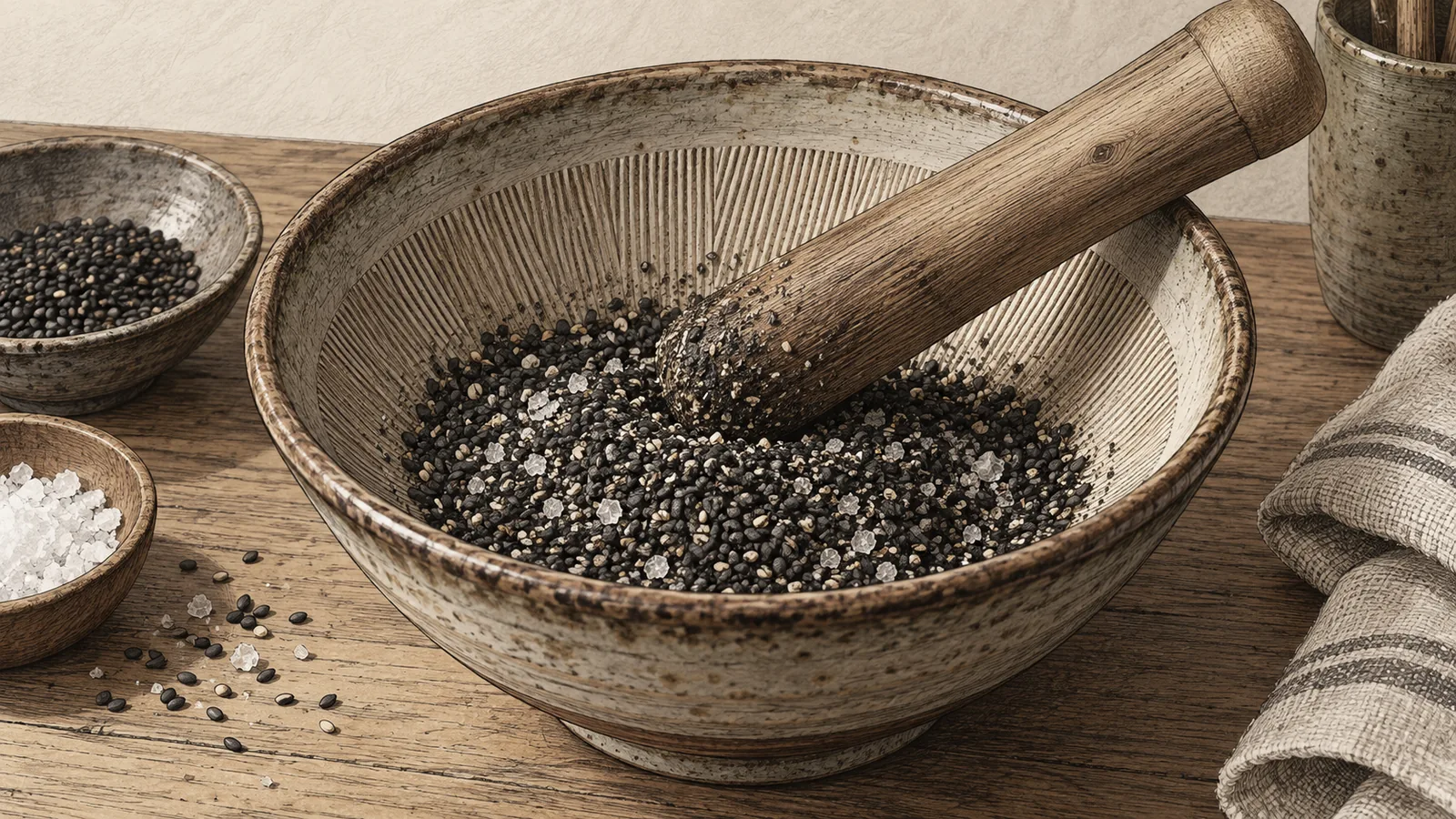
Gomashio is toasted sesame seed, usually black, ground lightly with roasted salt. There is no fixed ratio. The published recipes we checked run from about 3:1 sesame to salt by the spoon, in an NHK recipe for red rice, through 4:1 from a Kyoto sesame-oil maker and a Japanese macrobiotic company, to 8:1 or 10:1 by weight and 18:1 in American macrobiotic teaching. It is best made in small batches, because crushed sesame goes stale.
What is gomashio?
The name is the recipe: goma, sesame, and shio, salt. Shinsei, a Japanese sesame company, defines it as fragrant toasted sesame mixed with salt, and lists where it goes: over sekihan, the red rice made with azuki beans; on onigiri and plain white rice; into egg dishes and tempura batter; over cucumber and cabbage. Shinsei also says Zen monks have long eaten it generously on rice porridge. That is the company’s account of the tradition, and a plausible one, but it is a company’s account.
Black sesame is the default for sekihan, which is the use most Japanese recipes are written around. The NHK Kyou no Ryouri recipe by the late kaiseki cook Yanagihara Kazunari is explicitly for okowa, the steamed glutinous-rice dishes, and names chestnut okowa and sekihan. White sesame versions exist and are sold, and nothing in the definition requires black.
What is the ratio of sesame to salt in gomashio?
This is the question with the least agreement and the most confident answers. Here is what six sources actually say.
| Source | Who they are | Sesame : salt | Measured by |
|---|---|---|---|
| NHK Kyou no Ryouri, Yanagihara Kazunari | Japanese public broadcaster; kaiseki cook | 1 tbsp : 1 tsp, about 3 : 1 | volume |
| Ohsawa Japan, “gomashio 8:2” | Japanese macrobiotic food company | 8 heaped tbsp : 2 level tbsp, 4 : 1 or a little more | volume |
| Yamada Seiyu | Kyoto sesame-oil maker | 4 heaped tbsp : 1 level tbsp, 4 : 1 or a little more | volume |
| JustBento, Makiko Itoh | Japanese-born cookery writer | 8 : 1 given as the commercial norm; 10 : 1 her own | weight |
| Gabriele Kushi | American macrobiotic teacher | 18 : 1, “the standard ratio” | not stated |
| Ajinomoto Park | Japanese food company recipe site | 1 tsp sesame : a pinch | unspecified |
So the range in print runs from about 3:1 to 18:1, and the spread is not noise. It follows two distinct lines.
The first is purpose. A topping for sekihan or okowa is the only salt that bowl of rice gets, so it has to carry salt; the NHK recipe is correspondingly salty. The American macrobiotic line treats gomashio as a sesame condiment with a little salt in it, and Gabriele Kushi’s post adds that readers should follow their “personal recommendations” for the ratio. The reasoning behind those individual adjustments belongs to macrobiotic practice, and this journal does not assess it.
The second is how you measure. Spoon ratios are not weight ratios. A level spoonful of fine salt weighs a good deal more than the same spoon heaped with whole sesame seed, so 4:1 by the spoon is a saltier mix by weight than it looks. The Japanese home recipes in the table are all spoon measures. JustBento’s 8:1 and 10:1 are by weight. Comparing them directly overstates how far apart they are.
Is macrobiotic gomashio always the low-salt one?
This is the thing most English-language readers are probably wrong about, and the mistake is reasonable. English recipes and product copy often present a high ratio, around 18:1, as “the macrobiotic formula”, and a lower one as the everyday Japanese version.
But the macrobiotic food company that bears George Ohsawa’s name publishes its gomashio as “8:2” — eight heaped tablespoons of sesame to two level tablespoons of salt. It adds that you can raise the sesame if you want it milder, and it suggests a portion about the size of the tip of a little fingernail. The very high ratios belong to one branch of the tradition, largely the American one, not to macrobiotics as a whole.
English Wikipedia gives 5:1 to 15:1 for Japanese gomashio and 18:1 for some macrobiotic diets. Neither figure carries a citation. We would treat them as a summary of what English recipes say, which is not the same thing as what Japanese kitchens do.
How is gomashio made?
The Ohsawa Japan, Yamada Seiyu and Gabriele Kushi versions follow the same order, and it is worth following.
- Roast the salt first. Dry, in a pan, until it looks shiny (Kushi) or takes on a little colour (Yamada Seiyu). Ohsawa Japan then grinds it to a powder in the suribachi before any sesame goes in. None of them says why; the obvious effect is a drier salt that grinds finely and does not clump.
- Toast the sesame. Until the seeds pop and crush easily between thumb and finger, releasing a white powder (Ohsawa Japan; Kushi uses the same finger test). The NHK recipe says to toast it without letting it colour.
- Grind gently. In a suribachi, the ridged Japanese mortar, in slow circles. Yamada Seiyu says rushing is the mistake: pressing too hard pushes oil out of the seed and it oxidises faster. Stop when the mixture turns light and fluffy, well before it becomes a paste.
There are two other methods on record. NHK’s takes the toasted sesame off the heat and stirs in the salt so that it warms through in the residual heat, with no grinding step in the recipe. JustBento’s dissolves the salt in water, pours it over the toasting seeds and cooks it off, so each seed ends up coated in salt rather than mixed with it. Both give a product with more whole seed and more crunch.
Salt grain matters more here than in most blends, because the salt has to sit with the seed rather than sift to the bottom. That is the same problem any seasoned salt faces, covered in what grain size does and does not change.
Why homemade gomashio beats the jar
Because crushed sesame is the perishable part. Every maker that addresses storage says so. Yamada Seiyu, which presses sesame oil for a living, ties over-grinding to faster oxidation. JustBento says not to grind ahead of time and gives about a month in an airtight container in a cool, dry place. Ohsawa Japan says to keep it in a covered jar in the refrigerator. A batch sized to a few weeks is the practical answer.
A jar on a shelf has had longer. It may also not be two ingredients. Shinsei explains that commercial gomashio often uses starch to bind salt crystals into larger granules, so that the salt spreads evenly among the seeds instead of settling. That is a sensible fix for a real problem, and it is also something a home cook would never add. Other jars are exactly what they say: Eden, an American natural-foods brand, describes its gomasio as organic roasted sesame seed and Eden Sea Salt.
The panel tells you which kind you have. Anything beyond sesame and salt is a formulation choice, not a tradition. And because sesame has been the ninth major food allergen under US labelling law since 1 January 2023, it has to be declared, whatever else is in the jar.
Is gomashio the same as furikake?
Not quite, and the difference is not the one most American shoppers assume. In Japan, gomashio is usually treated as a member of the furikake family. The definition attributed to Japan’s national furikake association describes furikake as seasoned dried fish, agricultural or livestock products, mixed with nori, sesame and seasonings, and eaten sprinkled over a staple such as rice. JustBento calls gomashio “the quintessential furikake”.
What separates it from the packets sold as furikake in the US is composition. Gomashio has one seasoning, the salt, and one other ingredient. Furikake as sold is typically a seasoned mixture: nori and sesame with some combination of dried egg or fish, sugar, soy and other seasonings. So the useful distinction is not “Japanese sesame thing versus Japanese seaweed thing”. It is two ingredients versus a formulation. Where gomashio sits among the world’s other salt condiments is in salt blends around the world; for the salts Japan makes itself, see moshio and Hakata salt.
We do not make gomashio. If you make your own, the salt should be fine enough to stay among the seeds and dry enough not to clump, and that is all a salt can contribute. The rest is the sesame, the pan and the patience with the pestle.
A caveat on our sourcing. Every ratio above is from a recipe page, not a standard, and most are spoon measures we have not converted to weight. The research note we started from named a Japanese commercial gomashio with starch, sugar, syrup and amino-acid seasoning; we could not load that maker’s panel, so we have not named it. Eden’s full ingredient panel did not render for us, and we quote only its product description.
Sources
- NHK Kyou no Ryouri — gomashio, recipe by Yanagihara Kazunari (Japanese)
- Ohsawa Japan — gomashio 8:2 (Japanese)
- Yamada Seiyu — a sesame maker’s gomashio recipe (Japanese)
- Shinsei — what gomashio is, how it is made and used (Japanese)
- JustBento — homemade furikake no. 6: gomashio, sesame salt
- Kushi’s Kitchen (Gabriele Kushi) — gomasio, sesame salt
- Eden Foods — Gomasio (Sesame Salt) organic
- Japanese Wikipedia — furikake, including the national furikake association definition
Read next
- Salt Blends Around the World — gomashio among the other salt condiments
- Moshio and Hakata Salt — the salts Japan makes itself
- Fine, Coarse or Crystal? — why grain matters in a blend
- Patagonian Fine Salt — a fine salt, nothing added
The Salt Guide
We are recording the salts on the American shelf one jar at a time — label, panel, price paid, crystal on white. Browse the guide →