
Sal de Gusano: Which Worm Is Actually in It
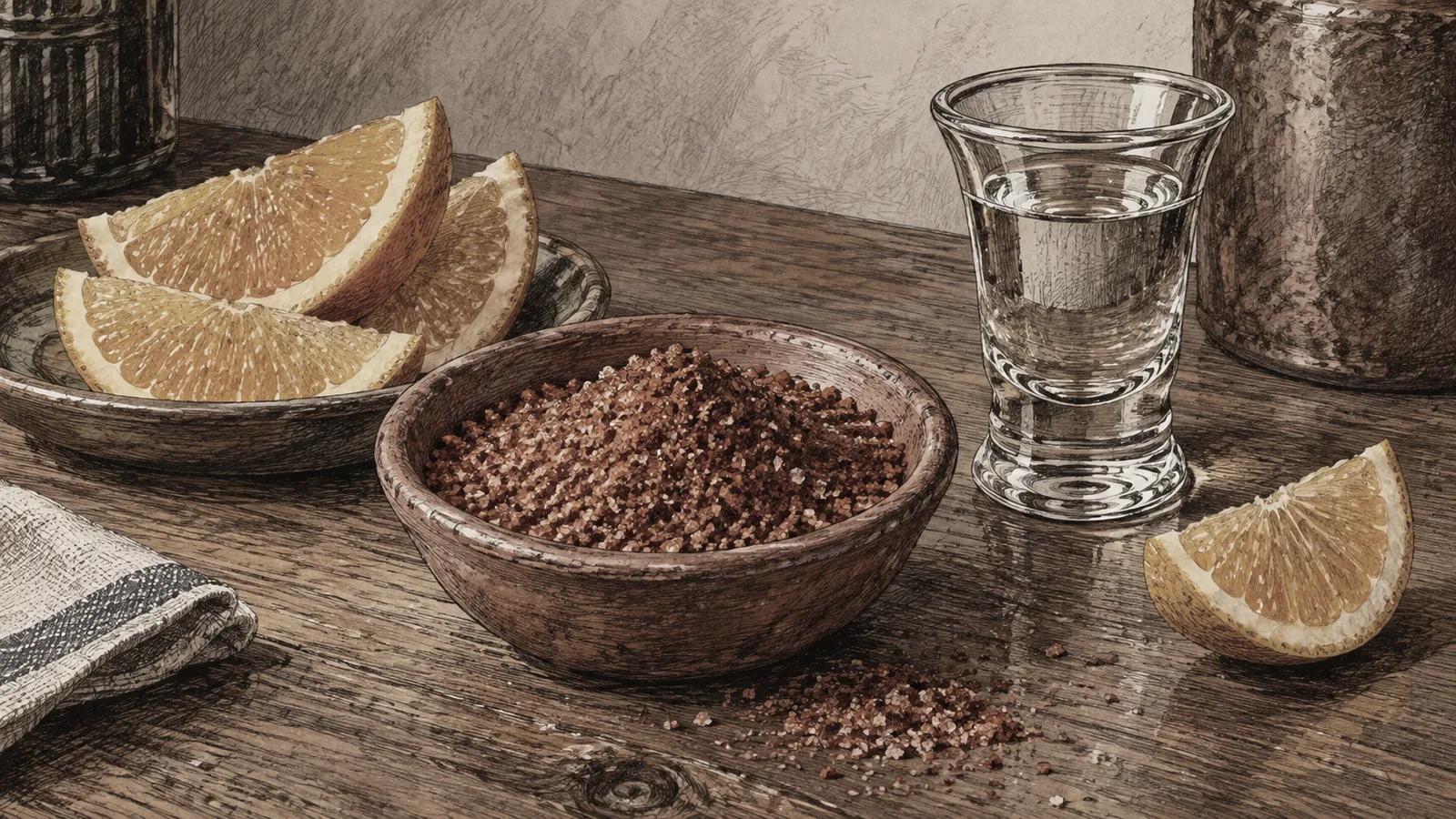
Sal de gusano is salt ground with dried chile and the toasted larvae of the red maguey worm. Larousse’s dictionary of Mexican gastronomy specifies the red worm, and a 2023 DNA study identified the red worm as the caterpillar of one moth, Comadia redtenbacheri, known in Mexico as the chinicuil. It is not the white maguey worm, which is a different insect in a different family. In the United States its legal position is unsettled rather than forbidden: the FDA has written no insect-specific rule for insects eaten on purpose.
What is in sal de gusano?
Three things: salt, chile and worm. Larousse Cocina’s online dictionary of Mexican gastronomy defines it as a mixture of salt with the powder of the toasted red maguey worm. Its method is short. The worm is mixed with salt, toasted on a comal and ground. Only “in some cases” does it contain a little ground dried chile.
Commercial versions invert that order of importance. Every product we could find lists chile as a standard ingredient, and the chile does most of the visible work. One retailer’s listing, for Worm Up, describes a “reddish-brown hue from chile and toasted larvae,” with visible flecks of both. No maker we found publishes a ratio of salt to larvae to chile. The survey of salt blends gives the tradition a paragraph. This page is about the insect, the label and the border.
Which worm? “Maguey worm” is more than one insect
The phrase covers at least two animals and sometimes a third. That is the source of most of the confusion in English-language writing, and the confusion is reasonable: all of them are pale grubs that live on agave, and all of them are eaten.
| Common names | Scientific name | Family | What it is | In sal de gusano? |
|---|---|---|---|---|
| Red maguey worm, gusano rojo, chinicuil | Comadia redtenbacheri | Cossidae (carpenter and goat moths) | Moth caterpillar that bores into the base and roots of the plant | Yes — the dictionary definition specifies the red worm |
| White maguey worm, gusano blanco, meocuil | Aegiale hesperiaris, the tequila giant skipper | Hesperiidae (skippers) | Butterfly caterpillar that feeds in the leaves | Not in any definition we found |
| Agave snout weevil | Scyphophorus acupunctatus | Curculionidae (weevils) | Beetle larva, also proposed as the “white worm” | No |
The table follows a 2023 paper in PeerJ by Akito Kawahara and colleagues at the Florida Museum of Natural History. The paper attributes red worms to Comadia redtenbacheri. It attributes white worms to either the skipper or the weevil, and it states plainly that before their work there was “still no consensus” on which insect was in modern mezcal bottles.
So they tested it. The team took 21 larvae from commercial mezcal bottles bought between 2018 and 2022. Eighteen yielded DNA sequences; the other three were identified by their anatomy. All of them were Comadia redtenbacheri, including worms that looked white. The paper’s explanation is that red worms lose their colour in alcohol and turn yellowish-white or white. The pale worm in your bottle is very probably a bleached red one.
Two further sources of confusion are worth naming. Spanish Wikipedia lists “Comadia redtenbacheri and Xyleutes redtenbacheri” as if they were two species. The second appears to be an older genus placement for the same moth; iNaturalist files that name under the same taxon. And one retail listing for a sal de gusano, EntoVida’s, says its red worms are larvae of the moth Hypopta agavis. The 2023 study does not use that name. It may be an older name for the same insect; we could not confirm its current standing, so we note it rather than correct it.
Read that carefully. The DNA study tested worms from bottles, not worms ground into salt. Nobody, as far as we could find, has sequenced sal de gusano. Our identification rests on two sources together. The dictionary says the salt uses the red worm. The genetics say the red worm is Comadia redtenbacheri. That is a strong inference. It is not a measurement.
How the worm is harvested
The chinicuil is wild-harvested. According to the PeerJ paper, collectors called gusaneros take the larvae by hand between May and September, using hooks or agave spines. The authors note the insect “may be locally threatened due to overcollection and habitat loss.”
The plant pays too. A study in Botanical Sciences by García-Montes, Octavio-Aguilar and Sánchez-González, published online in December 2024 and in the journal’s 2025 volume, looked at eight populations of ixtle maguey, Agave applanata: three without extraction and five with. To get the larvae out, the authors write, “the individual must be sacrificed.” Populations without extraction had the highest growth rates, and extraction “decreases the populations of this species by up to 57 %”. The juveniles collectors prefer are the plants that produce the most offshoots.
That 57 per cent needs its qualification. It is a comparison of population growth against unharvested sites, not a count of plants destroyed, and it is a maximum, not an average. It is also one agave species, studied where chinicuil is taken in Hidalgo, not the espadín most mezcal is made from. The PeerJ authors state more generally that when the moth is harvested, the agave dies. One maker tells it differently. The founder of Gran Mitla told the website Mezcalistas in 2013 that his worms come from espadín plants taken out of the earth so their roots can be cleaned, and that the agave “is taken back to its place without any harm.” We cannot test either account for sal de gusano in particular, and we are not going to pick one.
How sal de gusano is used
Larousse Cocina describes the Oaxacan custom: small sips of mezcal alternate with pinches of the salt, sometimes with lime. Outside Oaxaca, and on most American bar menus, it arrives with orange slices. That pairing is widespread, but we could not find an authoritative source that dates it, so we will not claim it as the older form. The salt is also used as a rim and on fruit.
For a salt company, the interesting point is how little the salt matters here. It is ground fine, it disappears under chile and roasted larvae, and its job is to carry and to preserve. Grain size matters more than origin. Fine salt clings to a cut orange in a way coarse salt does not.
What commercial versions actually contain
We looked for current ingredient statements from the makers themselves. The evidence is thinner than the category’s popularity would suggest.
| Product | Ingredients as published | Worm named | Where the wording comes from |
|---|---|---|---|
| Gran Mitla Sal de Gusano | “Adult agave worms … toasted and ground with hand-harvested Oaxacan sea salt and dried Oaxacan chilies” | Chinicuil (“100% Chinicuil” in the product name) | Maker’s US site; an “Ingredients” line written as a sentence, not a formatted panel |
| EntoVida Sal de Gusano Rojo | “Sea Salt, Chinicuil, Chile, and Calcium Carbonate” | Hypopta agavis | Retailer listing (Edible Insects) |
| Worm Up Sal de Gusano | “Roasted chinicuil (agave worms), Oaxacan sea salt, dried pasilla chiles” | Chinicuil | Retailer listing (Wine Dispensary) |
Three things stand out. First, only one of the three lists an additive, calcium carbonate, which is a flow agent and carrier. Second, the worm’s position varies from first to second. On a regulated panel that order would mean weight, but retailer copy is not a panel, so we would not read the order as a formula. Third, the salt’s origin moves. Gran Mitla’s site now says “hand-harvested Oaxacan sea salt.” The same company’s founder told Mezcalistas in 2013 that it used organic sea salt from Colima, with the costeño chile of Oaxaca. Either the sourcing changed or one of the descriptions is loose. We cannot tell which, and that is a common problem with blends. “Organic” on salt, incidentally, means less than it appears to.
Gran Mitla’s product page also says its worms are “adult agave worms.” An adult Comadia is a moth. The 2013 interview makes the meaning clear: fully grown larvae, at least a year old. The wording is careless, not deceptive, but it is exactly the kind of sentence to check before repeating.
Can sal de gusano be imported into the US?
This is the question with the least settled answer, and we will not pretend otherwise.
- There is no insect-specific rule. US law defines food as “articles used for food or drink for man”, which on its face covers an insect eaten on purpose. But Marie Boyd’s 2017 survey in the Yale Law & Policy Review describes the FDA’s regulation of insects as food as “largely characterized by inaction”, and argues the agency has yet to say plainly that such insects are food.
- Ordinary import rules apply. Under the Bioterrorism Act provisions in force since 12 December 2003, facilities that make food for US consumption must register with the FDA, and imported shipments need prior notice.
- Wild harvest is the awkward part. The same survey reports that, in a 2015 FDA presentation, the agency “appears to have rejected” the sale of wild-collected insects for human food, citing concerns about disease and pesticides. The chinicuil is collected in the wild.
- Allergen labelling is not triggered. Insects are not among the nine major food allergens in US law, so the worm does not require an allergen statement. We found none on the Gran Mitla or Worm Up pages; the EntoVida listing has an allergy tab whose content we could not read. The product is not vegetarian.
Put together, that is a gap, not a ban. Sal de gusano is openly sold by American retailers, which proves it is available. It does not prove that the FDA has ruled on it. We are not lawyers, and nothing here is advice on importing it. The honest summary is that sal de gusano is openly sold, not specifically authorised. That distinction matters less to a cook than to anyone planning to bring it in by the case.
For a buyer, three questions do most of the work. Who is the named US importer? Is there a full English ingredient panel with the worm named? And does the maker say where its salt comes from? The limits of a supplier certificate apply here as much as to plain salt.
A caveat on our own sourcing: the identification of the worm in sal de gusano rests on a culinary definition plus a DNA study of mezcal bottles, not on any test of the salt itself. Two of the three ingredient statements above come from retailers rather than makers, and the maker that does publish one gives descriptive copy rather than a formal panel. We do not make or sell sal de gusano.
Sources
- Kawahara et al. (2023), Mezcal worm in a bottle: DNA evidence suggests a single moth species, PeerJ
- Larousse Cocina — sal de gusano
- García-Montes et al. (2025), The impact of chinicuil extraction on ixtle maguey populations, Botanical Sciences
- Gran Mitla U.S. — Sal de Gusano product page
- Mezcalistas (2013) — Gran Mitla brings artisanal sal de gusano to the market
- Edible Insects — EntoVida Sal de Gusano Rojo, retailer listing
- Wine Dispensary — Worm Up Sal de Gusano, retailer listing
- Boyd (2017), Cricket Soup: A Critical Examination of the Regulation of Insects as Food, Yale Law & Policy Review
Read next
- Salt Blends Around the World — the survey this page goes deeper on
- Who Actually Makes Your Sea Salt — when the salt in a blend is bought in
- Is Organic Salt a Real Thing — what the word can and cannot mean on salt
- Patagonian Sea Salt — the category, in full
The Salt Guide
We are recording the salts on the American shelf one jar at a time — label, panel, price paid, crystal on white. Browse the guide →