
Organic Sea Salt Is Not What You Think
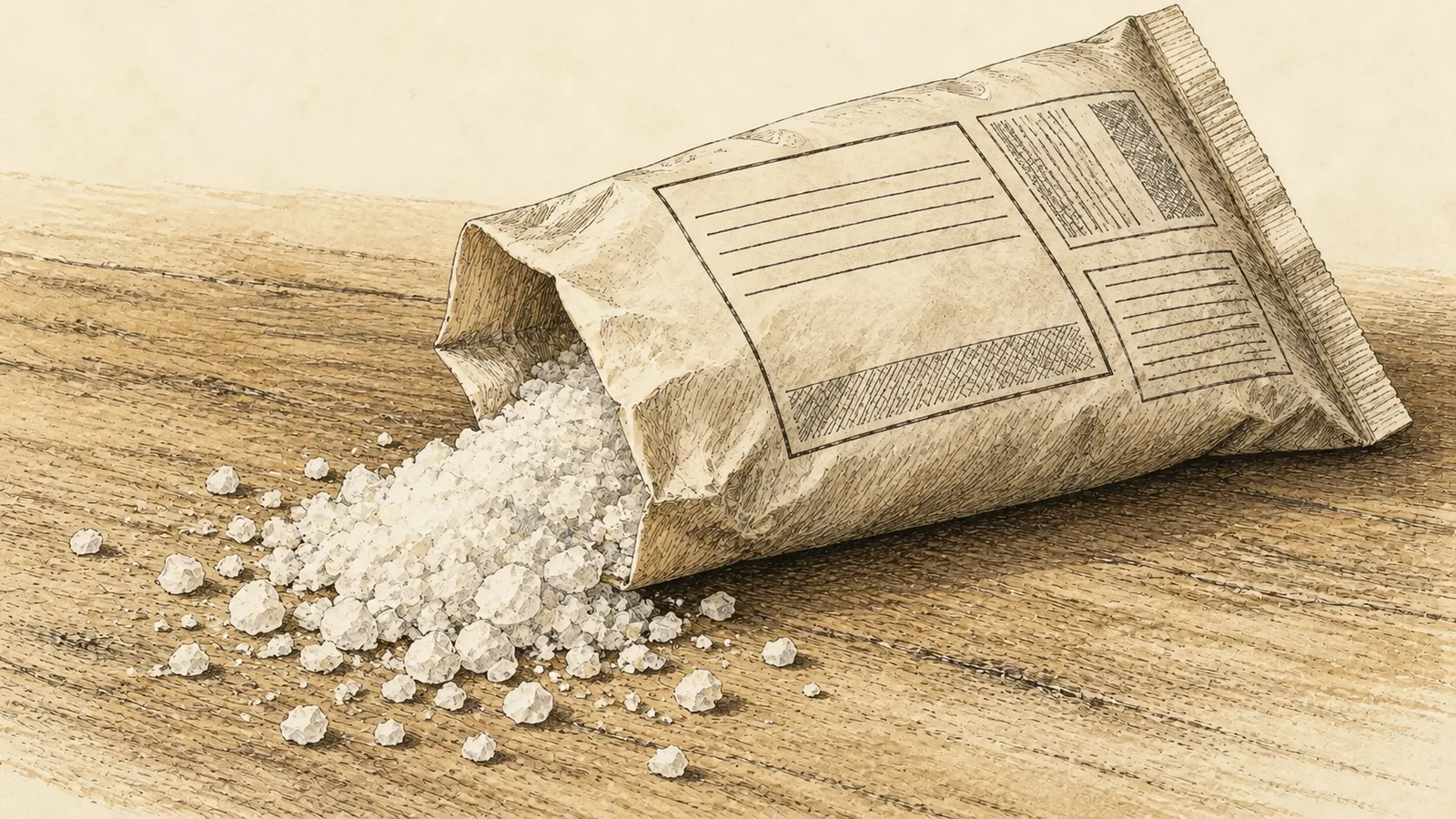
In the United States, salt cannot be certified organic. USDA guidance states it in one sentence: salt is a mineral, not a product of agriculture, and therefore cannot be certified organic. It is not listed among the allowed nonagricultural substances at 7 CFR 205.605, and it is excluded outright from the organic percentage calculation at 7 CFR 205.301. A jar labelled “organic” that contains salt is telling you about the other ingredients. Europe went a different way, and that is where the story gets interesting.
What the USDA actually says
The Agricultural Marketing Service publishes a short guidance note on salt and preservatives in organic food. It is not ambiguous. Salt is a mineral rather than a crop, so there is no farm, no soil, no three-year transition period and nothing for a certifier to inspect in the way the National Organic Program inspects a carrot.
The same note goes on to the practical consequence, and it is the sentence a shopper should carry around: something could be labeled an organic salt, but that would mean that there were other ingredients in the product that were certified organic, and not the salt itself.
Salt used in a certified organic product still has to be declared. It goes on the ingredient list and into the organic system plan. What it does not do is count toward the organic percentage, and it does not get to wear the seal on its own account.
Where salt actually sits in the rulebook
This is the part that is routinely got wrong, including in our own first draft of this article, so it is worth being exact.
The National List at 7 CFR 205.605 sets out the nonagricultural substances that may be used in food labelled organic. Paragraph (a) covers nonsynthetics. Read it: agar-agar, bentonite, calcium carbonate, calcium chloride, carrageenan, kaolin, magnesium chloride, potassium chloride, potassium iodide, sodium bicarbonate, sodium carbonate, yeast. Sodium chloride is not on it. Neither is salt, under that name or any other.
So salt is not an approved nonagricultural ingredient. It is handled a rung further back. Each of the three labelling categories at 7 CFR 205.301 — 100 per cent organic, organic, and made with organic ingredients — computes its percentage “by weight or fluid volume, excluding water and salt.” Salt is carved out of the arithmetic entirely, alongside water. It is not permitted; it is not in the equation.
That distinction matters because it explains why there is no route to a certificate. A certifier cannot certify salt organic, cannot refuse to certify it, and has nothing to audit. There is no USDA-accredited organic salt certification in the United States because there is no scheme for one to exist under.
So why does the shelf say organic?
Because most of the products saying it are not salt. They are seasonings that contain salt, and the certification attaches to something else in the jar.
| What the label says | What is actually certified | What it tells you about the salt |
|---|---|---|
| Organic garlic salt | The garlic | Nothing |
| Organic herb or smoked seasoning blend | The herbs, and sometimes the smoking fuel | Nothing |
| USDA organic seal on a food containing salt | The agricultural ingredients, salt excluded from the count | Nothing |
| Organic-certified facility | The handling operation and its plan | That the plant can handle organic goods |
| BRCGS, IFS, SQF, Kosher, Halal | A named site, a named product list, a date range | Food safety or ritual status, not origin |
| “Natural” | Nothing. There is no FDA definition | Nothing |
Certification of the facility is the one that fools people most often, and the Portuguese producer Necton is the neatest example of the confusion rather than of clarity. Its quality page says the company’s integrated system meets the requirements of the Halal, Kosher, organic and BRCGS certifications, which is a sentence about a handling operation. Its salt page, however, is titled Organic Atlantic Sea Salt, and the quality page carries a Portuguese organic mark and the logo of Kiwa Sativa, a certification body. So the word is attached to the product, not only to the plant. Whether that reflects a certificate covering the salt itself — which a member state may issue in the gap the EU left — or a facility certificate presented product-side, we cannot tell, because no certificate number, scheme or scope is published on either page. That is European organic salt in one company: inside the regulation, unregulated at EU level, and marked anyway.
The same logic applies to smoked and blended salts generally, which we have picked apart before in our breakdown of how much of a seasoning salt is actually salt. If the herbs are ten per cent of the jar and certified, the jar can carry a claim. The other ninety per cent cannot.
Europe took the opposite turn, then reversed into a hedge
This is where the American picture stops being the whole picture, and where any article that says flatly “organic salt does not exist” overstates its case.
When Regulation (EU) 2018/848 came into application on 1 January 2022, the scope of organic production and labelling was widened to include sea salt and other salts for food and feed. The European Union deliberately did what the United States has not: it brought a mineral inside the organic tent.
Having done so, the Commission had to write production rules. Its delegated regulation of 2 May 2023 proposed a set: salt to come only from the sea, rock deposits, natural brine or salt lakes; no mining with explosives; no evaporation or drying on non-renewable energy after a two-year grace period; no additives except iodine; and, most pointedly, a ban on recrystallisation — dissolving salt and growing it again — on the reasoning that organic salt should correspond to the true nature of the product.
The European Parliament threw it out. On 11 July 2023 it adopted an objection by 468 votes to 151 with 17 abstentions, arguing among other things that salt is not an agricultural product, that the mining restrictions were disproportionate, and that the purity requirements — given microplastic levels in seawater — were stricter than those applied to organic farm produce. The delegated act never entered into force.
So the European position today is a hedge: salt is inside the scope of the organic regulation, and there are no EU-wide production rules for it. Member states have filled the gap themselves. France homologated a national specification for organic salt production by an arrêté of 15 July 2024, complementing Regulation (EU) 2018/848 — and two things about that record need stating. The official journal also carries an arrêté of 24 June 2024 under an identical title, and we could not establish what the later one did to it. And the INAO document that circulates as the text is a draft: it is headed homologué par l’arrêté interministériel du XXX, date left as a placeholder, and its salt provisions are marked as under national opposition procedure. What is reliably reported of the homologated text is a ban on extracting rock salt with explosives, on recrystallisation, and on additives and processing aids. The fuller list we first printed — flotation, density separation, plastic liners, drying on non-renewable energy — comes from that draft, and we say so.
Britain is split down the middle by the same question. The UK government’s own explanatory memorandum on the EU proposal notes that Great Britain’s organic regulations exclude salt, because salt is a mineral rather than food or feed, while businesses in Northern Ireland — still inside the EU rules under the Windsor Framework — may produce and market salt as organic. The same island, two answers, decided by a trade border rather than by chemistry.
What “natural” is doing on the packet
Very little. The FDA has never engaged in rulemaking to define natural for food. Its longstanding policy is only that nothing artificial or synthetic has been added, and the agency says explicitly that this policy was not written to address production methods, processing methods, or any nutritional question.
Which means that on a bag of salt the word is close to content-free. Almost all salt is nothing but salt. A vacuum-refined, dissolved and recrystallised salt from a factory can carry the word as comfortably as a hand-raked one, and frequently does. A word that cannot be failed is a word that cannot be relied on. We treat it the same way we treat an unnamed sea on a label, which is the subject of a separate piece on who actually makes your salt.
What to read on the label instead
- The named water body or deposit, and the country.
- The ingredient list — salt, and what else. Anticaking agents and iodine are declared.
- Whether the producer is named, or only a brand.
- Whether the salt was washed, refined or recrystallised, which changes taste and texture more than anything a certificate covers.
- A composition figure with a stated basis, and whether it is a producer analysis or a regulatory minimum. The difference is most of the argument, as the Maldon numbers show.
None of those is an organic claim, and none is a health claim. Iodine is a separate question with a real public-health history behind it, handled in our piece on iodised salt.
What we will not print
We will not print the word organic on a salt. Under the rules that govern us in our home market, it would be meaningless; under the European rules it would be true only if we entered a scheme we are not in, met a specification we have not been audited against, and sold into a jurisdiction that recognises it.
Our blends do contain agricultural ingredients — herbs, garlic, chilli — and those could in principle be certified organic one day. If they ever are, we will say which ingredient carries the certificate and what fraction of the jar it represents. That is a deliberate design choice and a defensible one. It is not an accident and it is not a shortcoming.
One caveat on our own position. We are pre-launch and hold no certification of any kind: not organic, not BRCGS, not Kosher, not Halal. The Necton certification detail above comes from the company’s own published material, not from a certificate we have inspected, and certificate scope and expiry should always be checked against the issuing body rather than a logo on a website. We are pursuing FDA facility registration and will not put a date on it.
Sources
- USDA Agricultural Marketing Service — salt and preservatives in organic food
- eCFR — 7 CFR 205.605, nonagricultural substances allowed
- eCFR — 7 CFR 205.301, excluding water and salt
- FDA — use of the term natural on food labeling
- EUR-Lex — Commission delegated regulation of 2 May 2023 on production rules for organic salt
- European Parliament — objection to the organic salt delegated act, 11 July 2023
- UK Government — explanatory memorandum on organic salts
- Légifrance — arrêté du 15 juillet 2024, organic salt specification
- INAO — draft French specification, salt under opposition procedure
- Necton — Organic Atlantic Sea Salt product page
Read next
- Is Iodized Salt Necessary — the one additive with a real history
- What Is Actually in Maldon — reading a company from its own paperwork
- How Much of a Chimichurri Salt Is Salt — where the agricultural ingredients actually are
- Patagonian Sea Salt — what we claim, and what we do not
The Salt Guide
We are recording the salts on the American shelf one jar at a time — label, panel, price paid, crystal on white. Browse the guide →