
Who Actually Makes Your Sea Salt
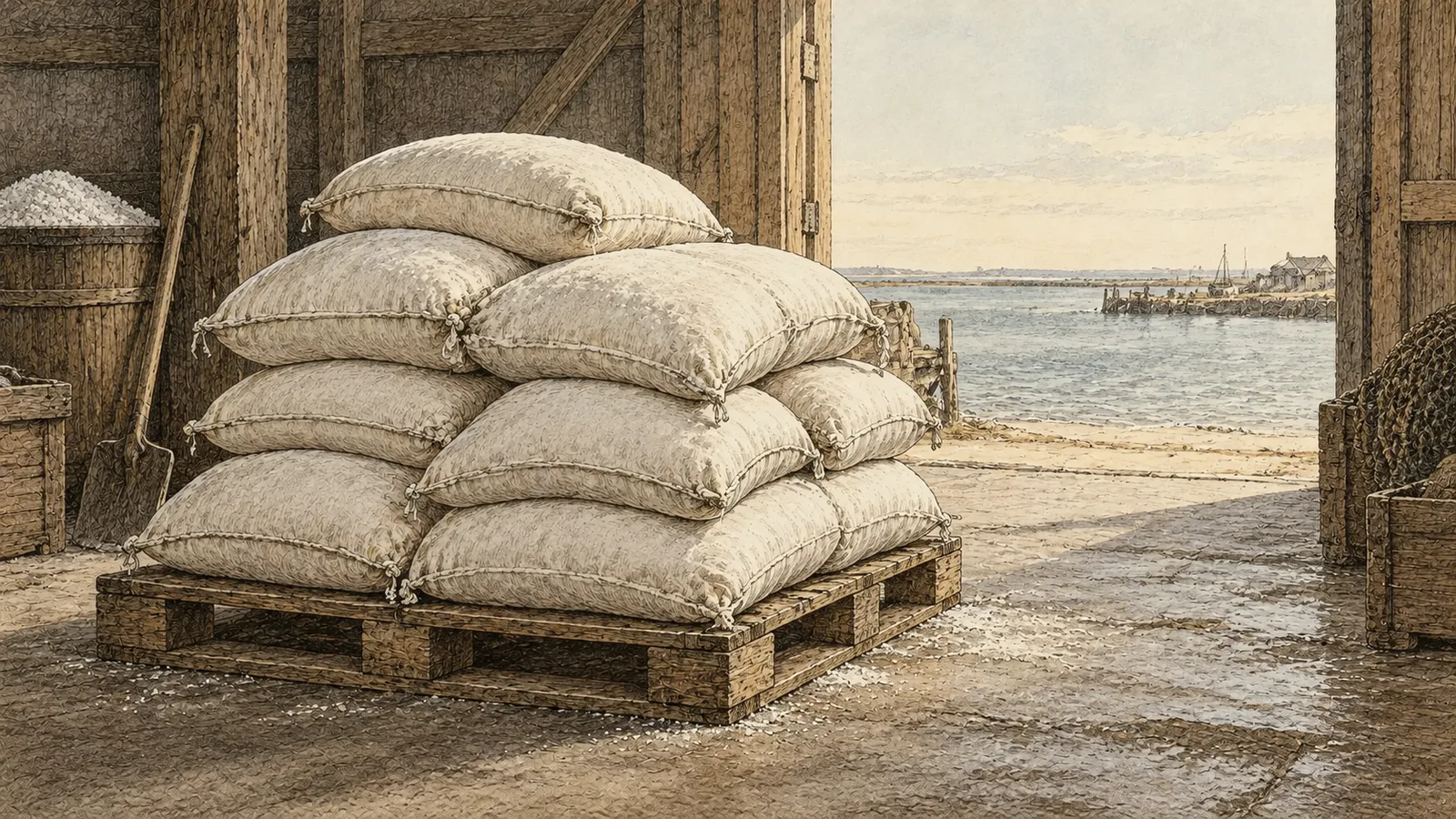
A sea salt brand and the place the salt was actually made are frequently two different facts. Falksalt is marketed from Sweden, and its own product data sheet gives the country of manufacture as Cyprus. Jacobsen makes flake and kosher salt in Oregon and states plainly that its fine sea salt is harvested by partners in Trapani, Sicily. Neither of those is a scandal. Both are disclosure, and disclosure is the only thing that reliably separates a legitimate brand from a company hoping you will not ask.
A salt company can be five different things
The word on the front of the packet is almost always a brand. Behind it sits one of five arrangements, and they are not interchangeable.
| Class | What it controls | The question that settles it | Worked example |
|---|---|---|---|
| Producer | The ponds or pans, and the harvest | Who owns the crystallisers? | Maldon, Halen Môn |
| Integrated producer | Harvest plus washing, milling, refining and packing | Which site produced this exact lot? | Groupe Salins, Salinor |
| Hybrid | Makes some formats, buys others | Which formats are local? | Jacobsen |
| Brand or packer | The label, the specification, the route to market | Is the producing saltwork named? | Falksalt, Celtic Sea Salt |
| Collective tradition | A place and a method shared by many makers | Which registered producer made the lot? | Guérande, Trapani |
None of these classes is better than another. A brand that buys well and specifies tightly can put a better salt in your kitchen than a producer who owns ponds and runs them badly. The classification is an evidence judgment, not a quality judgment. It tells you what you are able to check.
The honest ones say so on their own websites
SaltWorks, the Washington company behind the Artisan Salt brand, describes itself openly as a sourcing and processing business. It selects suppliers, inspects crystals, blends, cold-smokes and packs, and it holds several million pounds of stock in a climate-controlled warehouse. It does not claim to own a saltern anywhere, and it does not need to. Everything it says about itself is consistent with what it is.
Celtic Sea Salt, sold in the United States by Selina Naturally, is the same shape of business with a more romantic name. Its own FAQ says the salts are hand-harvested by partner producers, names an underground brine spring in Villena, Spain, for one line and Catalonia for another, and describes a testing regime: local suppliers test every lot at source, the company reviews specifications before packing, and third-party laboratories check heavy metals and microbiology. That is a brand describing a supply chain rather than a farm. It is also more information than most producers publish.
The useful thing about both disclosures is that they let a buyer match a claim to a chain of custody. Once a company tells you it sources, you can ask the next question. Once it does not, you cannot.
Falksalt: Sweden on the tub, Cyprus on the data sheet
Falksalt sea salt flakes are packed and marketed by Salinity AB, whose Gothenburg address sits at the foot of the product data sheet. The brand’s own site says the salt is brought home “to refine and pack it in our salt production facilities on the west coast of Sweden”.
The product data sheet is more specific. Under country of manufacture it says Cyprus. Under raw material origin it says the Mediterranean. It gives sodium chloride at 98.71 per cent, lists an anticaking agent among the additives, and cites ISO 9001, ISO 14001, HACCP and BRC. The version we read is dated May 2020, which is worth saying out loud: it is a company document, not an independent analysis, and it is six years old.
Nothing on that sheet is hidden. It is simply that the sheet and the tub are read by different people. The buyer reads the sheet. The cook reads the tub.
Morton, McCormick and the sea with no name
Morton’s retail pages for fine and coarse sea salt say only that the salt was created by sea water evaporated by the sun. Neither page names a sea, a country or a saltworks. Both, though, carry a link inviting you to read where the sea salt comes from, and that page names two places: a Grantsville, Utah plant that harvests from the Great Salt Lake, and what it calls an affiliated Inagua, Bahamas facility harvesting ocean water since 1954. The origin is published. It is simply one click off the product page, and one of the two sources is an inland lake. McCormick’s foodservice fine grind is titled Mediterranean Style Sea Salt; the word style is doing work in a title, although the description does say the product contains salt from the Mediterranean Sea. No country, no saltworks, no producer.
Morton’s corporate situation is a good illustration of why a brand page can be true and stale at the same time. In April 2021 the United States Department of Justice cleared Stone Canyon Industry Holdings to acquire Morton Salt only on condition that it divest US Salt, including the Watkins Glen refinery, because the combination would otherwise have reduced competition in round-can table salt and other evaporated salt markets. Then in 2026 the Bahamian side moved. Lusca Group announced on 7 May 2026 that it had received final approvals to acquire Morton Bahamas Limited, which operates the Great Inagua works, with closing set for 1 June 2026; on closing the company was to be renamed Lusca Salt Bahamas Limited and its products marketed under the Bahamas Salt brand, against up to US$125 million of committed investment. We have found no published confirmation that the closing completed, so we report it as scheduled rather than done. Morton’s own sourcing page, meanwhile, still describes Inagua as an affiliated facility.
That is the ordinary condition of this industry. Ownership moves faster than websites. A brand is a durable object; the works behind it is not.
The hybrids are the most instructive
Jacobsen Salt Co. is the clearest case in North America. Its FAQ separates the lines without being asked: the Pure Flake and Pure Kosher salts are harvested from Netarts Bay on the Oregon coast, and the Pure Italian Fine Sea Salt is harvested by named partners in the open-air ponds of Trapani. The company even publishes a page about Trapani. A reader who wants Oregon salt can buy Oregon salt, and a reader who wants an everyday fine salt is told exactly where it came from.
That single act of separation is what makes everything else Jacobsen says credible. If it were prepared to blur the fine salt, you would have to wonder about the flake.
Cornish Sea Salt is the case where we have to correct ourselves. Our working notes described it as a hybrid using Cornish seawater plus sea-derived inputs sourced from elsewhere. We could not stand that up. The company’s own pages say the salt is hand-harvested from Grade A waters off the Cornish coast and is 100 per cent natural with no additives. Its reduced-sodium TekSalt is described as natural sea salt crystals enriched with a brine from the company itself, drawn from the same Cornish waters — so the brine, at least, is stated to be local; the crystals it laminates are described only as natural sea salt. We have found no current company statement of non-Cornish inputs, and we are not going to imply one. What the company does claim, on its own pages, is that the local geology reduces the sodium content and delivers more flavour with less salt. That is a company claim about flavour, not an independent measurement, and we report it as the former.
What it looks like when nobody checks
In 2017 Food Standards Scotland investigated Hebridean Sea Salt and stated that over 80 per cent of the salt in the product did not originate in the Hebrides but was imported table salt. The agency was explicit that this was not a food safety issue, and equally explicit that deception of consumers on that scale was unacceptable and damaging to Scotland’s reputation for authentic food. The company was later wound up.
We raise it not because the industry is crooked — the overwhelming majority of it is not — but because it is the only well-documented case of the failure mode this whole article is about, and it took a regulator with laboratory access to find it. A shopper could not have. Which is the argument for buying from people who volunteer the information before anyone asks.
Five questions that settle it
- Which water body, named, and which country?
- Who operates the crystallisers — the brand, or a partner?
- Is every format in the range from that same source, or only some?
- Where does milling, smoking, blending and packing happen?
- Can a lot code be traced back to a pond, a harvest and a pack date?
A company that can answer all five in writing is a company you can hold to something. A company that answers three and deflects on two has told you which two matter.
Where that leaves us
Ours is Argentine sea salt from the Atlantic coast of Chubut, made by a small producer using a low-temperature process, as the producer publishes it. We did not build the works and we do not operate it. By the taxonomy above we are a brand, buying from a producer, and we would rather write that down than let the photographs imply otherwise. The category itself now has a compositional standard behind it, which we have written about separately, and the wider geography of who makes salt and where is covered in our survey of the producing coasts. If you want the same reading applied to the most famous finishing salt on the shelf, that is the Maldon piece.
The reason to care about any of this is narrow and practical. “Sea salt” describes a body of water. It does not describe a company, a method, a country or a crystal. Everything you actually taste was decided after the water was collected, by someone whose name may or may not be on the packet.
Our own disclosure gap, stated plainly: we do not publish the name of the producer we buy from, for commercial reasons. That is exactly the omission this article treats as a weakness elsewhere, and a reader is entitled to weigh it the same way. What we can give is the coast, the country, the process as the producer describes it, and the composition figures from the producer data sheet — which are producer figures, not independent analyses. We are also pre-launch and hold no third-party food-safety certification of our own yet.
Sources
- SaltWorks — about us, sourcing and processing model
- Celtic Sea Salt — FAQ on origins, partner producers and lot testing
- Falksalt — Sea Salt Flakes product data sheet, version 1.0, May 2020
- Jacobsen Salt Co — FAQ distinguishing Oregon salt from Italian fine sea salt
- Cornish Sea Salt Company — Cornish sea salt, origin and range
- Cornish Sea Salt Company — TekSalt, crystals enriched with its own brine
- Morton Salt — sea salt sourcing and production, Great Salt Lake and Inagua
- McCormick Culinary — Fine Grind Mediterranean Style Sea Salt
- Falksalt — brand site, refining and packing on the west coast of Sweden
- US Department of Justice — Stone Canyon required to divest US Salt to acquire Morton Salt, April 2021
- Eye Witness News — Lusca unveils Inagua investment after Morton acquisition approval
- Food Standards Scotland — statement regarding Hebridean Sea Salt
Read next
- What Is Actually in Maldon — the same reading, applied to one company
- Where Salt Is Made — the producing coasts, by region
- What Is Patagonian Sea Salt — the category, and our place in it
- Patagonian Sea Salt — what we buy and from where
The Salt Guide
We are recording the salts on the American shelf one jar at a time — label, panel, price paid, crystal on white. Browse the guide →