
Where Salt Is Made: 25 Saltworks You Can Visit or Watch
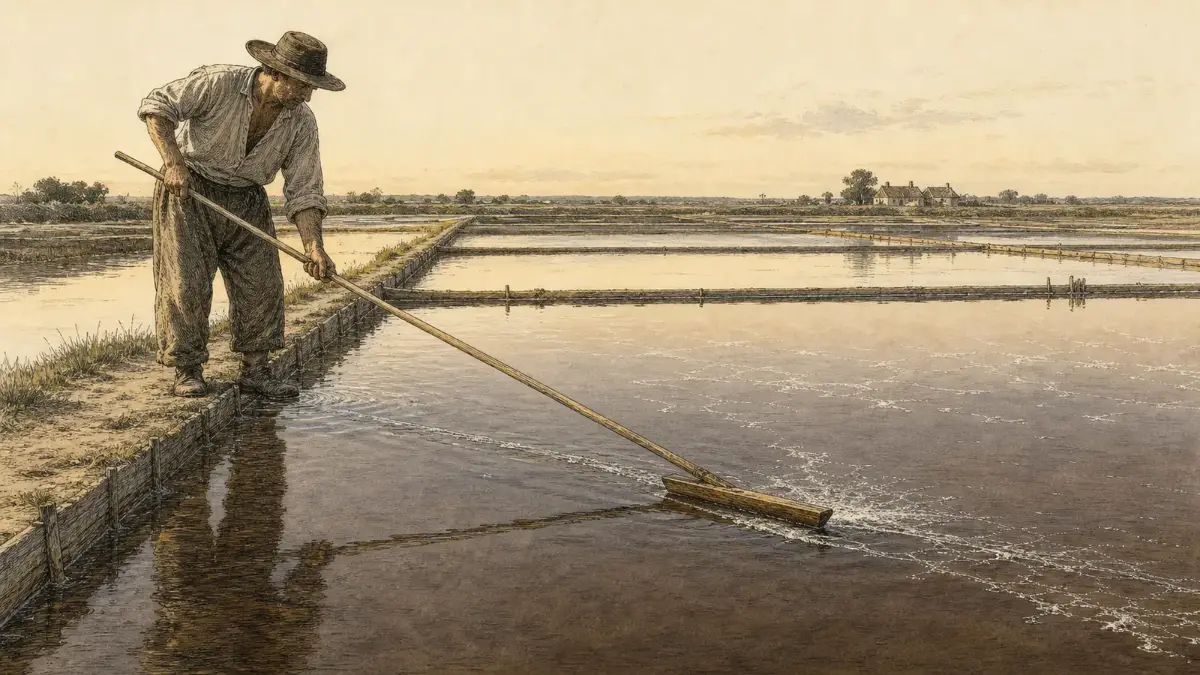
Salt is one of the few foods you can still watch being made from beginning to end, outdoors, by people who will explain it. Twenty-five saltworks that let you in — or, where they do not, show you properly on film — sorted by where you are, with what you will actually see.
Read how sea salt is made first and the ponds start to make sense: the colours run down the brine ladder from grey-green at the intake to pink in the middle, where the algae that tolerate strong brine bloom, to white in the crystallisers. Then watch for the three things every works has — the intake, the concentrating ponds or tower, and the pan or crystalliser where the salt finally grows — and for the one thing that separates a working saltworks from a museum, which is a harvest date.
Links go to the farm, tour or method pages and to films of the process, never to a shop. Hours, prices and seasons change; confirm before you travel. Harvest is July to September in the northern hemisphere and December to March in the south.
The Americas
Kona Sea Salt, Keahole Point, Hawai‘i. Seven acres of long solar tunnels fed by seawater pumped from 2,200 feet down; a four-week cycle from sea to crystal. Daily paid farm tours with a tasting. Farm tours · Video
Hanapēpē salt ponds, Kaua‘i, Hawai‘i. Family wells, tanks and clay beds worked every summer for centuries; the salt is shared and never sold. Not open to visitors — watch the film. PBS Family Ingredients · History
San Juan Island Sea Salt, Friday Harbor, Washington. Fourteen hoop houses, each a 1,500-gallon pond — “a greenhouse with an inside ocean” — and no heaters or fans. No farm tours; the virtual tour is three short films. Virtual farm tour · Our process
Cargill, San Francisco Bay, California. The pink and green ponds you see from the plane: a three-to-five-year brine cycle and a September–December harvest. No tours; the company page and a news film. Sea salt harvesting · ABC10
J.Q. Dickinson Salt-Works, Malden, West Virginia. Not seawater but a 350-foot brine well from an ancient sea, concentrated in “sun houses” and finished in crystallising houses. The closest working salt tour to the Midwest. Paid tours and events. Tours · Method
Bulls Bay Saltworks, McClellanville, South Carolina. Two 84-foot greenhouses of shallow containers at staggered stages, with solar-powered fans pulling the humidity out. No tours; the FAQ explains the method and there is a television walk-through. FAQ · SCETV
Exportadora de Sal, Guerrero Negro, Baja California Sur. The largest solar saltworks in the world: 33,000 hectares of ponds, 260-tonne trucks and roughly eight million tonnes a year on a windy, foggy desert coast. Town operators run tours; aerial film. Report · Video
Salinas de Cáhuil, Pichilemu, Chile. Coloured pond chains worked by families with wooden shovels and ox-carts on the cold Pacific coast; flor de sal; harvest December to March. Roadside, and the salineros will talk. Photo story · Video
Salineras de Maras, Cusco, Peru. Some 4,500 stepped pans on a mountainside at 3,200 metres, fed by a single salt spring; three-day cycles worked by the community. Open to visitors. UNESCO tentative list · Drone film
Salinas del Gualicho, Río Negro, Argentina. Patagonia’s salt harvest as it actually happens: an inland salt lake below sea level where tractor cutters and harvesters lift 400,000 tonnes a summer, mostly for the chemical industry. Lake salt, not sea salt — but it is what the region’s wind and sun can do. No tours; the provincial film shows the harvest. Report · Video
Europe
Terre de Sel, Guérande, France. The home of fleur de sel: a visitor centre run by the paludiers themselves, with themed walks through the working marsh and the cooperative’s 225 members raking beside you in summer. Open year-round; book. Terre de Sel · The cooperative · Harvest film
Salin d’Aigues-Mortes, Camargue, France. A little train through pink ponds to the salt mountain, with flamingos and an exhibition hall. Open in season, about €14. Petit train · Drone film
Valle Salado de Añana, Álava, Basque Country. Inland, from a brine spring: terraced wooden pans stepping down a hillside, restored over the last two decades, with the best-designed salt visit in Iberia — tours, tastings and workshops. Open year-round, €8–13. Experiences · Official film
Sečovlje Salina Nature Park, Piran, Slovenia. Medieval-method pans where the salt grows on a cultivated mat of algae and minerals called petola; a two-kilometre route, a salt museum and webcams. Open daily. Visiting · Aerial film
Saline di Trapani e Paceco, Trapani, Sicily. A WWF reserve of working pans and stone windmills; the harvest is visible July to September. Free guided tours; book. Guided tours · The full cycle, on film
Ciechocinek graduation towers, Kujawy, Poland. Three thorn walls totalling 1.7 kilometres, sixteen metres high, still concentrating brine for a boiling house that has run for the better part of two centuries; a spa town grew up around the salty air. Open daily; salt-works museum Tuesday to Sunday; webcam. The towers · Museum · Drone film
Bad Rothenfelde, Lower Saxony, Germany. A 412-metre graduation wall with a working wind-driven brine pump on the roof; guides release the sails to show it turning. Tours Easter to October, €2. Die Windkunst · Aerial film
Blackthorn Salt, Ayr, Scotland. A newly built graduation tower: larch frame, packed blackthorn, seawater trickling from 54 wooden taps while the wind off the Firth of Clyde does the work. Tower tours by arrangement. Our method · Tower tours · Video
Halen Môn, Anglesey, Wales. The Saltcote visitor centre: a film, exhibits, viewing windows onto the pans and a tasting. Daily tours, about £10. Tide to table · Tour bookings
Saltverk, Reykjanes, Westfjords, Iceland. Arctic seawater evaporated with geothermal steam into flakes, at 66° north. Summer tours twice daily, no booking. Story · Video
Læsø Saltsyderi, Læsø, Denmark. Reconstructed medieval boiling huts: strong brine from shallow wells in the salt meadows, iron pans over open fires. Open with free hourly talks May to October. Læsø Salt · Video
Asia and the Pacific
Lake Grassmere, Marlborough, New Zealand. The southern hemisphere’s cold-coast solar works, at the latitude of northern Patagonia: seawater pumped into pink ponds between the White Bluffs and Cape Campbell, concentrated by the north-west wind, harvested at the end of summer. Roadside viewing on State Highway 1. Explainer · Film
Ako Salt Country, Akō, Hyōgo, Japan. Three centuries of Japanese salt fields restored side by side — sand-bed, tidal and bamboo-rack methods — including a flow-down rack you can work yourself. Open; hands-on. Ako Kaiyō Kagakukan · History
Jingzaijiao tile-paved salt fields, Tainan, Taiwan. Fields from 1818 with beds paved in a mosaic of broken roof tiles; visitors are handed a rake. Open. Official gallery · Drone film
Taepyeong Salt Farm, Jeungdo, Sinan, Korea. Korea’s largest solar salt farm, 4.6 square kilometres of pans with a salt museum and a harvest you can join. Open April to October. The farm · Aerial film
And Patagonia?
There is no solar saltworks on the Patagonian coast to visit today. The sea salt from Chubut is made indoors, at low heat, in small plants rather than visitor attractions, and the region’s big harvests happen on inland salt lakes like the Gualicho above. If you are driving south in summer, Salina de Piedras in Partido de Patagones, Buenos Aires province, turns pink and can be seen from the road; it is machine-harvested for about 45 days from late December.
Common questions
Late summer. In Europe and North America that means July to September, when the crystallisers are full and the piles are growing; solar works in the southern hemisphere harvest from December to March. Greenhouse makers and pan makers work most of the year and are less seasonal.
Yes. Kona Sea Salt in Hawai‘i runs daily farm tours, and J.Q. Dickinson in West Virginia opens its salt-works to visitors. Most of the small East Coast and Pacific Northwest makers do not take visitors, but several have published films of their greenhouses, which are linked above.
Because of what lives in strong brine. As the seawater concentrates, the ordinary sea life dies off and salt-loving microbes take over — a green alga called Dunaliella salina that turns red under stress, and pink archaea. The colour is a sign that the brine is near the top of the ladder, and it also darkens the water so that it absorbs more sun and evaporates faster.
Usually, but ask. Heritage works often sell a mix of their own hand harvest and salt from larger partners, and some places on this list — Hanapēpē above all — make salt that is never sold at all.
Sources
- Every entry links to the works’ own pages and to films of the process; all were opened and checked in September 2026.
- Korovessis & Lekkas, Solar saltworks production process evolution — the biology of the pond chain, including Dunaliella and the halophilic archaea
- Turismo Patagones — Salina de Piedras
- Diario Río Negro — the Gualicho harvest
Read next
The Salt Guide
We are recording the salts on the American shelf one jar at a time — label, panel, price paid, crystal on white. Browse the guide →