
How Sea Salt Is Made: Sun, Wind, Fire and the Brine Ladder
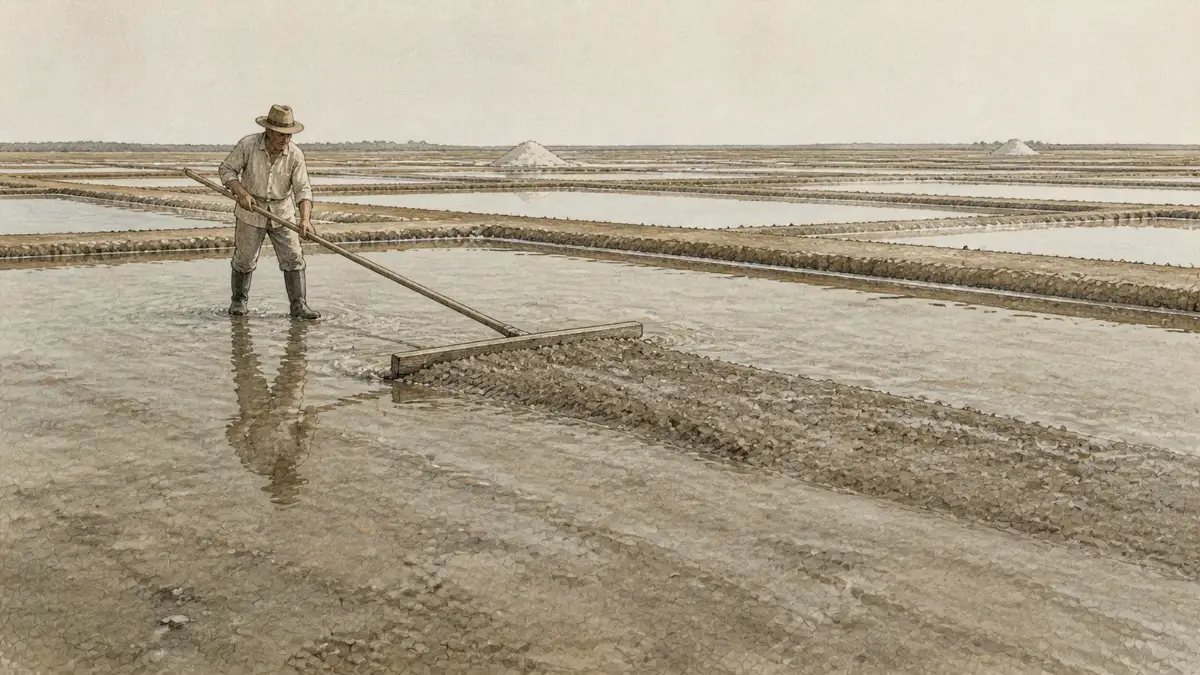
Every sea salt starts as seawater that is about 3.5% salt, and every method is a way of getting rid of the other 96.5%. Sun, wind, glass, fire or a vacuum — the choice decides the crystal, the cost, the season and most of what a label is allowed to say.
Seawater is not salt dissolved in water so much as a mixture of salts, and they do not all come out at once. As the water leaves, the brine gets denser and the dissolved minerals crystallise one after another, each at its own density. Salt makers have measured that density in degrees Baumé (°Bé) for two centuries, and the sequence is the same in a Breton marsh, a Hawaiian greenhouse and a Polish boiling house. Everything else — the rakes, the tunnels, the fires — is a way of climbing that ladder faster, cleaner or cheaper.
The brine ladder
Seawater sits at about 3.5 °Bé. Nothing useful happens until roughly nine-tenths of the water is gone.
| Density | What comes out | What the salt maker does |
|---|---|---|
| 3.5 °Bé | Nothing yet — this is the sea | Pump, settle, filter |
| from about 4.6 °Bé | Calcium carbonate (chalk) and iron | Keeps it in the first ponds, away from the salt |
| from about 13.2 °Bé | Gypsum (calcium sulfate) | Same — it coats the floor of the middle ponds |
| 25.7 °Bé | Sodium chloride begins to crystallise | Moves the brine into the crystallisers and harvests |
| 29–30 °Bé | Magnesium and potassium salts (the bittern) | Drains the pond before they spoil the salt |
The ladder is the reason unrefined sea salt is still 97–99% sodium chloride: the calcium comes out early and the magnesium comes out late, and the maker harvests in the window between. It is also the reason a coarse grey salt tastes different from a washed white one. Harvest late or skip the rinse and the salt keeps some of that magnesium-rich liquor; rinse it in clean brine and most of it goes. Argentina’s food code even legislates the window: a “sal marina argentina” must keep more than 2% calcium, magnesium and potassium on a dry basis, so it cannot be washed to nothing.
The arithmetic is unforgiving. To make one kilo of salt, about 44 kilos of water have to leave; a cubic metre of seawater yields roughly 22 kilos. In a solar works about 90% of the pond area does nothing but concentrate brine to the foot of the ladder, and only the last 10% — the crystallisers — ever grows salt.
Sun: the solar saltworks
The oldest method and still, by tonnage, almost the only one. Seawater is let into a chain of shallow ponds, each denser than the last, and the sun and wind do the work over months. In Guérande, on the French Atlantic coast, a paludier walks clay ponds that were shaped a thousand years ago: coarse grey salt is raked from the floor once a day in summer, and on a dry afternoon with a light wind a film of tiny crystals forms on the surface and is skimmed before evening as fleur de sel — about a kilo per pond per day. The floor gives the grey salt its colour and its lead limit.
Industrial solar works are the same idea with tractors. Lake Grassmere in New Zealand, at the same latitude as northern Patagonia, pumps seawater through a chain of ponds driven by a north-west wind and harvests around 60,000 tonnes a year; Cargill’s ponds on San Francisco Bay run a three-to-five-year brine cycle. The constraint is rain. Cargill’s rule of thumb is that every inch of rain dissolves a quarter inch of harvested salt, which is why solar salt is a dry-season crop and why the great solar works sit on desert coasts.
What the sun makes: cubic grains on the floor of the pond, big or small depending on how long they were left; and, on the surface, hollow pyramids that float until they are heavy enough to sink. Small pyramids are fleur de sel. Large ones are the flake salt the finishing shelf is built on.
Wind: the graduation tower
Where the summers are too wet or too short, salt makers learned to use the wind on its own. A graduation tower is a wall of packed blackthorn twigs, sometimes hundreds of metres long, with brine trickling down through it while the wind blows across. The thin films on the thorns evaporate far faster than an open pond. The towers at Ciechocinek in Poland, begun in the 1820s on some 7,000 oak piles, still take a 5% brine to about 27% — the foot of the ladder — in around three days, provided the air is dry enough; the concentrated brine is then piped to a boiling house that has run for the better part of two centuries. In the German spa towns the towers were fed by wind-driven pumps, and at Bad Rothenfelde one still turns.
Japan does the same with bamboo. In the ryūka-shiki (“flow-down”) method seawater is dripped over racks of bamboo twigs and the wind lifts it from 3.5% to 5–7% each pass; recirculated for one to ten days it reaches 10–11% and goes to the pan. And in Ayrshire, Scotland, Blackthorn Salt built a new larch-and-thorn tower and runs seawater through 54 wooden taps at the top, letting the wind off the Firth of Clyde do the concentrating before a low fire finishes the flakes.
The wind alone never grows the crystal. A tower gets the brine to the foot of the ladder; something else — a pan, a fire, a greenhouse — has to grow the salt.
Glass: the greenhouse
The newest family, and the one most small American makers use. Seawater sits in shallow trays or a lined pond inside a polytunnel or hoop house; the cover keeps out rain, dust and birds and raises the temperature by twenty or thirty degrees; vents let the humid air escape. Kona Sea Salt on Hawai‘i runs seven acres of long tunnels fed by cold seawater from 2,200 feet down and takes about four weeks from sea to crystal. San Juan Island Sea Salt in Washington fills fourteen hoop houses, each holding a 1,500-gallon pond, and uses no heaters or fans at all. Isle of Skye Sea Salt does it at 57° north with sun and wind alone in four to eight weeks. In Kōchi, Japan, eleven makers grow salt in vinyl houses where the brine boxes reach 60 °C on a summer afternoon.
The trick is humidity. A sealed greenhouse becomes a sauna and evaporation stops; a vented one dries. Bulls Bay Saltworks in South Carolina runs solar-powered fans to pull the wet air out of its two 84-foot houses. Ventilation also steers the crystal: a still, warm house grows large cubes on the floor, a breezy one keeps the surface moving and grows smaller grains faster. The other lesson is structural. Maine Sea Salt ran ten 200-foot hoop houses on the Down East coast until a December 2023 storm with 90-mile-an-hour gusts tore the covers off; the company closed the next summer.
Fire: the open pan
Boiling seawater is the method of cold coasts and short summers. The medieval salt huts of Læsø in Denmark boiled seabed brine in iron pans over wood fires; the reconstruction on the island still does, and the reason the method faded is written into the forests they cut down to fuel it. Taking seawater all the way from 3.5% to crystal by heat alone costs roughly eight to ten times the energy of finishing a brine that sun or wind has already carried to the foot of the ladder, which is why towers and pans were so often paired.
Modern flake makers keep the pan and change the fuel. Maldon has boiled Essex seawater in open pans since 1882; Jacobsen boils Netarts Bay water in Oregon and then holds the pans in a narrow band of temperature so the crystals grow as flakes; Saltverk in Iceland runs the pans on geothermal steam. The pyramid flake is a creature of the pan: brine held just below a simmer evaporates fastest at its surface, and a crystal that starts there grows outward as a hollow pyramid, held up by surface tension until it is large enough to sink or be lifted out. Heat is also what makes the small indoor producer possible on a coast where the weather will not cooperate.
Vacuum: the refinery and the shortcut
Most of the salt in the world’s kitchens is made in vacuum evaporators — sealed vessels where brine boils at low temperature under reduced pressure, the steam from one stage heating the next. It produces small, uniform cubes of very pure sodium chloride quickly and cheaply, and it is the method behind most table salt and most kosher salt. A few sea-salt makers use a vacuum stage as a shortcut up the ladder: Halen Môn in Wales concentrates filtered Anglesey seawater gently under vacuum, then grows its flakes in open pans. The crystal you buy is still made in the pan; the vacuum only replaced the wind.
What each method leaves in the jar
| Method | Typical crystal | Time from sea to salt | Where you see it |
|---|---|---|---|
| Solar ponds | Coarse cubes; fleur de sel on the surface | Months to years | Guérande, Camargue, Lake Grassmere, San Francisco Bay |
| Wind tower | None on its own — concentrated brine for a pan | Days | Ciechocinek, Bad Rothenfelde, Blackthorn, Noto |
| Greenhouse | Small to medium grains; some flakes | Two to eight weeks | Kona, San Juan Island, Skye, Kōchi |
| Open pan | Pyramid flakes | Hours to days | Maldon, Jacobsen, Saltverk, Læsø |
| Vacuum evaporator | Fine uniform cubes | Hours | Most table and kosher salt; a stage at Halen Môn |
None of this changes what the salt is. Sodium chloride is about 39% sodium by weight whether it came out of a marsh or a vacuum vessel; what changes is how much of it fits on a spoon, which is why sodium by salt type is a question about crystal shape, not origin. The method does decide two things you can taste: how much of the bittern the salt kept, and how the crystal breaks.
What is in our jar
The Patagonian salt we sell comes from seawater collected at the shore on the Chubut coast, filtered, and evaporated indoors at low temperature — below 60 °C, over roughly three weeks — then dried and graded into fine, coarse and flake. On the ladder above, that puts it in the heated-pan family, with the heat kept low enough that the crystal grows slowly rather than being boiled out. It is not a solar salt and it is not a tower salt, and anyone selling Patagonian sea salt as either should be asked which salina, because there is no solar works on that coast today. What the slow, low heat gives the salt is an even crystal that can be milled fine or coarse, or grown on into flakes. What it does not give it is magic; the method is the method.
Common questions
Yes, but not all at once. Seawater is a mixture of salts that crystallise at different densities, so a salt maker concentrates the brine past the point where chalk and gypsum drop out, harvests the sodium chloride, and drains the magnesium-rich bittern before it contaminates the crop. Most of the skill is in where you stop.
Because about 44 kilos of water have to leave for every kilo of salt, and nine-tenths of that has to happen before a single crystal appears. Sun and wind are free but slow; fire is fast but expensive. A greenhouse sits in between at two to eight weeks.
The liquor left after the sodium chloride has crystallised, rich in magnesium and potassium chlorides and sulfates. Left in, it makes the salt bitter and damp; drained off, it is sold as nigari for setting tofu. Unwashed salts keep a little of it on purpose.
Physically, yes — the energy is sunlight and wind, with the cover keeping rain and grit out. In trade terms “solar salt” usually means open ponds. If a label matters to you, ask which the maker means.
No. Every salt is roughly 39% sodium by weight. Method changes crystal size and shape, and therefore how much salt a teaspoon holds; it does not change what the salt is.
More places than you would think, on both coasts of the United States and across Europe. We keep a list: where salt is made — 25 saltworks you can visit or watch.
Sources
- Korovessis & Lekkas, Solar saltworks production process evolution (Global NEST Journal) — the Baumé sequence and pond ratios
- Sedivy, Environmental balance of salt production (Global NEST Journal) — water evaporated per tonne of salt
- Le Crin de Sel — the Guérande harvest, fleur de sel and gros sel
- Dominion Salt — Lake Grassmere solar saltworks brochure
- Cargill — sea salt harvesting in San Francisco Bay
- Sustainability (2026) — brine concentration in the Ciechocinek graduation towers
- Blackthorn Salt — our method
- Shinkai Salt, Suzu — the ryūka-shiki flow-down method
- Kona Sea Salt — the farm
- San Juan Island Sea Salt — our process
- Isle of Skye Sea Salt — our method
- Bulls Bay Saltworks — FAQ
- Island Institute — Maine Sea Salt Company’s hoop houses
- Bangor Daily News — Maine Sea Salt Company closes (2024)
- Læsø Saltsyderi — medieval salt boiling
- Maldon — our salt
- Jacobsen Salt Co. — about
- Saltverk — geothermal salt in the Westfjords
- Halen Môn — tide to table
- Tosa Okinoshima Engyo — greenhouse salt making in Kōchi
Read next
The Salt Guide
We are recording the salts on the American shelf one jar at a time — label, panel, price paid, crystal on white. Browse the guide →