
What Is Grey Salt, and Why Is Its Lead Limit Double Everyone Else's?
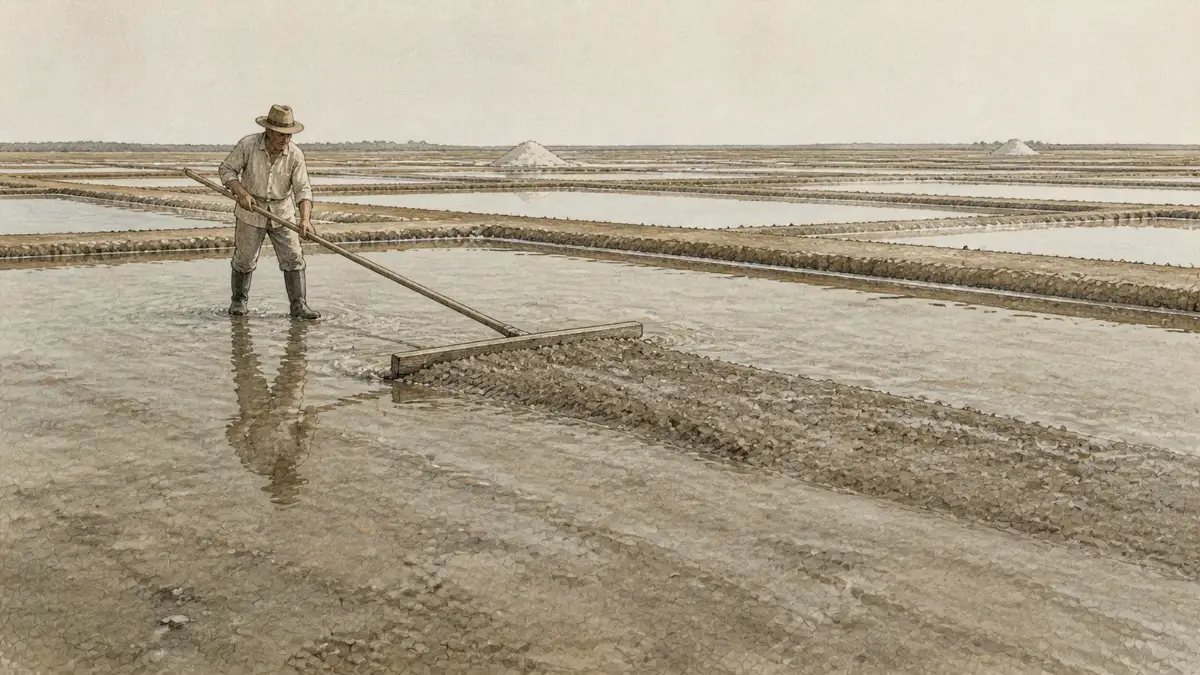
Sel gris is raked off the clay bottom of a salt marsh, which is where the grey comes from and also where a regulatory oddity comes from that almost nobody who sells it mentions.
Why is it grey?
Contact with clay. In the marshes of the French Atlantic coast the crystallising ponds have a clay floor, and salt raked from the bottom carries fine grey sediment with it. Fleur de sel from the same pond, skimmed off the surface, never touches it.
The Guérande specification quantifies the difference: fleur de sel is capped at 0.20% insoluble matter, grey salt at 1%. Five times as much, and the insoluble matter is the point.
How does it differ in composition?
It is wetter and it carries more of the magnesium and potassium that stay behind in the mother liquor. A typical Guérande coarse grey salt declares about 85 g of sodium chloride per 100 g, with 500 mg magnesium, 200 mg potassium and 152 mg calcium.
That 85% is not a mineral achievement so much as a water measurement — at 12% moisture it works out to roughly 96.6% on a dry basis. Grey salt is damp salt that has kept its bittern.
The lead thing
Here is the fact that does not appear in the marketing.
European law sets a maximum lead level of 1.0 mg/kg for salt generally. And it sets a separate, higher limit of 2.0 mg/kg specifically for “'fleur de sel' and 'grey salt' manually harvested from salt marshes with a clay bottom.”
The European legislature wrote a category into contaminants law and doubled its lead allowance. The reason is not sinister — clay carries trace lead, and hand-harvested marsh salt necessarily contains clay — but the implication is worth stating plainly: the feature that defines this product is the feature that raises its lead load, and the regulator formally accommodated it.
This has been to court. In February 2025 a proposed class action was filed in the Central District of California against the company behind the Celtic Sea Salt brand, alleging 460 parts per billion of lead by ICP-MS. What made it unusual is that the company’s own published FAQ gives a higher figure — averaging 489 ppb, which it still publishes. The dispute was never about the measurement. It was about whether a California Proposition 65 warning is required. On 11 April 2025 the plaintiff voluntarily dismissed: his individual claims with prejudice, the putative class claims without. No court ruled on whether a warning was owed, so the dismissal settles nothing either way — the class claims could be brought again by someone else, and as of September 2026 nobody has. What outlasted the litigation is the number, which was never in dispute.
For scale: 489 ppb is 0.489 mg/kg, comfortably inside the European limit even for ordinary salt. California's warning threshold is set far lower than a safety limit, and a Prop 65 warning is a disclosure requirement rather than a finding of harm. We are not telling you grey salt is dangerous. We are telling you the numbers exist and that they are not secret.
Is "Celtic sea salt" a place?
No. There is no Celtic appellation and no Celtic salt region. Celtic Sea Salt is a US trademark, filed in 1998 and owned by a Maryland company. The generic category is sel gris, or grey salt, and European law calls it exactly that.
Some grey salt is from Guérande and says so, because that name is protected. Where a package says only “Celtic,” the origin is a question you have to ask.
What is it good for?
Cooking, mostly — which is the opposite of fleur de sel from the same pond. It is damp, coarse and irregular, it dissolves slowly, and it is far cheaper: $11 to $19 a kilo against fleur de sel's $68. It is the everyday salt of the region that produces both.
The dampness that makes it pleasant to pinch also makes it clump, and it will not behave in a grinder. That is not a defect. It is what unwashed marsh salt is.
Common questions
No. The magnesium and potassium are real and are present at levels far too low to matter nutritionally. It is a texture and flavour product.
The published figures sit inside the European limit for salt of any kind, including the ordinary 1.0 mg/kg limit rather than the 2.0 mg/kg concession. What we think you should know is that the concession exists, because the people selling it rarely mention it.
Because it is unwashed and unrefined and has kept the magnesium-rich liquor that ordinary salt production drains away. Magnesium chloride pulls water out of the air at about 33% humidity, where pure salt stays dry until 75%.
Sel gris is the category. Celtic Sea Salt is one American brand within it. The words are not interchangeable, and only one of them tells you anything about where the salt is from — and it is not the trademarked one.
Sources
- Commission Regulation (EU) 2023/915 — contaminant maximum levels, including the clay-marsh salt derogation
- Commission Implementing Regulation (EU) No 238/2012 — Guérande PGI specification
- USPTO — CELTIC SEA SALT trademark, serial 75505689
- OEHHA — Proposition 65 maximum allowable dose level for lead
- Open Food Facts — Le Guérandais coarse grey salt declaration
- Gonzalez v. Celtic Ocean International, LLC — notice of voluntary dismissal, 11 April 2025 (C.D. Cal., No. 2:25-cv-01177)
In the Salt Guide
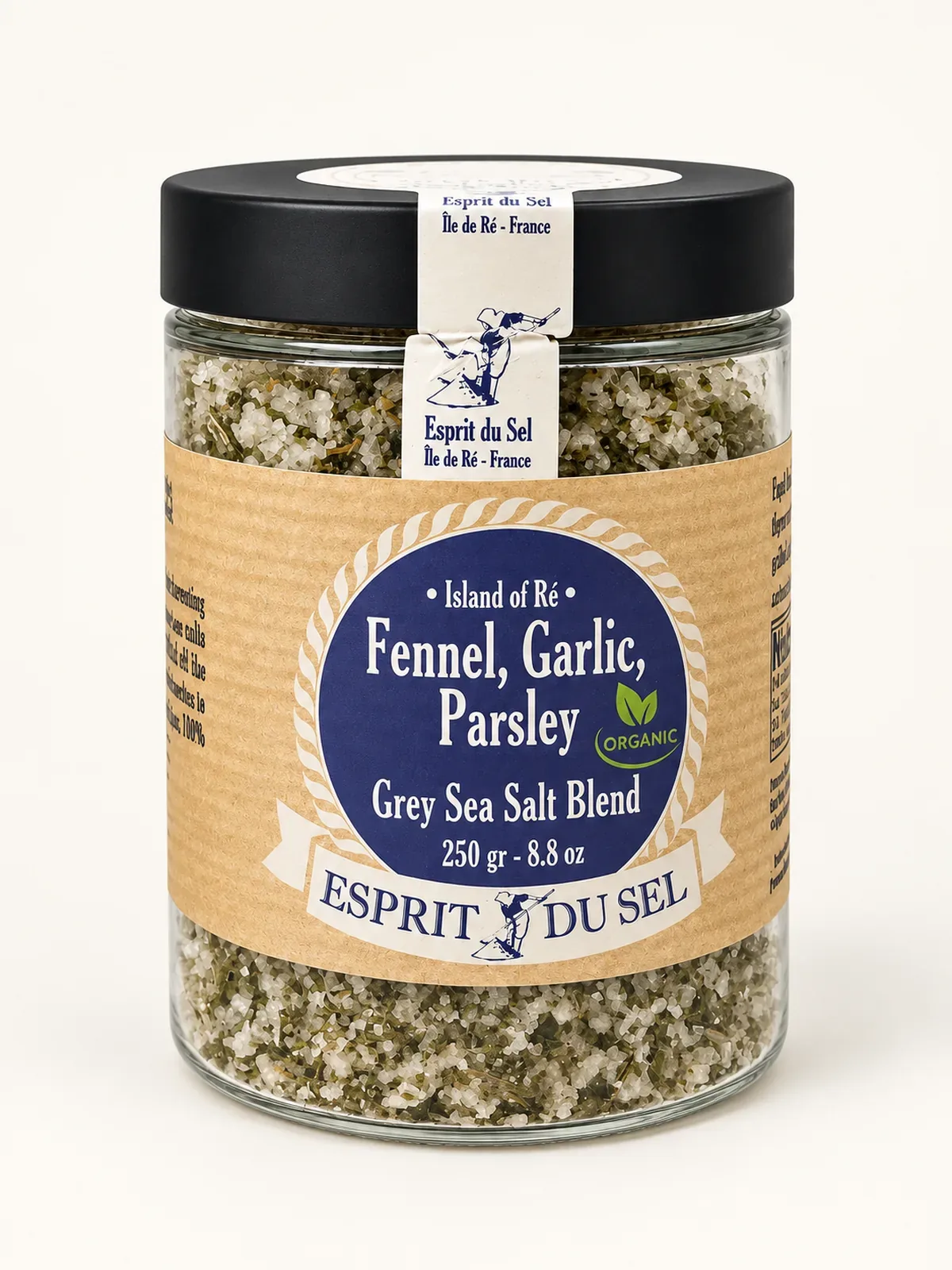
Esprit du Sel — Island of Ré Fennel, Garlic, Parsley
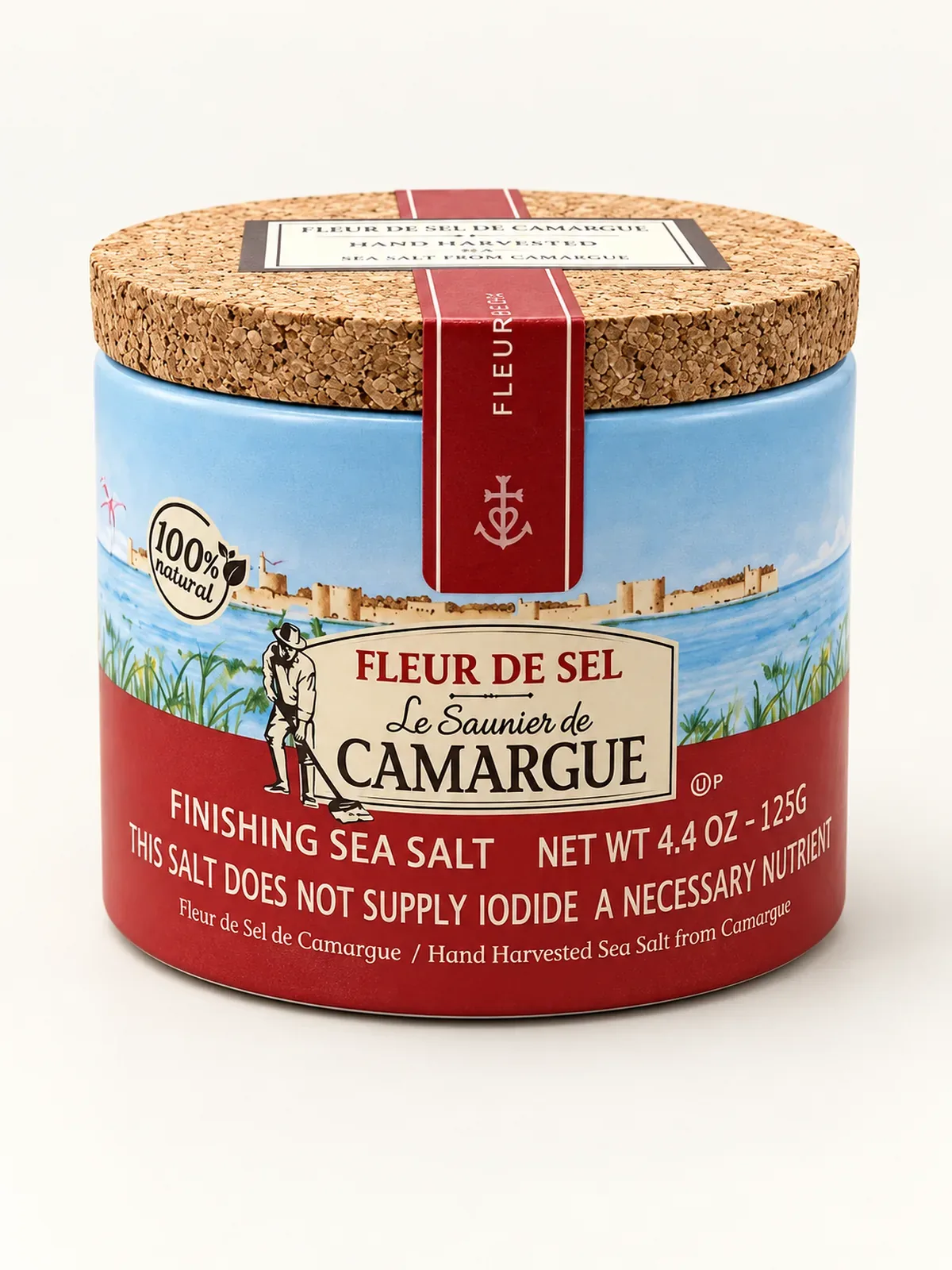
Le Saunier de Camargue — Fleur de Sel
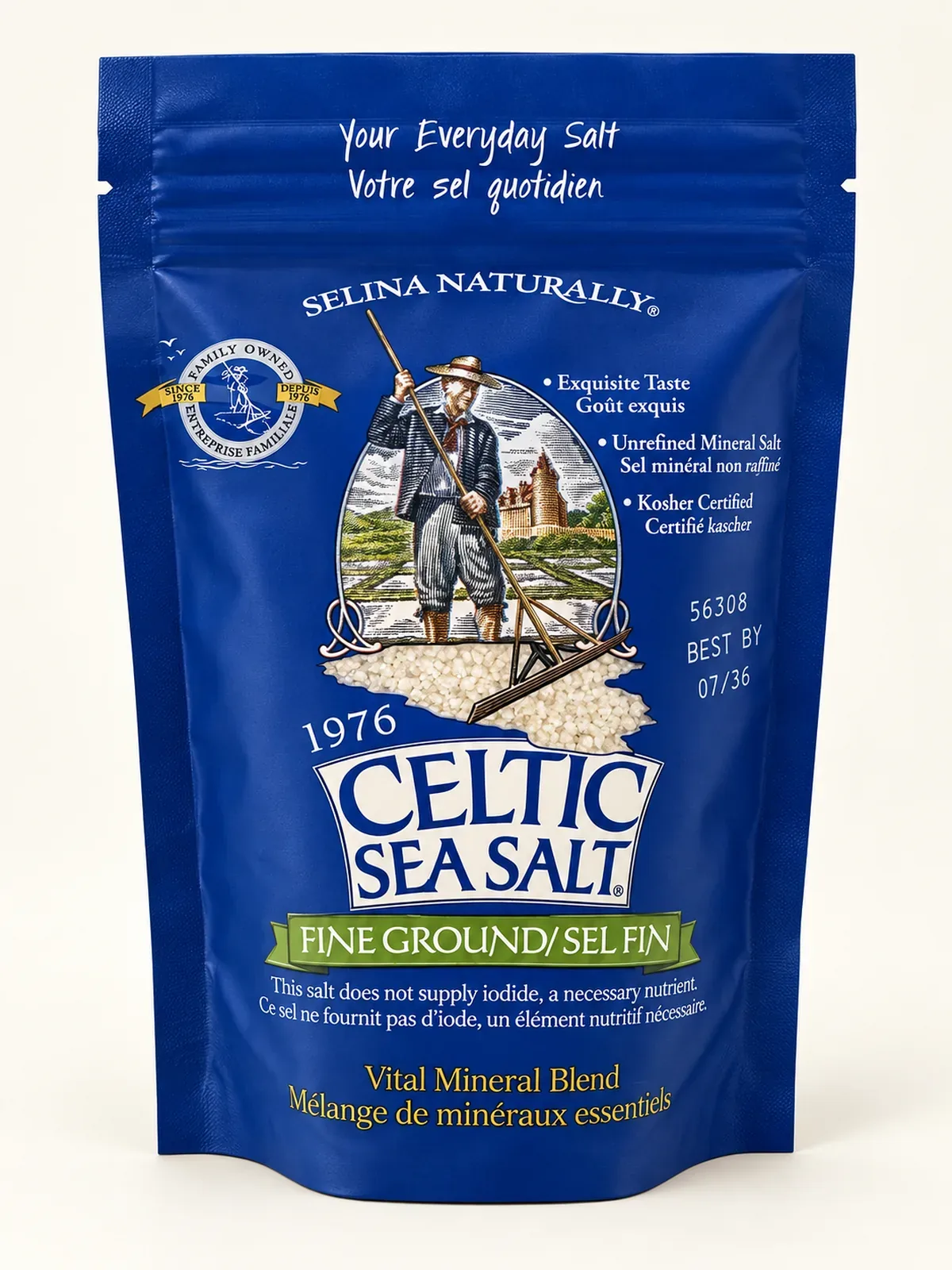
Selina Naturally — Celtic Sea Salt Fine Ground
Retail salts, one entry each: label, panel, price paid, and the crystal on white. Browse the guide →
Get the next guide
An email when we publish a new salt guide or recipe, and first word when the Patagonian salts are ready to order.
We write when there is something to say, not on a schedule.