
What Is Fleur de Sel, and Why Does It Cost $68 a Kilo?
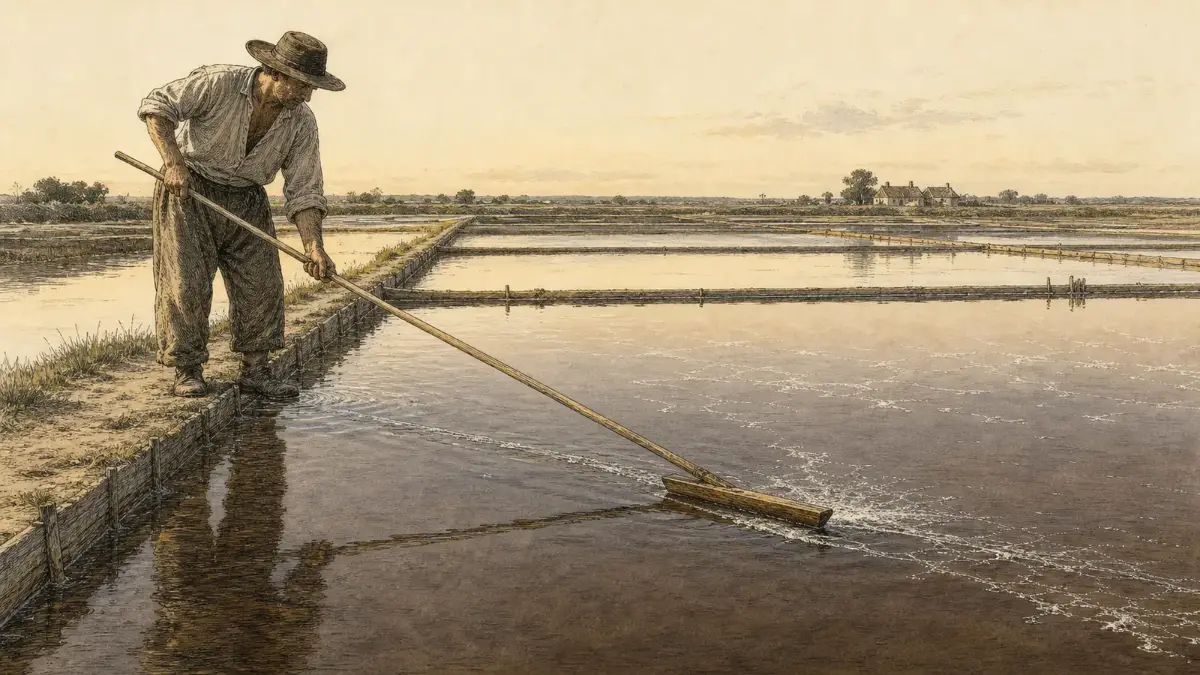
Fleur de sel is the thin crust that forms on the surface of a salt pond on a good afternoon, lifted off by hand before it sinks. The price is a yield problem, not a marketing one.
What is it, physically?
On still, warm, breezy days a fragile film of crystals forms on the surface of the brine. A worker skims it off with a flat tool — in Guérande, a lousse — before it grows heavy enough to fall. If the wind drops or it rains, there is none that day.
The salt underneath, raked off the floor of the same pond, is grey salt. Same water, same day, same worker. The difference is vertical.
Why is it so expensive?
Because of the ratio. A single Guérande crystallising pond yields about fifty kilos of coarse salt a day and two kilos of fleur de sel. Across the marsh, seasonal deliveries run around 12,500 tonnes of coarse salt to 500 tonnes of fleur de sel — roughly five per cent of output.
Current US retail bears that out: fleur de sel de Guérande around $68 per kilo, grey salt from the same marshes $11 to $19, ordinary coarse sea salt around $35.
You are paying for the twenty-five to one ratio and for the fact that it cannot be made to order.
Is "fleur de sel" a protected term?
No. This surprises people and it is worth being precise about.
“Sel de Guérande” and “Fleur de sel de Guérande” are protected — a European PGI granted in March 2012, certified by CERTIPAQ. Camargue received its own PGI only in January 2024.
But the words fleur de sel on their own protect nothing. Anyone anywhere may print them on a bag. European food law itself uses the phrase generically: a 2023 contaminants regulation refers to “'fleur de sel' and 'grey salt' manually harvested from salt marshes with a clay bottom” as a category, not a place.
If the origin matters to you, the geographic name is the thing to look for. The two French words are not a guarantee of anything.
A correction worth making
You will read in a great many places that fleur de sel de Guérande carries the French Label Rouge quality mark. It does not. The Label Rouge, obtained in 1991, covers “Sel Marin de l'Atlantique” — the grey salt. Fleur de sel is not in it. The PGI is the certification that applies.
What is actually in it?
Less sodium chloride than you would guess, and no fixed figure.
The French national food composition table gives fleur de sel at roughly 95 g of sodium chloride per 100 g, with 424 mg magnesium, 171 mg calcium and 103 mg potassium. A UK laboratory survey measured fleur de sel at 91.48% sodium chloride — the only category in that survey that fell clearly below pure salt, which is consistent with its residual moisture and magnesium.
And it moves. A peer-reviewed study following one Portuguese season found sodium chloride falling from 96% to 87% across a single harvest. Fleur de sel does not have a composition so much as a range.
Notably, the Guérande specification sets no minimum for sodium chloride at all. It caps insoluble matter at 0.20% and moisture at 12%, and requires hand harvesting. What it protects is a method and a place, not a chemistry.
Is it worth buying?
For what it does, often yes. For what it is sold as, sometimes not.
Fleur de sel is a finishing salt: damp, fragile, crunchy for a moment and then gone. Put it on a tomato, a steak off the grill, butter on bread, caramel. It is wasted in a pot of pasta water, where it dissolves into the same sodium chloride as the cheapest salt in the shop.
What it is not is more nutritious. The mineral content is real and measurable and it is present in quantities far too small to matter to a diet. That is a flavour and texture argument, and it is a good one. It is not a health argument, and anyone selling it to you as one is telling you something they cannot support.
Common questions
It is a sea salt, harvested from the surface rather than the floor of the pond. All fleur de sel is sea salt; almost no sea salt is fleur de sel.
Yes, and it is — in Portugal, Spain, Croatia and elsewhere. Some of those countries define the term in national law. The phrase itself is unprotected, so the only reliable signal of origin is a geographic designation.
Because it is meant to be. The Guérande specification permits up to 12% moisture. That water is part of the texture, and it is why fleur de sel clings to food instead of bouncing off it.
No. Dissolved in water it is indistinguishable from table salt and costs sixty times more. Use it at the end, on the plate, where you can feel it.
Sources
- Commission Implementing Regulation (EU) No 238/2012 — PGI registration, Sel de Guérande / Fleur de sel de Guérande
- Commission Implementing Regulation (EU) 2024/423 — PGI registration, Sel de Camargue / Fleur de sel de Camargue
- Commission Regulation (EU) 2023/915 — maximum levels for certain contaminants in food
- Codex Alimentarius CXS 150-1985 — standard for food grade salt
- ANSES Ciqual — French food composition table, fleur de sel
- Sainz A, Boski T, Sampath DMR, J Coastal Research 2019;35(6) — seasonal variation in fleur de sel composition
- Action on Salt — Gourmet Salt Survey, 2011
In the Salt Guide
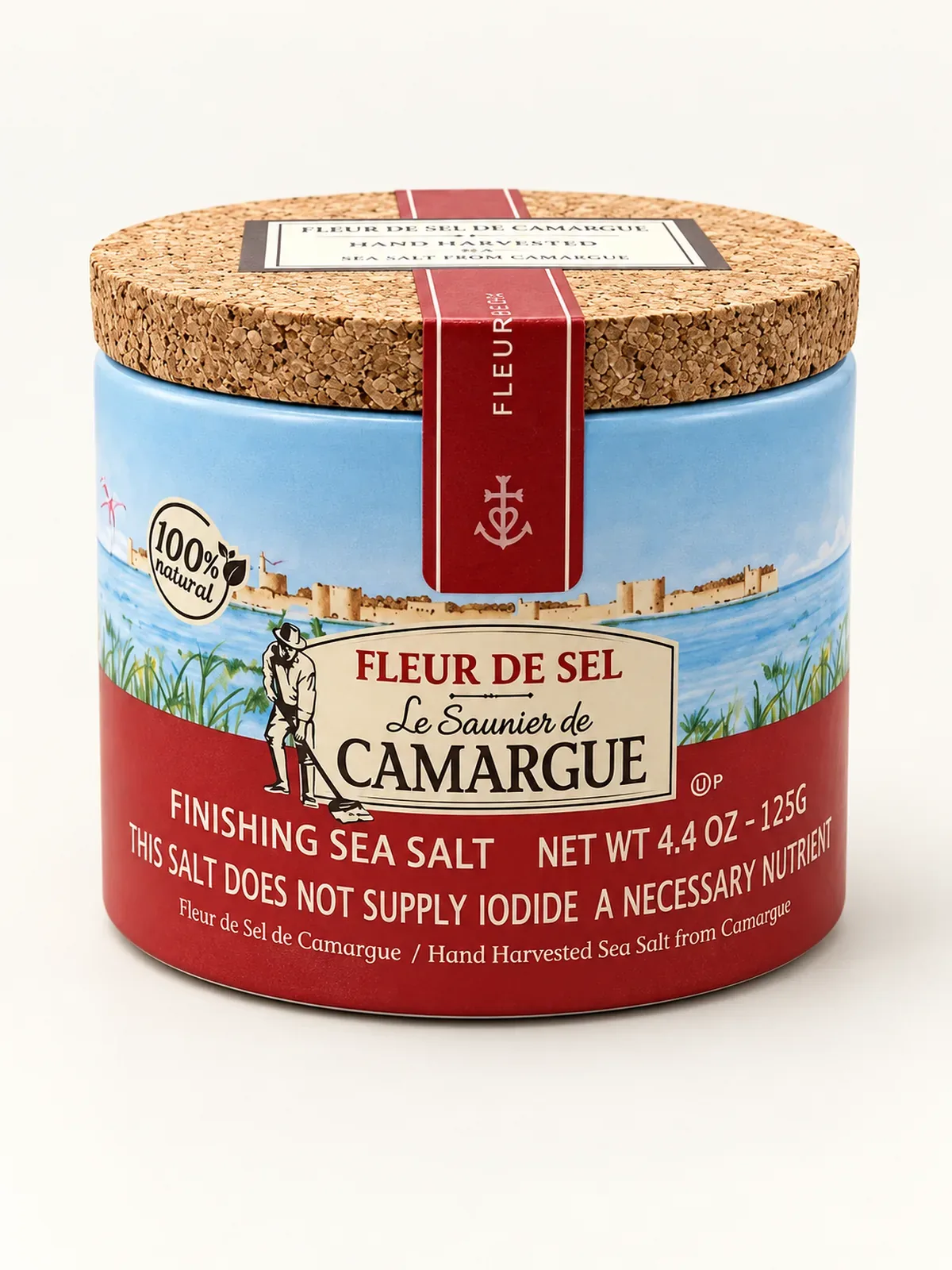
Le Saunier de Camargue — Fleur de Sel
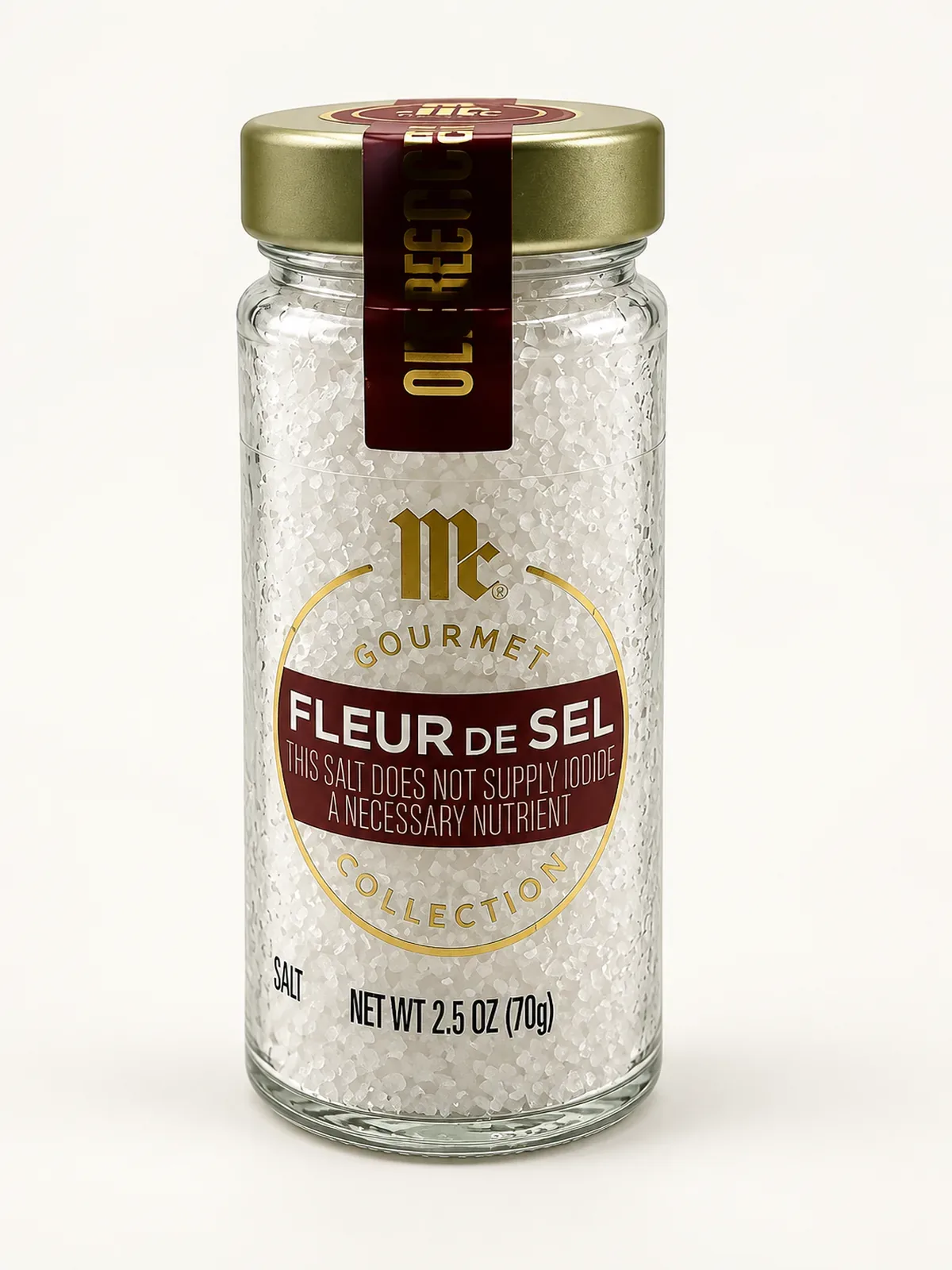
McCormick Gourmet — Fleur de Sel
Retail salts, one entry each: label, panel, price paid, and the crystal on white. Browse the guide →
Get the next guide
An email when we publish a new salt guide or recipe, and first word when the Patagonian salts are ready to order.
We write when there is something to say, not on a schedule.