
Japanese Sea Salt: Moshio, Hakata and the Rain Problem
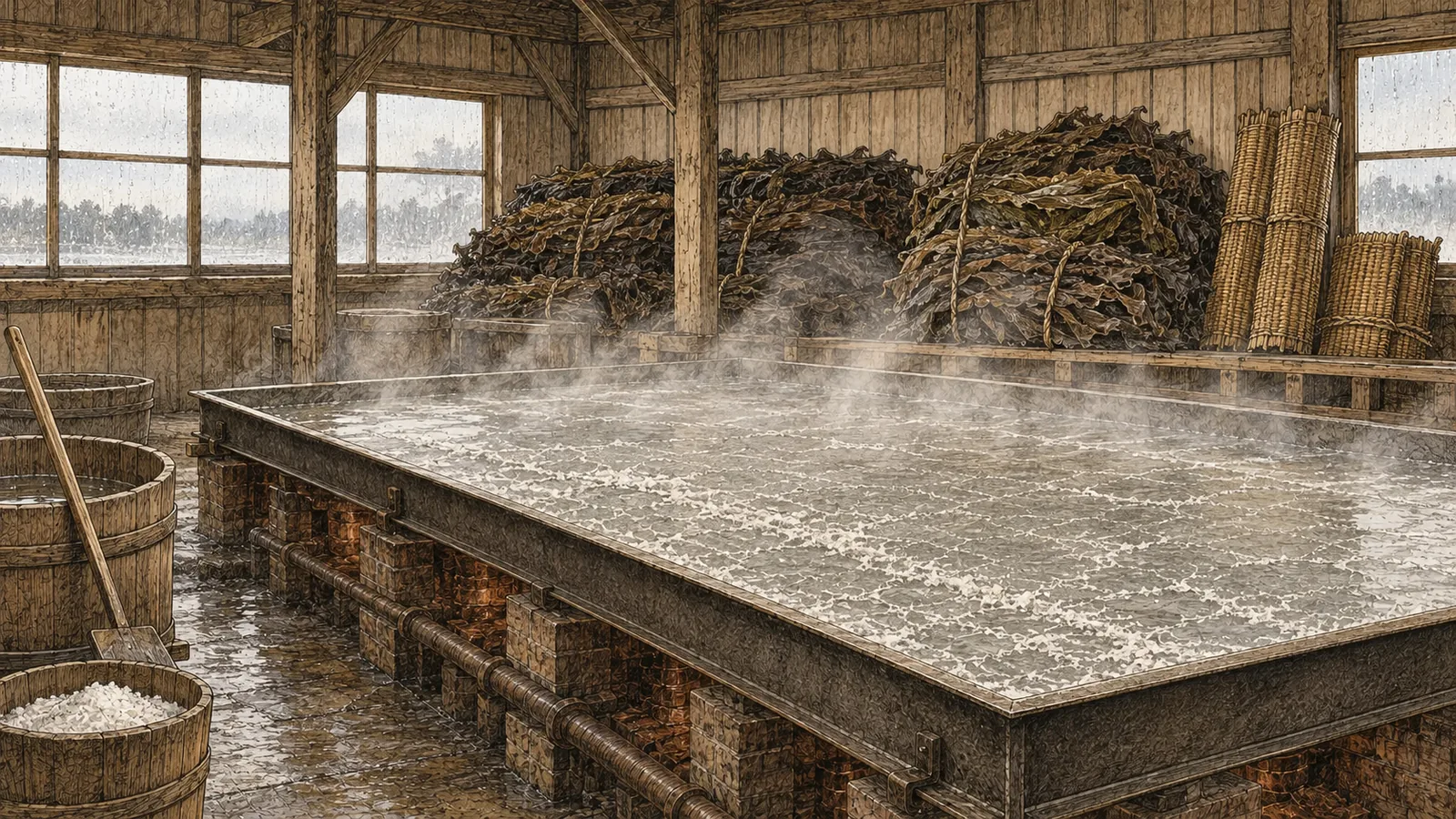
Japan has one of the longest coastlines in the world and makes almost no salt by leaving seawater in open ponds. Its own industry body, the Salt Industry Center of Japan, gives the reason directly: the Japanese climate of heavy rainfall and high humidity is unsuitable, and there are no salt lakes or rock salt deposits either. So Japanese salt is concentrated by some other means — and the two best-known examples take opposite routes. Amabito no Moshio concentrates brine using seaweed; Hakata Salt dissolves imported salt-field salt in Seto Inland Sea water and boils it again. Both publish exactly what they do, which is more than most sea salts manage.
Why open ponds do not work there
Evaporating seawater outdoors is a race between the sun and the weather. You need a long dry season, low humidity and preferably wind, because the pond has to lose about ninety-six per cent of its water before anything crystallises. Rain running into a half-finished pond does not merely pause the process. It undoes it.
Japan sits in the monsoon belt. The Salt Industry Center of Japan states the consequence flatly in its public explanation of production methods, and adds the second half of the problem: unlike most large economies, Japan has neither rock salt nor salt lakes to fall back on. Every grain has to come out of seawater, in a climate that will not cooperate.
The result is that Japan has spent a thousand years engineering around the weather, and the engineering is the interesting part.
The salt fields Japan used instead
Three successive salt-field systems, then a fourth thing that is not a salt field at all. The Salt Industry Center describes each.
Agehama, the banked salt terrace, appears in the medieval period. Seawater is carried up by hand and thrown over sand spread on a terrace above the tide line. The sand dries, the salt concentrates on the grains, the sand is swept up and rinsed in fresh seawater to make a strong brine, and the brine is boiled. It could not be worked in bad weather or in winter, so the season ran spring to autumn. The method survives on the Noto Peninsula.
Irihama, the channelled salt terrace, arrives in the mid-seventeenth century and is the efficiency breakthrough. Build the terrace between high and low water, and the tide fills the channels for you; capillary action does the wetting that a person used to do with a bucket. It spread around the Seto Inland Sea, which had the right combination of tidal range and climate, and it was still in use into the 1960s.
Ryuka, the sloping terrace, is pumped seawater cascading down bamboo racks, with wind doing the evaporation. It worked all year and cut the labour sharply. It is also where our sources disagree, so we will show the disagreement rather than pick a side. The Salt Industry Center English page says ryuka “was used from the late 1960s to about 1970”. Japanese sources give a far longer run: the Tobacco and Salt Museum dates it from the second half of the Showa 20s — the early 1950s — to 1971, when the salt fields were abolished. We think the English page is the outlier, for a reason internal to it: a method credited with replacing irihama nationally cannot have had two years to do it, and the same page has irihama running into the 1960s.
Then, around 1970, all of it stopped. Ion-exchange membrane electrodialysis pulls sodium and chloride ions straight out of seawater electrically, concentrating brine to fifteen to twenty per cent regardless of the weather, and it replaced the salt fields completely. In 1971 the Act on Special Measures Concerning Modernization of Salt Production prohibited salt production in Japan by methods other than the ion-exchange membrane method. A country cancelled its own salt-making tradition by statute, in the name of productivity, and it took until the abolition of the salt monopoly in 1997 before producing salt directly from seawater was generally permitted again.
Almost everything distinctive in Japanese salt today dates from after that door reopened, or from the narrow exceptions before it.
Amabito no Moshio: seaweed as the concentrator
Moshio means seaweed salt, and the version sold now is a reconstruction, not a survival. The chain of evidence is unusually clear for a heritage product, which is why it is worth setting out.
In 1984, during construction work at Kenmin no Hama on Kamikamagari Island in what is now Kure City, Hiroshima, the Okiura site yielded salt-making earthenware dated to the Kofun period. The official Hiroshima tourism guide dates the wider run of excavated salt-making remains there from roughly 1,500 years ago through the Heian and Kamakura periods. Researchers worked for about a decade on how the pottery had been used, taking their cue from lines in the Man’yoshu about cutting seaweed at morning calm and burning moshio at evening. Commercial production began in July 1998, run by Kamagari Bussan.
The method, as the producer describes it: hondawara seaweed — a sargassum, called tamamo in the old poems — is repeatedly soaked in seawater and dried, each cycle raising the salt concentration of the liquid, until you have a strong brine. That brine is then boiled down. The company describes the finished salt as pale beige with no sharp edge to the saltiness.
Two honest qualifications. First, the seaweed is functional, not decorative: it is the concentrating surface, the same job the sand did in an agehama field. Whatever it contributes to flavour is a secondary effect of using it as equipment. Second, the City of Hiroshima lists Amabito no Moshio as a Hiroshima Brand product — which is a municipal promotional listing, not a protected designation of origin. It is not the Guérande situation and should not be described as one.
Hakata Salt: the counter-example, published by the company
Hakata Salt Co. was founded out of a 1970s consumer movement against the ion-exchange product. Its head office is in Matsuyama, Ehime Prefecture, and the salt is made at its Omishima plant, Omishima being an island in the Seto Inland Sea that forms part of Imabari, also in Ehime. Here is what the company says on its own Japanese site about the raw material: the company uses as its feedstock a concentrated brine made by completely dissolving imported salt-field salt in seawater of the Seto Inland Sea. That brine is boiled down to crystal, and the crystals are left to dry naturally in the factory for several days rather than machine-dried, in order to retain a measured amount of nigari — the magnesium-bearing bittern that the company says gives the salt a rounded rather than sharp taste.
The imported salt comes from Guerrero Negro in Mexico and Price in Australia, and the company’s stated reason is energy: bringing in salt already grown in open ponds abroad, it says, uses far less fuel than boiling Japanese seawater down from scratch. Two sources also give it supply security.
Take a moment with that. A salt sold throughout Japan as a Seto Inland Sea product is, by its maker’s own published account, mostly Mexican and Australian salt redissolved in Japanese seawater and recrystallised. It is a hybrid, and the company is the one telling you so.
Our interest here is not in catching anyone out. It is the opposite. Compare this with the supermarket grinder that says “Mediterranean sea salt” and names no coast, no saltworks and no process. Hakata Salt names two countries, a body of water, a dissolution step, a boiling step and a drying decision. The disclosure is the thing worth admiring. That a company will tell you its salt was made twice, in two hemispheres, is far more useful than a label implying it was made once, somewhere nice.
The same problem, four coasts
| Coast | Climate problem | How it is answered | What comes out |
|---|---|---|---|
| Seto Inland Sea, Japan | Heavy rainfall, high humidity; no rock salt or salt lakes | Seaweed-cycle concentration and boiling, or imported salt redissolved and boiled | Pale beige fine granules; moist coarse crystals holding bittern |
| Essex and Anglesey, Britain | Cool, cloudy, wet; no reliable dry season | Brine concentrated then evaporated over heat — Maldon over gas-fired flues | Hollow pyramid flakes, low magnesium |
| Reykjanes, Iceland | Cold and wet; no usable sun at all | Open pans heated with geothermal water, which Saltverk gives as 93 °C | Flake salt made on volcanic heat |
| Chubut coast, Argentina | Cold, dry, windy; a short working season | A low-temperature process, as our producer publishes it | Coarse and flake crystals retaining their non-sodium fraction |
The pattern across that table is the useful part. Hot and dry works. Cold and dry works. Warm and wet is the hard case, and it is the one that forces a producer either to spend energy or to import. The method a salt is made by is very often a fact about rainfall rather than a fact about philosophy, which is the thread running through every coast on the map.
Which means the reflex ranking — open-air pond good, heated pan lesser — is mostly a geography prejudice. Maldon is heated. Halen Môn is heated. Saltverk is heated. Amabito no Moshio is boiled. These are not compromises, they are the correct engineering for the coast each one sits on. Applying heat to brine is a legitimate way to make salt and always has been. It is what half the world has to do.
What to do with moshio in a kitchen
Treat it as a finishing salt with a savoury edge, and put it where that edge has room: plain rice, onigiri, a steamed or grilled white fish, a soft-boiled egg, tempura served with salt instead of dipping sauce, chilled tofu. It is fine-grained, so it disappears into anything wet; it earns its keep on dry surfaces where you taste it as a separate thing.
Where it is wasted is under a strong sauce, in a brine, or in baking, where you are paying a premium for a character that will not survive. The same is true of every finishing salt, including ours. Salting logic does not change with the passport: the questions are still what grain size you want and when in the cooking it goes on.
And no, there is no nutritional argument here. Seaweed-derived character is a flavour and colour fact. Sodium chloride is sodium chloride however it was concentrated, and anyone selling you moshio on any other basis has stopped describing the salt.
On our own sourcing: we have not visited Kamagari or Imabari, and everything above about either producer is their own published account or a municipal page, not independent laboratory work. The Hakata Salt process wording is our translation of the company’s Japanese site; we have quoted its substance rather than a certified translation. The Saltverk temperature and the Maldon flue detail are likewise company statements. We would rather tell you whose word each fact rests on than present the lot as established record. And the Patagonian line in the table is deliberately thin, because our producer has not confirmed times or temperatures to us in writing and we will not invent them.
Sources
- Salt Industry Center of Japan — salt production method, and why the Japanese climate is unsuitable
- Salt Industry Center of Japan — agehama, irihama, ryuka and ion-exchange membrane methods
- Tobacco and Salt Museum — ryuka-shiki salt fields, dated to 1971
- Kamagari Bussan — Amabito no Moshio, the Okiura site, the 1984 find and July 1998 production
- City of Hiroshima — Hiroshima Brand listing for Amabito no Moshio seaweed salt
- Official Hiroshima travel guide — Kamagari ancient salt-making ruins exhibition hall
- Hakata Salt Co. — how Hakata Salt is made, company statement of raw material and process
- Hakata Salt Co. — the philosophy behind Hakata Salt, the 1971 Act and imported salt sources
- Saltverk — geothermal salt production at Reykjanes, Iceland
Read next
- How Sea Salt Is Made — pond, pan, tower and membrane
- What Is Smoked Salt — the other way fire gets into salt
- Where Salt Is Made — climate, coastline and method
- Patagonian Sea Salt — a cold dry coast, for comparison
The Salt Guide
We are recording the salts on the American shelf one jar at a time — label, panel, price paid, crystal on white. Browse the guide →