
The Penguins Live in Burrows
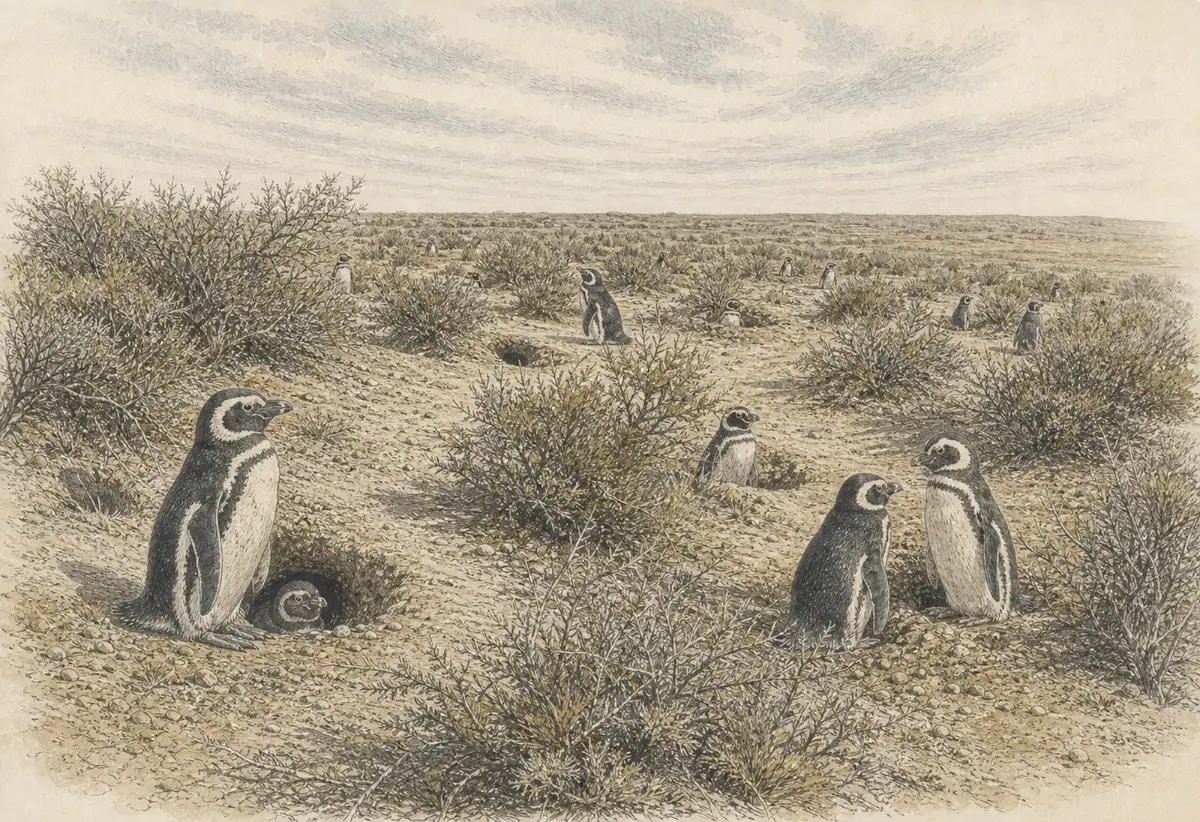
About 110 kilometres down the coast from Rawson there is a peninsula three kilometres long and six hundred metres wide, made of sand, clay and gravel. It holds the largest continental colony of Magellanic penguins in the world. It is hot, it is dry, there are no trees, and the penguins live underground.
Ask almost anyone to picture a penguin and you get ice. A white sheet, a grey sky, a bird standing on frozen ground. That image belongs to four or five species out of eighteen, and none of them is this one.
Where this is
Punta Tombo sits in the Florentino Ameghino department of Chubut, on the Atlantic coast, roughly 110 kilometres from Rawson. Our salt is evaporated from seawater taken from the same coastline further north. We are not claiming the penguins live in it. We are saying that when we talk about the Patagonian Atlantic, this is the actual place, and it looks nothing like the brochure.
The protected area is Patagonian steppe: low thorny scrub, tussock grass, gravel underfoot, and wind from the west that does not stop. No trees. The colour is dust and pale ochre, and the sea at the end of it is grey-green and cold.
The burrows
Magellanic penguins dig. They excavate burrows in the dry earth, or nest under bushes, or occasionally settle for a shallow scrape in the open. A colony at Punta Tombo is not a crowd standing on rock. It is thousands of holes in scrubby ground with birds standing at the entrances, and worn paths running down to the water.
The males come back first, from about the middle of September into October, and many return to the burrow they used before. The females follow. Two eggs, usually in October. Incubation runs 39 to 42 days.
They share the ground with gulls, cormorants, lesser rheas and guanacos. A rhea walking past a penguin colony is not a composite image. It is Tuesday.
The number, and the direction it is going
The province puts the colony at close to half a million individuals. Researchers at the University of Washington, who have monitored it for decades, count well over a hundred thousand breeding pairs and note something less comfortable: the species has been in sustained decline since 1989.
The pressures are almost all at sea. Shifting prey, fishing bycatch, competition for the same fish, oil pollution. A colony can be perfectly protected on land and still shrink, because the birds spend most of the year somewhere else entirely.
The backhoe
In November 2021 a rancher drove a backhoe through nesting ground next to the reserve. Roughly 175 nests were destroyed. More than a hundred penguins were killed. The Argentine press called it the Punta Tombo massacre.
In November 2024 he was convicted of environmental damage, animal cruelty and malice. He received a suspended three-year sentence and faces fines reported at up to half a million dollars, along with restrictions on grazing near penguin habitat. It was the first environmental case in Argentina to reach an oral trial.
The protected area was then expanded roughly eightfold, from about 500 acres to close to 4,000, with a new management plan covering the seabirds, the plants and the sea lions as well.
That is the part worth sitting with. The colony is not protected because it is famous. It is protected because someone destroyed part of it and a court, eventually, said so.
Why a salt company is writing this
Because we buy from this coast, and because we would rather describe it accurately than decoratively. There is a version of Patagonia that sells easily: peaks, glaciers, a lone rider. The coast our salt comes from is flat, dry, windblown and full of birds living in holes in the ground, and that is more interesting than the version with mountains in it.
We have not stood there. Everything above is what the province, the researchers and the courts have recorded. When we can show you this coastline, it will be drawn rather than photographed, for exactly the same reason.
Related
- What Is Patagonian Sea Salt? — where the salt actually comes from
- Patagonian Salt Flakes — salt from this coastline
Get the next guide
An email when we publish a new salt guide or recipe, and first word when the Patagonian salts are ready to order.
We write when there is something to say, not on a schedule.