
The Coast Was Emptied Once
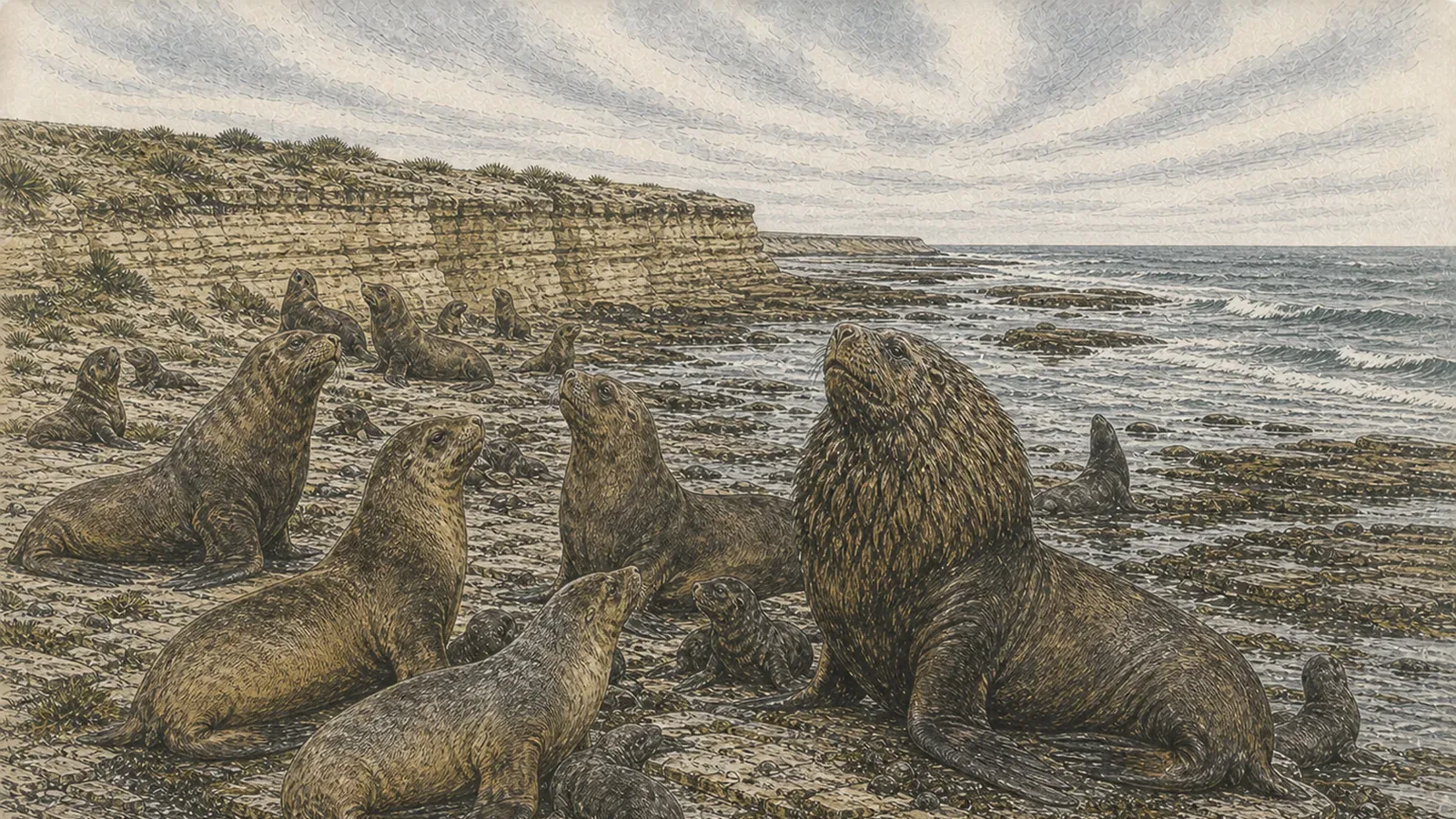
There are sea lions on the rocks below the cliffs where our seawater comes from, and there are more of them every year. That is not because the coast was left alone. It is because the industry that emptied it stopped, and the animals have spent decades climbing back to about a third of what they were.
Provenance stories are almost always told in the present tense, as though the place has been exactly this quiet forever and was simply waiting to be discovered. This coast has a different history, and it is more interesting than the version we could have written.
What is on the rocks
Southern sea lions, Otaria flavescens. The bulls are not what most people picture when they hear “seal”: a heavy maned neck, a blunt upturned muzzle, a head built along the lines of a lion, which is where the name comes from. The females are less than half their size. They haul out on the flat rock platforms below the low cliffs — the restinga that goes under at high tide — and you generally hear a colony before you see it.
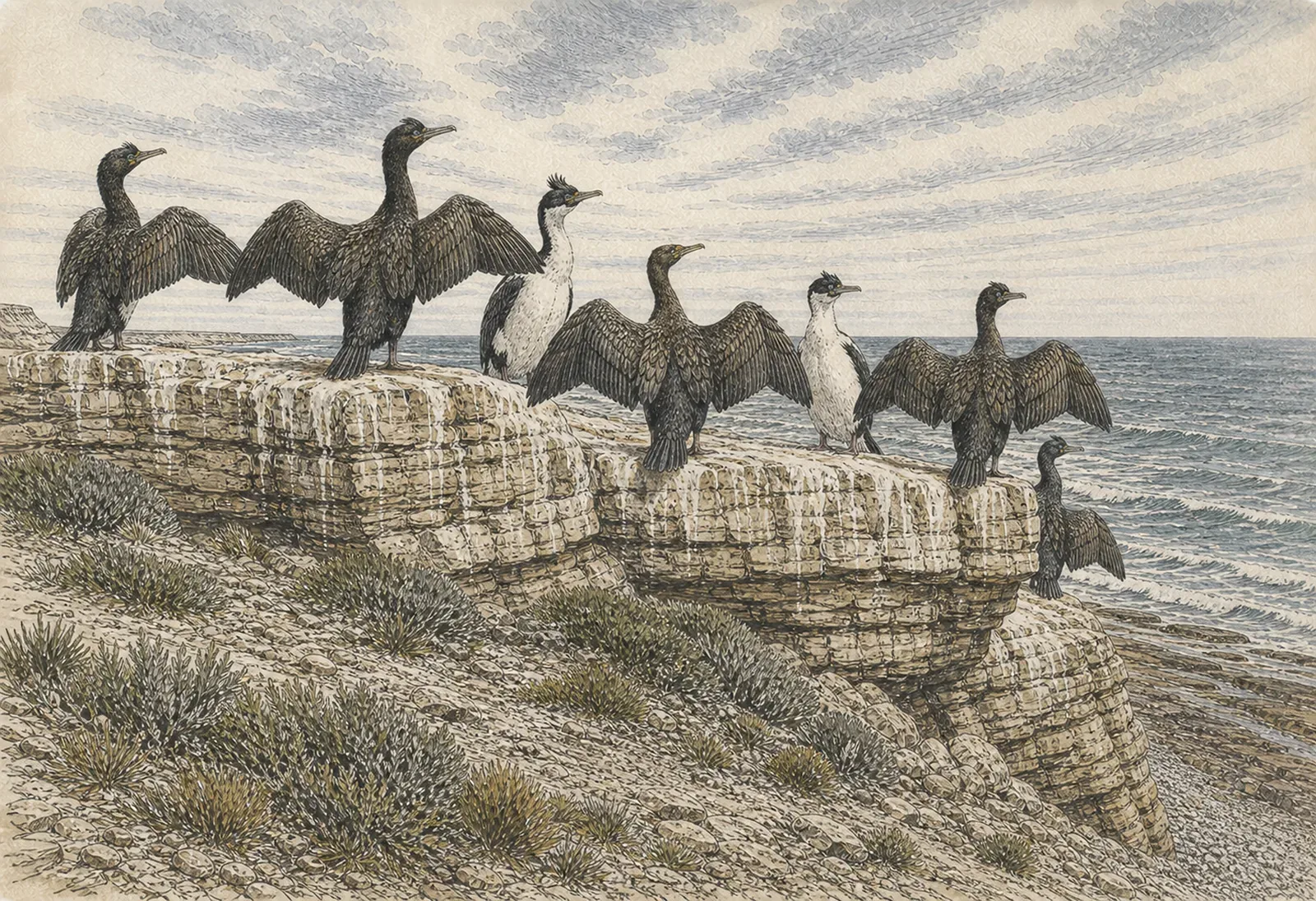
On the ledges above them, rock and imperial cormorants stand with their wings held open to dry. The rock underneath is streaked white. Neither of these is a rare sight here, and that is exactly why it is worth writing down.
What was taken
The South American sea lion was hunted commercially through the first half of the twentieth century, for hides and oil, and the population fell to very low levels. This was not a marginal footnote in the region’s history. It was an industry, it ran the length of the Patagonian coast, and it ran for decades.
The honest limit of what we can tell you: we could not find a reliable total for how many animals were taken in Argentine waters, and we are not going to invent one. The published work is clear that the exploitation was heavy and that the population collapsed. The bookkeeping is harder to pin down than the outcome.
A third of the way back
What is documented is the shape of the recovery. The Argentine population, mainland and coastal islands together, is estimated at around 184,000 animals across roughly 140 registered colonies, about 74 of which have some protected status. The trend is increasing in Río Negro, Chubut, Santa Cruz and Tierra del Fuego. The IUCN lists the species as Least Concern, globally and in Argentina.
Then the number that reframes the others: the population is currently estimated at about one third of its original size. Recovery has been faster in recent decades, helped by better juvenile survival and, probably, more food.
So: not endangered, and not restored. A third of the way back out of a hole somebody else dug.
What this does not tell you about salt
Here is the point where a brand in our position is supposed to say that abundant wildlife proves the water is pristine. We are not going to, because it does not follow.
A sea lion colony is a large concentration of large mammals living, feeding and defecating on a rock platform. Ecologically that is a healthy sign. It is not a water quality certificate, and anyone selling you one on the strength of a wildlife photograph is doing something we would criticise in another company.
What the recovery does tell you is narrower, and we think better. It tells you this coast has an extraction history — that it was worked hard, emptied, and left. It tells you the current quiet is recent. Sea salt production here runs at roughly two tonnes a month across the entire category, and it is easy to read that as timelessness. It is not. It is what a coast looks like a few decades after the money leaves.
Why a salt company is writing this
Because we are asking you to believe a provenance story, and provenance stories are usually told as though the place has always been exactly as it is now: untouched, unchanged, waiting.
This one has not. The coast our seawater comes from was an extraction economy within living memory, and what is out there today is a recovery rather than a wilderness. That is a less flattering sentence than the one we could have written. It has the advantage of being true.
Related
- What Is Patagonian Sea Salt? — where the salt actually comes from
- The Penguins Live in Burrows — the other thing this coast is known for
- Why There Are No Mountains in Our Salt Photographs — what this coast actually looks like
Get the next guide
An email when we publish a new salt guide or recipe, and first word when the Patagonian salts are ready to order.
We write when there is something to say, not on a schedule.