
Why There Are No Mountains in Our Salt Photographs
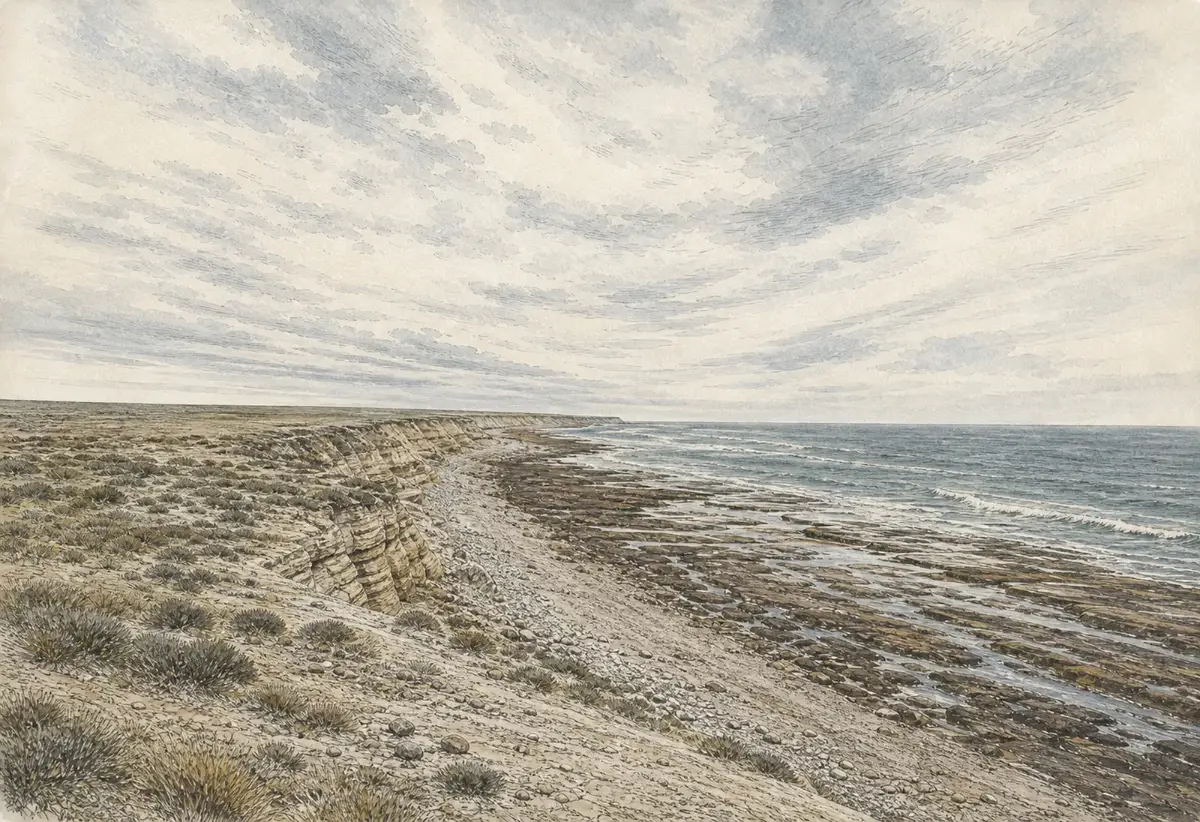
Search for Patagonia and you get granite spires, turquoise lakes and glaciers. All of it is real. None of it is anywhere near our salt, which comes from a flat, treeless coast on the other side of the province.
The distance, precisely
Our seawater is collected on the Atlantic coast of Chubut, near Rawson. The nearest Andean town of any size is Esquel, in the west of the same province. The drive is 612 kilometres along four different roads and takes the better part of eight hours. In a straight line it is roughly 500.
Same province. Two landscapes with almost nothing in common.
Patagonia is three places, not one
The Andes, in the west: forest, lakes, rivers, snow, national parks. Esquel sits at the foot of the cordillera and is the gateway to Los Alerces, which protects trees that were standing before Rome. This is the Patagonia that appears on posters.
The steppe, in the middle: hundreds of kilometres of dry shrubland in the rain shadow of those mountains. Low thorny bushes, tussock grass, guanacos, wind. Almost nobody photographs it, and it is most of what Patagonia actually is.
The coast, in the east: low sedimentary cliffs dropping to gravel beaches and restinga, the flat rock platform the tide uncovers twice a day. Penguins, sea lions, cormorants, and a cold grey-green Atlantic. This is where the salt is.
What that means for the pictures
It would be very easy to put a mountain behind a jar of salt. It would also be a lie, and a specific enough one that any Argentine reader would catch it immediately. The Andes are not visible from this coast. They are not near this coast. Between the two there is a desert.
So the rule we work to is narrow. Mountains are Argentina, and we will draw them. They will never appear behind the salt — not in a product photograph, not in a scene of the coast, not in anything about how the salt is made.
That rule has already cost us a set of otherwise beautiful illustrations. They showed seawater evaporating in open pans under the sun, on a shoreline with peaks behind it. Both halves were wrong. Our producer evaporates indoors under controlled heat, and there is no mountain within 500 kilometres of the plant. The drawings were lovely and they are not going on the site. That sentence about the heat used to carry a temperature as well. We never had the figure from the producer in writing, and an article about refusing the prettier version of a story is the worst place in the world to keep a number we cannot stand up, so it has gone the way of the illustrations.
The version that is true is better anyway
A windblown gravel coast where salt is made indoors at low temperature by two people, six hundred kilometres from the scenery everyone associates with the word Patagonia, is a stranger and more specific thing than another photograph of a mountain. It is also the only version we can put our name to.
Related
- The Penguins Live in Burrows — the coast, described accurately
- Why Our Smoked Salt Isn’t Quebracho — another romantic claim declined
- Sourcing and Standards — what we can and cannot say
Get the next guide
An email when we publish a new salt guide or recipe, and first word when the Patagonian salts are ready to order.
We write when there is something to say, not on a schedule.