
Salt Supplier Red Flags, and What to Ask Instead
A good salt supplier can tell you in writing who made the salt, where, how, to what specification, and what happens if any of that changes. US federal law requires surprisingly little of this: the FDA records rule asks for lot codes only “to the extent this information exists”, restaurants are excluded from it, and salt is not on the FDA’s Food Traceability List. So a restaurant or small food brand has to ask for itself. Below is the checklist we use, including on our own producer.
Why the law will not do this for you
Most buyers assume a food ingredient arrives with a paper trail because the law demands one. For salt, the paper trail the law demands is thin.
The FDA’s records rule, 21 CFR Part 1 Subpart J, requires businesses that make, pack, hold or distribute food to record where it came from and where it went: one step back, one step forward. The record must include a lot or code number “to the extent this information exists.” If the supplier never assigned one, there is nothing to record. Restaurants, defined as facilities selling food directly to consumers for immediate consumption, are excluded from the rule altogether.
The newer Food Traceability Rule, which does require lot-level traceability, applies only to foods on the FDA’s Food Traceability List. That list has 23 entries, among them soft cheeses, shell eggs, nut butters, fresh herbs, leafy greens and several kinds of finfish. Salt, dried spices and seasonings are not on it. In any case, Congress has directed the FDA not to enforce the rule before 20 July 2028, and the agency says it will comply.
The one point at which the law makes supplier checking compulsory is import. Under the Foreign Supplier Verification Programs rule, the US owner or consignee of imported food must analyse its hazards, evaluate the foreign supplier’s performance and carry out verification such as audits, sampling or record review. If you bring salt in yourself, the checklist below stops being good practice and becomes, in large part, a legal duty.
And “food grade” is a floor, not a description. The Codex standard for food-grade salt requires at least 97 per cent sodium chloride on a dry basis, excluding additives, and caps copper at 2 mg/kg. Salt that meets it can come from any sea, any mine and any process. It says nothing about origin, grain or taste.
Scale the checklist to the job
Not every buyer needs every answer. A finishing salt scattered on plates in a restaurant needs a consistent crystal and a clean contaminant record. A fine salt dosed into a snack line needs tight tolerances on particle size, moisture and flow, because grain size decides how the salt doses and how much of it sticks. A curing blend needs strict compositional control, because the nitrite in it is a technical ingredient, not a seasoning. Start with what the salt has to do, then decide how much of the list below to press.
Ten questions to ask any salt supplier
- Who harvested or manufactured the base salt, at which site, and who owns the specification? The brand on the bag is often not the maker. We have set out the five kinds of salt company in who actually makes your sea salt.
- Which stages do you perform, and which are subcontracted? Harvest, washing, drying, grinding, sieving, smoking, blending and packing can happen at four different companies.
- Which certificates cover the exact site and the exact product you are quoting, and when do they expire? A logo on a website is not a certificate. More on this below.
- What are the guaranteed limits for particle size distribution, moisture, bulk density, sodium chloride and additives? Ask for the specification, not a brochure.
- Which contaminants are tested on every lot, which on a surveillance plan, and by what method against what limit? Heavy metals relevant to the origin at a minimum. For sea salt, some buyers now also ask about microplastics.
- For smoked salt: is it exposed to wood smoke directly, or made with a smoke flavouring? If directly, which wood, and what chamber controls. The difference is explained in what smoked salt is.
- What allergen and cross-contact controls apply to every blend component? Salt on its own is simple. A blend brings in seeds, dairy, wheat and whatever else shares the line.
- How are colour, crystal breakage and flavour drift controlled between lots?
- What is the notice period for any change to source, process, wood, formula, packaging or certification?
- What happens if weather, harvest or capacity interrupts supply? Is there an alternate site, and would you be told if it were used?
Three kinds of number, and which one you are holding
A supplier will usually send one of three documents, and they are not interchangeable.
A specification is a promise: the limits every lot will fall within. A typical analysis is a description: what one sample, or an average, looked like at some point. A certificate of analysis is a measurement of the specific lot you received. The first is what you contract against. The second is what most small producers have. The third is what you want for anything that goes into a finished product under your own name.
None of these is dishonest. The mistake is reading a typical analysis as a guarantee. Ask which one you have, and ask for the date and the lab.
Certificates: check the scope, not the logo
The Global Food Safety Initiative certifies no one. It benchmarks certification programmes, and accredited certification bodies issue the certificates. A certificate belongs to a site, not a brand, and it lists the products and processes it covers. We went through the schemes in what a salt certificate actually covers.
Two checks cost nothing. The BRCGS Directory lets a free registered user look up the certification status of more than 55,000 sites and download authentic certificates. The USDA’s Organic Integrity Database lists certified organic operations. Because salt itself cannot be certified organic, an “organic salt” claim should lead you to a certified blend or operation there. If it leads nowhere, you have your answer.
Red flags, and what to ask for instead
| What you see | What it may mean | What to ask for |
|---|---|---|
| A romantic origin and no named producer or site | The seller is a brand or packer, not the maker | The manufacturer of record and a site-level specification |
| “Sea salt” offered as proof of purity | Origin is being used in place of test data | A certificate of analysis with contaminant results |
| “Natural smoke” with no wood or process named | Possibly a smoke flavouring rather than direct smoking | The process flow and the full ingredient declaration |
| “Organic salt” | USDA treats salt as a mineral; the claim cannot apply to salt alone | The certificate for the finished blend and its agricultural ingredients |
| Certification logos with no certificate | The certificate may not cover this site or this product | The current certificate and its scope page |
| A lower-sodium claim with no reference or data | No reference food, serving basis or analysis | The current nutrition panel and the analytical basis |
| A protected-sounding name detached from its place | A style term borrowing a registered origin | The register entry; see protected-origin salt |
| Curing salt sold like a seasoning | A nitrite blend without dosing controls | Treat it as a technical ingredient with a validated recipe |
| “We’ll try” on volume or dates | No committed capacity, often a seasonal harvest | A written monthly allocation and lead time |
| A new lot that looks or tastes different, unannounced | Silent substitution of source or process | A change-notification clause with a stated notice period |
A lot code is worth more than a logo
In March 2024 the FDA told consumers to throw away ground cinnamon products carrying specific lot codes, after its own sampling of retail cinnamon found lead at 2.03 to 3.4 ppm. That was not salt, but salt blends are full of ground spices, and the mechanism is the point. Where lot codes existed, the problem could be pinned to particular jars. Where they do not, the only response is to pull everything.
So ask whether the supplier codes every lot, where the code is printed, and whether the code leads back to a harvest or production date and to an analysis. Then keep your own record of which lot went into which batch of yours. It costs a notebook.
The commercial questions matter as much as the chemistry
An under-documented supplier is not the same as a dishonest one. Artisanal harvests are seasonal, a single site often does all the work, and paperwork comes second. None of that is a reason not to buy from them. It is a reason to know, before you print a menu or a label, what you will do when the next lot is late or different.
Ask the minimum order, the lead time, and the realistic monthly volume. Ask who to call in a recall. A small producer who says “I do not have that document, but here is what I do have” is a better supplier than a large one with a wall of logos and no scope page. The list is not a pass mark. It is a map of what you know and what you are taking on trust.
We apply it to our own producer
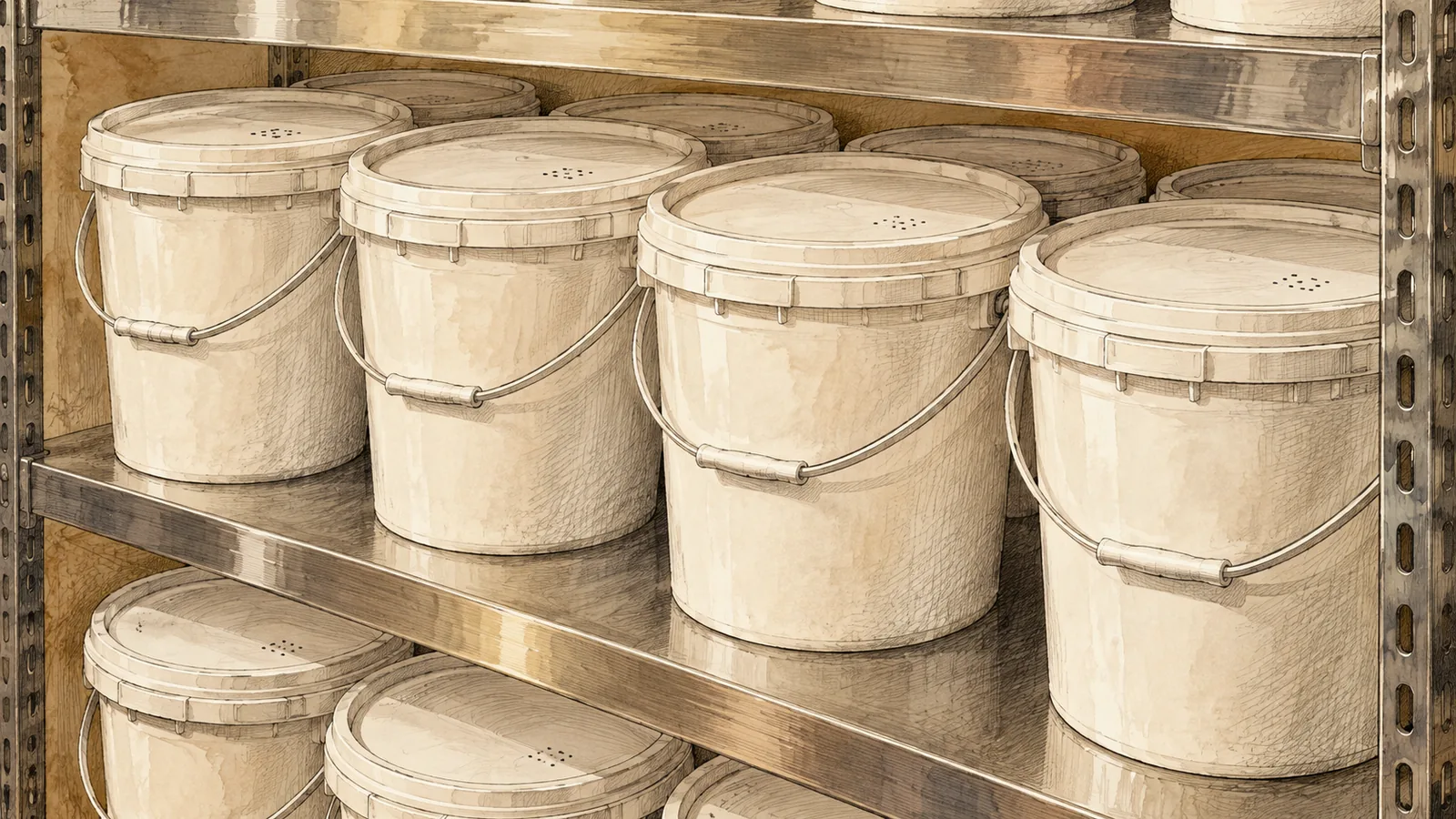
The first shipment from the Patagonian producer we buy from arrived with lot codes on the bucket lids. That answers one line of the list. We have asked in writing for confirmation that the salt is not iodised, and for the volume the producer can commit to each month. The question of whether anything else is added is on the list we have not yet sent. We are arranging an independent analysis by a US laboratory, and we are holding our detailed process questions until those results are in, so that we ask them knowing what the salt actually contains. That includes the Codex floor quoted above. We make no claim, in either direction, about how our salt measures against 97 per cent sodium chloride on a dry basis: one figure on the producer’s own label is among the things the independent analysis has to settle, and until it does, our own figure is unverified.
The first question on the list is one we do not fully answer in public: we do not print our producer’s name, for reasons set out in the article on who makes your salt. We would rather say so than pretend the list is easier to meet than it is.
As of this writing, several of our producer’s answers are outstanding: the independent analysis has not been run, we do not yet hold copies of the certificates the producer lists, and there is no written change-notification commitment. Until they are in, we are relying on the producer’s own labels and data, which is precisely the position this checklist is designed to get a buyer out of.
Sources
- eCFR — 21 CFR Part 1 Subpart J, establishment and maintenance of records
- FDA — Food Traceability List
- FDA — Food Traceability Rule and compliance date
- FDA — Foreign Supplier Verification Programs for importers
- Codex Alimentarius — CXS 150-1985, Standard for Food Grade Salt
- Global Food Safety Initiative — how certification works
- BRCGS — the Directory and free certificate lookup
- FDA — steps to ensure the safety of cinnamon products, March 2024
Read next
- What a Salt Certificate Actually Covers — site, scope and expiry, not logos
- Who Actually Makes Your Sea Salt — the first question on the list
- What Is Smoked Salt and How Is It Made? — direct smoke versus flavouring
- Patagonian Sea Salt — the salt we are putting through this checklist
The Salt Guide
We are recording the salts on the American shelf one jar at a time — label, panel, price paid, crystal on white. Browse the guide →