
PDO, PGI, DO: Which Sea Salts Have Protected Names
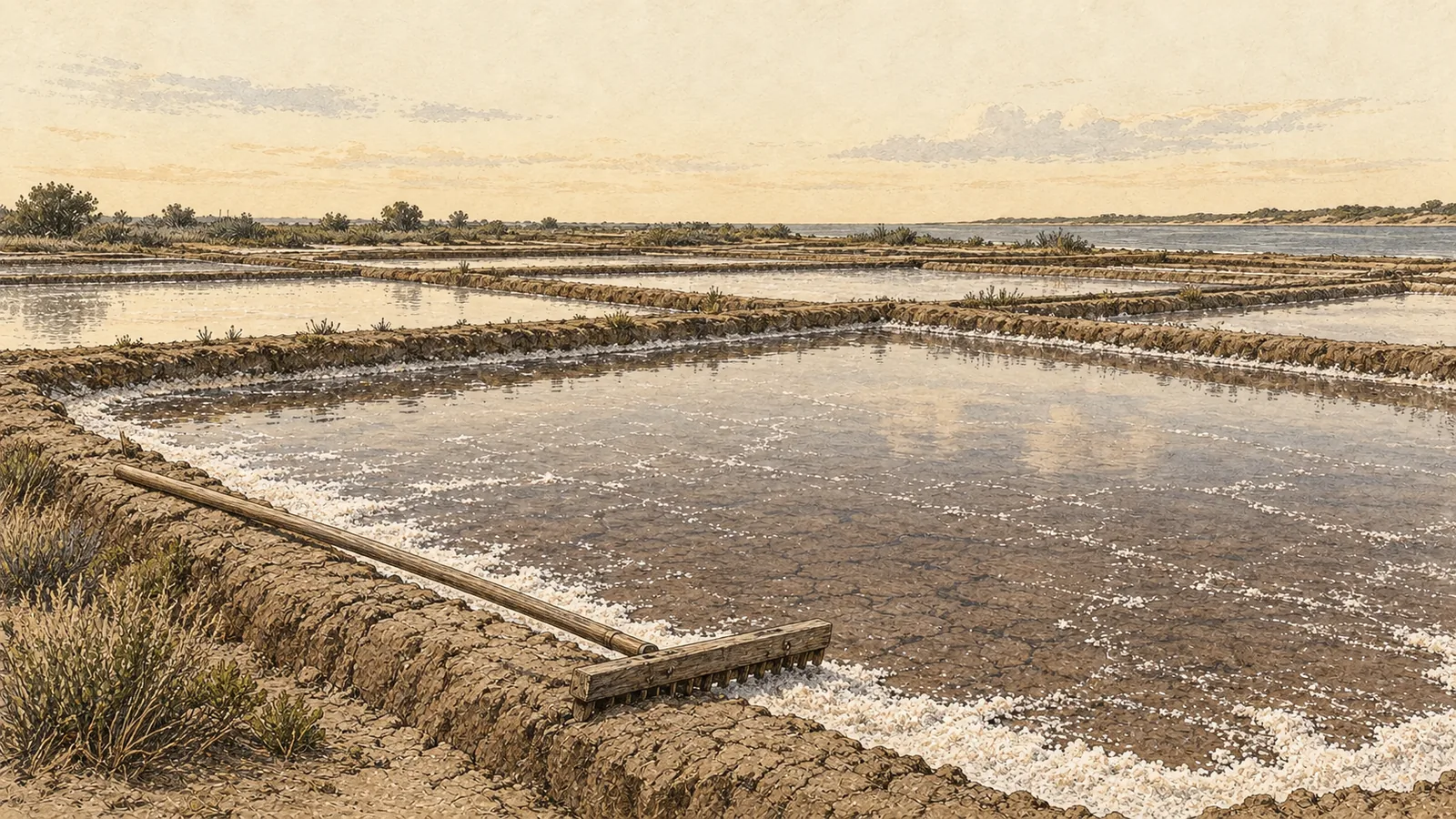
A protected name is the strongest origin architecture in salt, and very few salts have one. We count ten registered entries in the European Union’s salt class, of which two are not sea salt at all. Maldon, Cyprus flake, Ibiza salt and everything from Patagonia have no protected name of any kind. What a seal protects is a place and a method written into a specification document, and those documents disagree with each other sharply: the Guérande specification forbids washing the salt after harvest, while the Trapani specification permits washing it and drying it at up to 250 °C. Read the specification, not the logo.
What PDO, PGI and DO actually mean
Three acronyms carry most of the weight.
PDO — protected designation of origin, AOP in French, DOP in Italian and Portuguese. Every stage of production has to happen inside the named area, and the product’s character has to be attributable to that area. It is the tighter of the two European schemes.
PGI — protected geographical indication, IGP. At least one stage of production has to happen inside the area, and the link to the place may rest on reputation rather than on chemistry. That is a real difference: a PGI can, in principle, allow processing elsewhere.
GI and denomination of origin are the equivalent instruments outside the European Union, run on each jurisdiction’s own terms.
None of the three is a quality mark. None certifies that a salt tastes better or is cleaner than an unprotected one. They bind a name to a place and to a written method, and give somebody standing to sue when a name is used loosely.
Which sea salts have a protected name
| Name | Country | Type | Registered | What the specification pins down |
|---|---|---|---|---|
| Sel de Guérande / Fleur de sel de Guérande | France | PGI | 2012 | Manual harvest, no additives, unwashed after harvest, moisture below 12 per cent |
| Sale Marino di Trapani | Italy | PGI | 2012 | Three named communes, no additives — but washing and drying to 250 °C are permitted |
| Sal de Tavira / Flor de Sal de Tavira | Portugal | PDO | 2013 | Traditional Algarve pans, hand harvest |
| Anglesey Sea Salt / Halen Môn | United Kingdom | PDO | 2014 | Menai Strait water; magnesium at least 0.2 per cent; moisture under 4 per cent |
| Piranska sol | Slovenia | PDO | 2014 | Daily hand harvest from a cultivated petola layer; unwashed, unrefined |
| Oriel Sea Salt | Ireland | PDO | 2016 | Irish Sea water off Co. Louth |
| Oriel Sea Minerals | Ireland | PDO | 2016 | Registered in the salt class alongside the salt itself |
| Achill Island Sea Salt | Ireland | PDO | 2023 | The newest sea salt on the register |
| Sel de Salies-de-Béarn | France | PGI | 2016 | Not sea salt — an inland salt spring |
| Sal de Rio Maior / Flor de Sal de Rio Maior | Portugal | PDO | 2025 | Not sea salt — an inland saline spring |
Two things about that table are worth saying. The first is that it is short: ten entries, across a trading bloc that registers thousands of protected cheeses, hams and oils. The second is that two of the ten are not marine at all. Salies-de-Béarn draws on an inland brine spring, Rio Maior on a saline spring in Santarém district. The register does not pretend otherwise, because the category is called salt, not sea salt.
The specifications disagree with each other
This is the part that gets lost. People read a protected-origin seal as a proxy for “unwashed, unheated, hand-made”. It is not. Each specification is negotiated separately, by the producers of that place, and they made different bargains.
The Guérande cahier des charges, homologated by France’s INAO, requires manual harvest with named tools, prohibits additives outright, and states that the salt is non raffiné et non lavé après récolte — unrefined and unwashed after harvest. Where drying is permitted it must be indirect, with no open flame and no contact with combustion gases. It sets moisture at 12 per cent or less and insoluble matter at 1 per cent or less for the grey salt, 0.20 per cent or less for the fleur de sel. It sets no mineral minimum at all.
The Trapani PGI specification describes a very different operation on the same principle. Salt from three Sicilian communes, harvested by hand or by machine, then washed counter-current in saturated brine, centrifuged, ground, dried at up to 250 °C and mechanically screened. Additives, bleaches, preservatives and anti-caking agents are excluded. So a PGI salt can be washed and heated hard, and still be a PGI salt, because that is what the region does and the specification says so.
The Halen Môn PDO specification is the only one in the group that writes a mineral floor into the text. Sodium chloride above 90 per cent by weight, calcium between 0.08 and 0.15 per cent, moisture below 4 per cent, and magnesium of at least 0.2 per cent. Note what kind of number that is. It is a regulatory minimum, not a typical analysis and not a lab result for the jar in your hand. Comparing it to a competitor’s measured figure is comparing a floor to a data point, as we flagged in our piece on Maldon.
Piran is stranger still. The Piranska sol PDO turns on the petola, a cultivated crust about a centimetre thick, made of cyanobacteria, gypsum, carbonates and clay, grown and maintained on the basin floor with wooden tools. It keeps the salt off the underlying mud and acts as a filter. The salt is raked daily with a wooden gavero and is neither refined nor rinsed. The protected thing, in other words, is partly a living organism that the salt workers farm. Nothing else on the register works like that, and it is the clearest demonstration anywhere that the pond floor is a manufacturing input — which is the whole argument behind grey salt.
What is not protected
Maldon has no designation. Neither does Cyprus flake salt, nor Ibiza salt, nor Sicilian salt sold without the Trapani mark, nor anything from Patagonia, including ours. A keyword search of the GOV.UK register of protected food and drink names returns three results, and only two are salt: Anglesey Sea Salt / Halen Môn and Oriel Sea Salt, both class 2.6. The third is Gower Salt Marsh Lamb, fresh meat caught by the word in its name. Maldon is not among them.
That absence is not a verdict. Maldon has been made on the same estuary since 1882 and is better known than most of the protected names combined. A register records who applied, who could organise a producer group and who could afford the file. It does not rank the salt.
A national designation is not a European one
Portugal is the instructive case. Its agriculture directorate lists six salt entries in its traditional-products register. Tavira and Rio Maior carry DOP — the European mark. Castro Marim carries only DO, a Portuguese national designation of origin granted by Despacho n.º 6105/2020, published in the Diário da República on 5 June 2020. Figueira da Foz, Aveiro and the generic sal marinho tradicional carry nothing at all.
Castro Marim flor de sal is sold internationally, and the phrase “protected designation” attaches to it honestly under Portuguese law. It is still not on the European register, and a buyer who assumes the two are the same thing has skipped a step. We had assumed it ourselves until we read the directorate’s own listing, which marks the difference in a single letter.
Outside Europe
Chile registered Sal de Cáhuil, Boyeruca y Lo Valdivia as a denomination of origin through INAPI, under its Sello de Origen programme, registration 1010767, covering a seasonal coastal-lagoon salina system on the O’Higgins coast. Neither INAPI page we read carries a date; the year 2013 comes from the agriculture ministry’s own survey. Nor is it held by a collective, as we first wrote. The register record names one company as titular, Sal de Mar y Turismo Pacífico Central SpA, with named salineros beneath it as authorised users. The practical consequence survives the correction: the right question about a bag of Cáhuil salt is not whether it is protected, but which registered producer made the lot.
The Philippines registered Alburquerque Asin Tibuok as a geographical indication on 3 October 2025, registration G/4/2024/00008, applied for by the local government of Alburquerque in Bohol. Note the registered name: it is not the bare phrase asin tibuok but the town plus the product. The salt is made by burning seawater-soaked coconut husks, filtering brine through the ash and boiling it in unglazed clay pots that have to be broken to free a single solid mass. UNESCO added it to the list of intangible cultural heritage in need of urgent safeguarding in December 2025, which tells you how thin the ground under it is.
Argentina took the other road
There is no Argentine protected name for sea salt, and none is being sought as far as we can establish. What Argentina did instead, in 2024, was write a compositional standard into its food code: Sal Marina Argentina, defined by Argentine seawater plus a minimum of 2 per cent calcium, magnesium and potassium chlorides on dry residue. We wrote that up in the law piece.
The two bargains are genuinely different. A protected name constrains where and how, and says nothing about what ends up in the crystal. The Argentine rule constrains what ends up in the crystal, and says nothing about which stretch of coast it came from. Of the names in the table above, Halen Môn is the only one that does both, and it does the compositional half with one number. We have not read every protected name on earth.
We are not going to argue that one route is superior. Our salt complies with an Argentine compositional article and carries no protected name, and if we claimed that was the better arrangement we would only be doing what the register-holders do in reverse. It is a different instrument for a different problem, and the honest position is to say which one a product holds.
Two caveats on our own work here. We could not load the European register’s own product-class filter directly, so the count of ten is assembled from individual registration regulations and the UK register rather than from a single authoritative list; if there is an eleventh salt-class entry we have missed it. And the Castro Marim and Rio Maior determinations were read in Portuguese, in translation, from a national register and a Commission announcement rather than from the full specification texts.
Sources
- GOV.UK — register of protected food and drink names
- UK GI scheme — Anglesey Sea Salt / Halen Môn PDO specification
- INAO — cahier des charges, IGP Sel de Guérande
- European Commission — Piranska sol PDO and the petola
- Qualigeo — Sale Marino di Trapani PGI specification
- EUR-Lex — Implementing Regulation (EU) 2023/2681, Achill Island Sea Salt PDO
- INAPI — Sello de Origen register record, registro 1010767
- ODEPA — Chilean geographical indications and denominations of origin
- IPOPHL — Alburquerque Asin Tibuok GI registration
Read next
- Argentina Wrote Sea Salt Into Law in 2024 — protection by composition instead of place
- What Is Actually in Maldon — the best-known salt with no designation
- What Is Fleur de Sel — the fraction Guerande protects most tightly
- Patagonian Sea Salt — what we hold and what we do not
The Salt Guide
We are recording the salts on the American shelf one jar at a time — label, panel, price paid, crystal on white. Browse the guide →