
Svan Salt: What Is in It and What Its Heritage Status Covers
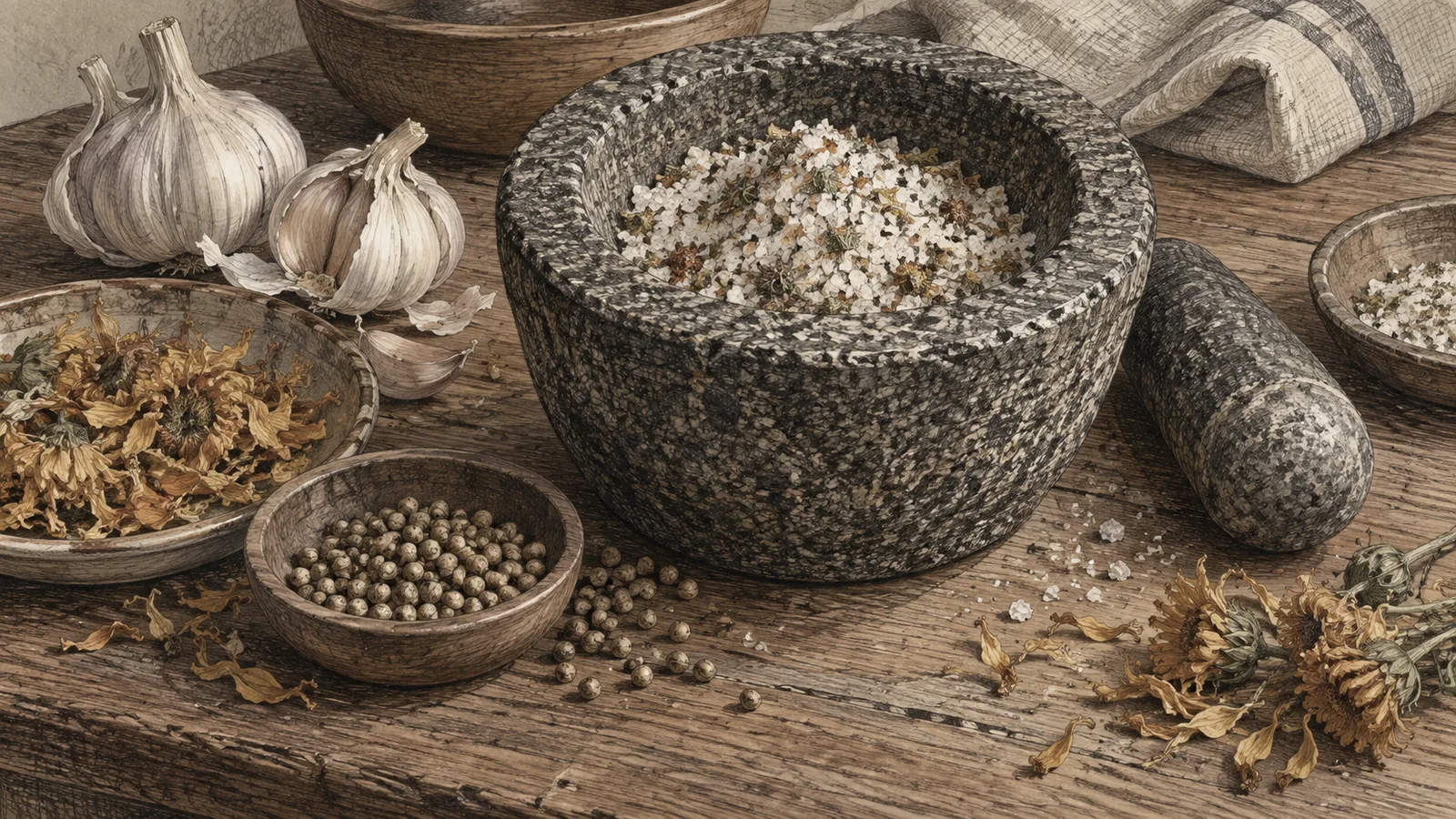
Svan salt — svanuri marili — is a damp, coarse seasoned salt from Svaneti in north-west Georgia: salt ground with garlic, coriander, blue fenugreek, dried marigold, chilli, dill and a wild caraway called gitsruli. On 9 March 2015 Georgia’s National Agency for Cultural Heritage Preservation gave the traditional method of making it monument status as intangible cultural heritage. It is not on any UNESCO list, and the status protects a practice, not a name or a recipe.
What is Svan salt made of?
There is no single formula, and every Georgian source we read says so in one way or another. What there is, is a stable core. We compared three Georgian or Georgia-based descriptions: the ingredient list published in 2015 by Heritage For Future, a Georgian heritage NGO documenting the element; the recipe on georgia.travel, the site of the national tourism administration; and the Slow Food Ark of Taste entry nominated from Georgia.
| Ingredient | Georgian name | Heritage For Future (2015) | georgia.travel | Ark of Taste |
|---|---|---|---|---|
| Salt | marili | coarse, white | four times the spices, combined | yes |
| Garlic | niori | yes | enough to moisten | yes |
| Coriander seed | kindzi | yes | 2 parts | yes |
| Blue fenugreek | utskho suneli | yes | 1 part | yes |
| Marigold petals | zaprana | yes | 1 part (“saffron”) | dried marigold flowers |
| Red chilli | tsitsaka | dried and ground | 1 part | dried red pepper |
| Dill | kama | yes | 1 part (“fennel (dill)”) | not listed |
| Gitsruli | gitsruli | yes | ½ part (“wild cumin”) | “caraway flower” |
| Summer savory | kondari | yes | not listed | not listed |
| Black pepper | pilpili | yes | not listed | not listed |
Six things appear in all three: salt, garlic, coriander, blue fenugreek, marigold and chilli. Gitsruli appears in all three under three different English names. Dill, savory and black pepper are where households part company.
The column most English recipes get wrong is the fifth. Georgian cooking uses the word zaprana, saffron, for dried marigold petals, known as Imeretian saffron, imeruli zaprana. The georgia.travel recipe says “saffron”, and the Ark of Taste entry, written for outsiders, says marigold. The Georgian sources are describing marigold, not crocus stigmas. An English recipe that calls for real saffron has mistranslated the word, and the mistake is reasonable: it is the word on the Georgian page.
What does the heritage status actually cover?
The decree is order No. 2/34 of 9 March 2015, issued by the National Agency for Cultural Heritage Preservation of Georgia and published in Georgia’s official legal register, Matsne, on 11 March 2015. It grants monument status to six Svan elements at once: the making of the chuniri, a bowed folk instrument; the making of the Svan felt hat; and, under the heading “Svan cuisine”, the traditional methods of making millet khachapuri, kubdari, tashmjabi and Svan salt.
Read the wording closely. What is protected is “the traditional method of making Svan salt”. That is a practice, listed on a national register. It is not a geographical indication, it does not reserve the name, and it sets no ingredient list or composition. Anyone, anywhere, may sell a jar called Svan salt.
It is also not UNESCO. Georgia has five elements on UNESCO’s Representative List of the Intangible Cultural Heritage of Humanity: polyphonic singing (2008), the qvevri wine-making method (2013), the living culture of the three Georgian scripts (2016), chidaoba wrestling (2018) and Georgian wheat culture (2025). Svan salt is not among them. English copy that calls it “UNESCO-listed” is wrong.
We also looked for it as a geographical indication. We did not find it among Georgia’s registered food GIs, though we could not load Sakpatenti’s own register to confirm.
So a label reading “heritage Svan salt” tells you that the tradition is recognised by the Georgian state. It tells you nothing about what is in that particular jar. That is not a flaw in the decree; it was never meant to certify products.
How is it made?
By hand, and in season. The Heritage For Future documentation describes garlic and salt going into a mortar first, the dried herbs and seeds following, and the whole pounded until the garlic has disappeared into the salt. It gives the making season as late spring and early autumn, before about 10 September, and says a hermetically sealed jar keeps for one to two years. Its worked quantities produce about 200 g.
The georgia.travel recipe is the only Georgian-published version we found with proportions: 2 parts coriander; 1 part each of dill, blue fenugreek, chilli and marigold; ½ part gitsruli; salt equal to four times the ground spices; and enough fresh garlic to moisten the mixture. It asks for whole seeds ground at home. Treat those numbers as one respectable household’s formula, published by a tourism body, not as a standard. There is no standard.
The fresh garlic is what makes the salt damp, and damp is correct. The same page lists what to look for when buying: a moist texture, a smell you notice before the jar is open, a dark colour rather than a bright yellow one, large grains of salt, and a sealed container. By that description, a dry, free-flowing, bright yellow powder is not what the Georgian sources mean.
What is gitsruli?
It is the ingredient that separates Svan salt from a generic Georgian spice salt, and the one we could least pin down. Heritage For Future describes it as a plant of the high meadows of Svaneti and also gives the name dzira, the usual Georgian word for cumin. The Ark of Taste entry calls it “a typical caraway flower” growing at around 2,000 metres, and says it is hard to find the authentic salt “even in lower parts of the region.” Locals, it adds, hold that without this flower it cannot be called Svan salt.
English sources translate it as wild cumin or caraway. We did not find a Georgian source that gives it a botanical name, and we are not going to supply one. What can be said is that it grows wild, at altitude, in one region, and that it is the ingredient a producer outside Svaneti is least able to buy.
What is in commercial Svan salt?
We read the ingredient lists of two versions sold to American buyers, from the sellers’ own pages, in September 2026. Both were marked sold out when we checked.
| Product | Ingredients, as listed | What differs from the Georgian core |
|---|---|---|
| Kalustyan’s Svanetian Seasoned Salt, Georgian (house brand) | Coriander, blue fenugreek, cumin, dill, garlic, black pepper, Salt | No marigold, no chilli; cumin where gitsruli would be; salt listed last |
| Suneli Valley Svanetian Salt (product of Georgia) | Salt, marigold petals, blue fenugreek, garlic, dill, coriander, chili powder, sunflower oil | Adds sunflower oil; no gitsruli or caraway in the list, although the product description mentions wild caraway |
Two things are worth noticing. US rules require ingredients to be listed in descending order of predominance by weight. Kalustyan’s page puts salt last, which means either the blend is mostly spice or the web listing does not follow the label order; the page does not say which, and we would check the jar before assuming. Suneli Valley’s sunflower oil is a carrier that no household recipe we read contains. Neither is a scandal. Both are the ordinary distance between a village mortar and a shelf.
How is Svan salt used?
In place of plain salt, which is how Kalustyan’s describes it and how the Georgian sources use it. The Ark of Taste entry lists potatoes in kubdari, the Svan meat pie; tomato and cucumber salads; and bean stews. The georgia.travel page adds fried pork, Georgian cheeses, sauces and meat. The Borjomi gastronomy guide, in Georgian, adds boiled and fried meat, meat stewed in tomato, boiled potatoes and soups.
Because it is moist, it does not go in a shaker. It is pinched, rubbed and stirred. And because it is roughly four parts salt to one part spice in the published proportions, it is seasoning first: a recipe that already salts a dish and then adds Svan salt “for flavour” has salted it twice. For how a garlic-carrying salt behaves against the powder, see garlic salt versus garlic powder; for where Svan salt sits among the world’s other seasoned salts, see salt blends around the world.
Where to find blue fenugreek in the US
Blue fenugreek, utskho suneli, is Trigonella caerulea. It is a different species from the fenugreek sold in Indian groceries, and Kalustyan’s describes it as less bitter and less astringent than that one. In the US it is a specialist-shop and online item. Kalustyan’s in New York lists a ground Georgian blue fenugreek; it too was sold out when we checked. Seed for growing it is sold by some American seed companies, which is the more reliable route if you intend to make this every year.
Substituting ordinary fenugreek is possible and changes the result. Leaving out the gitsruli, on the view the Ark of Taste entry reports from Svaneti, means it is not Svan salt at all. A cook outside Georgia is making a version, and saying so costs nothing.
We do not make a Svan salt, and we will not. If you are interested in why a named origin matters on a salt at all, protected-origin salt covers the registered examples.
A caveat on our sourcing. The decree names the practice but not the ingredients, so the ingredient comparison rests on an NGO’s documentation, a tourism board’s recipe and a Slow Food entry, not on any legal text. We read the Heritage For Future page through a translation tool, and could not open Sakpatenti’s register. If you can point us to a Georgian botanical identification of gitsruli, we would like to see it.
Sources
- Matsne (Georgian legislative herald) — National Agency for Cultural Heritage Preservation, order No. 2/34, 9 March 2015
- UNESCO Intangible Cultural Heritage — Georgia and its inscribed elements
- Heritage For Future — the traditional method of making Svan salt (in Georgian, 2015)
- Georgia Travel (Georgian National Tourism Administration) — Svan salt
- Slow Food Foundation for Biodiversity — Ark of Taste: Svanetian salt
- Kalustyan’s — Svanetian Seasoned Salt, Georgian
- Suneli Valley — Svanetian Salt
- Kalustyan’s — Blue Fenugreek Seed (Utskho Suneli), Georgian, Powder
Read next
- Salt Blends Around the World — the survey this goes deeper than
- Protected-Origin Salt — what a registered name does protect
- Garlic Salt vs Garlic Powder — the other garlic-carrying salt
- Patagonian Coarse Salt — a plain coarse salt, nothing added
The Salt Guide
We are recording the salts on the American shelf one jar at a time — label, panel, price paid, crystal on white. Browse the guide →