
What Is Actually in Goya Adobo
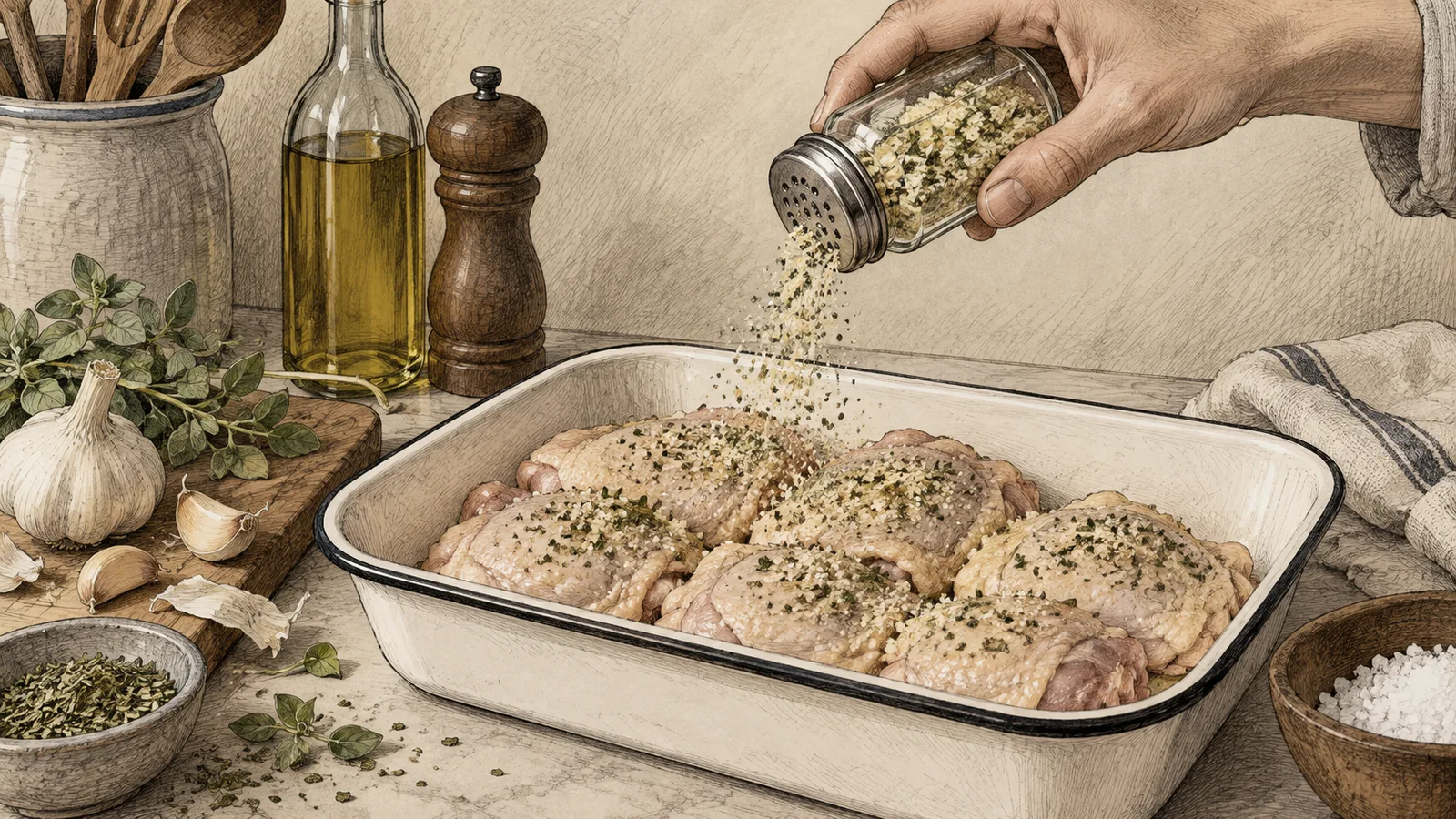
Goya’s own panel for Adobo All-Purpose Seasoning with Pepper lists six ingredients: SALT, GARLIC, TRICALCIUM PHOSPHATE (ANTICAKING AGENT), BLACK PEPPER, OREGANO, TURMERIC. There is no MSG on it. Sodium is 520 mg per ¼ tsp (1.5 g), 23 per cent of the Daily Value, which works out at roughly 88 per cent salt by weight. The Light version is sold as “50% Less Sodium” and puts potassium chloride second on its list.
The panel, word for word
It is a short list and a candid one. Every ingredient is named. There is no “spices”, no “natural flavor”, no sugar, no starch and no flavour enhancer. The text on Goya’s product page and the panel printed on the 8 oz pack shown there agree:
- Salt
- Garlic
- Tricalcium phosphate (anticaking agent)
- Black pepper
- Oregano
- Turmeric
US ingredient lists run in descending order of weight, so garlic is the main thing in the shaker that is not salt, and there is more anticaking agent than black pepper. That last detail surprises people. It should not. The label says what the tricalcium phosphate is for, and a fine garlic powder that clumps is no use in a shaker. Pepper, oregano and turmeric are there in the small quantities a seasoning needs.
The pack says Product of USA and gives Goya Foods, Jersey City, New Jersey as distributor, with a second address for Goya en España near Seville. Goya lists the product in 8, 12, 16.5 and 28 oz sizes.
How much of it is salt
The label does not say, but the sodium line lets you work it out. 520 mg in 1.5 g is about 347 mg of sodium per gram of product. Pure sodium chloride is 39.3 per cent sodium, 393 mg per gram. Divide one by the other: about 88 per cent salt.
That is our arithmetic, not Goya’s. Sodium above 140 mg is declared to the nearest 10 mg, so the true figure sits between 515 and 525 mg. The serving weight is rounded too: under 2 g it is stated to the nearest 0.1 g, so 1.5 g means anything from 1.45 to 1.55 g. Allowing for both, the salt share sits between roughly 85 and 91 per cent. The midpoint is the useful number. The estimate assumes the sodium comes from the salt, which on a six-ingredient panel with no other sodium source listed is a safe assumption.
So the garlic, the anticaking agent, the pepper, the oregano and the turmeric together make up about an eighth of what is in the shaker. Adobo is not a spice blend with some salt in it. It is garlic-seasoned salt with a little pepper and herb, coloured yellow. That is exactly what it is sold as, and there is nothing wrong with it. It is still worth knowing when you reach for it.
Is there MSG in Goya Adobo
Not in the with-pepper version. Monosodium glutamate does not appear on the panel, and in the United States it would have to be named if it were added.
The confusion is reasonable, because a neighbouring Goya product does contain it. Goya’s Sazón with Coriander and Annatto lists MONOSODIUM GLUTAMATE as its first ingredient, ahead of salt, followed by dehydrated garlic, cumin, Yellow 5, tricalcium phosphate, coriander, annatto and Red 40. Sazón comes in foil packets, adobo in a shaker, and both carry the same brand on a yellow-and-blue label. In a dish seasoned with both, the labels say the glutamate came from the sazón. The adobo panel gives no reason to think otherwise.
What “Light” removes, and what it does not
Goya sells two lower-sodium adobos, Adobo Light with Pepper and Adobo All-Purpose Seasoning Light without Pepper, both with “(50% Less Sodium)” in the product name. The pack photograph on Goya’s page for the with-pepper version reads SALT, POTASSIUM CHLORIDE, GARLIC, TRICALCIUM PHOSPHATE (ANTICAKING AGENT), BLACK PEPPER, OREGANO, TURMERIC. Kroger’s listing for the same 8 oz item gives the same first four ingredients, with oregano ahead of black pepper. Goya also sells an adobo made with Mediterranean sea salt. The three panels side by side:
| Label line | Adobo with Pepper | Adobo Light with Pepper | Adobo with Mediterranean Sea Salt with Pepper |
|---|---|---|---|
| First ingredient | Salt | Salt | Sea salt |
| Second ingredient | Garlic | Potassium chloride | Garlic |
| Serving size | ¼ tsp (1.5 g) | ¼ tsp (1.5 g) on Goya’s pack photo; about 1 g on Kroger’s panel | ¼ tsp (1.5 g) |
| Sodium per serving | 520 mg (23% DV) | 260 mg (11% DV) per 1.5 g; 170 mg (7% DV) per serving on Kroger’s panel | 520 mg (23% DV) |
| Potassium per serving | Not declared | Could not be read; not listed on Kroger’s panel | Not declared |
| Salt share, our estimate | About 88% | Not estimated | About 88% |
On the pack figures the Light version cuts the sodium by exactly half, which is what the product name promises. It does it by adding potassium chloride, which sits second on the list. What we cannot tell you is how much. Goya’s product page carries no nutrition text for the Light version, only photographs of the pack, and we could not read a potassium figure from them that we would stand behind. Kroger’s panel for the same 8 oz item lists no potassium at all. Without a printed potassium figure there is no honest way to split the product into salt, potassium chloride and seasoning, so we have not.
The two panels also disagree on the serving. Goya’s pack photo gives ¼ tsp at 1.5 g and 260 mg of sodium. Kroger’s gives 227 servings in the 8 oz jar, which is about 1 g each, at 170 mg. Per gram, the two work out almost the same, 173 against 170 mg, so they probably describe the same powder on different serving conventions. Goya’s own page does not state a serving size in text, and we have taken the pack photograph as Goya’s figure. What potassium chloride is, and why it tastes the way it does, is covered in potassium chloride vs sodium chloride.
The word itself is regulated. Under 21 CFR 101.56, a food whose reference food has 40 calories or less and 3 g of fat or less per reference amount may use “light” without further qualification if its sodium is reduced by 50 per cent or more. Regular adobo declares zero calories and zero fat per serving, which puts it in that group, so a 50 per cent cut is what the word requires, and the printed figures show exactly that. Goya puts the percentage in the product name as well, which is the more useful half of the claim. The wider vocabulary of lite and substitute salts is set out in lite salt vs salt substitute.
The sea salt version has the same sodium
This is the row we would put on a wall. Goya’s adobo with Mediterranean sea salt swaps the first word of the panel from SALT to SEA SALT and keeps the rest in the same order. Its Nutrition Facts, on a 9 oz pack of about 170 servings, give 520 mg of sodium per ¼ tsp (1.5 g). That is the same figure as the regular product, to the milligram.
Goya does not claim otherwise, and it is worth saying so. The sea salt version makes no sodium claim at all. The misunderstanding is the shopper’s, not the label’s, and it is a reasonable one: sea salt is widely marketed as if it were a different substance. It is sodium chloride from a different source, and a gram of it carries about as much sodium as a gram of any other white salt. The numbers across salt types are in sodium by salt type. Our own salt is sea salt, and the same is true of it.
What adobo was before it was a shaker
In Spanish, adobo is above all a wet thing. The Real Academia Española defines it as a broth or sauce for seasoning food, and in its fuller culinary sense as one made especially of “vinagre, sal, orégano, ajos y pimentón” — vinegar, salt, oregano, garlic and paprika — used to season and preserve meat.
Read against that definition, the dry shaker keeps three of the five: salt, garlic and oregano. The vinegar is gone, as it would have to be in a powder. So is the pimentón. The colour now comes from turmeric, which is the last ingredient on the panel. What remains is the garlic-and-salt core, dried so it can sit in a cupboard and be used in seconds.
Goya’s own instruction is brief: “A simple shake before cooking is all it takes.” Its product page recommends it for meat, chicken, fish and vegetables. The page also calls Goya “the #1 brand of Latin all-purpose seasonings”, which is a marketing claim, not a figure we can check.
What this means for how it seasons
The practical conclusion is simple. Adobo is the salt in the dish. A recipe that calls for adobo and then salt to taste is asking for salt twice, and the first addition is already about seven-eighths salt. Seasoned by eye, it behaves much like a fine salt with garlic in it, because that is what it is. Measure it as salt, and let the garlic be the bonus rather than the point.
The Light version seasons with half the sodium and some potassium chloride in its place, and whether it tastes the same is a question for the cook. The sea salt version seasons exactly as the regular one does. For the related case of salt carrying garlic and nothing else, see garlic salt vs garlic powder.
A caveat on our sourcing. The regular with-pepper ingredient list is text on Goya’s product page; the Nutrition Facts, and the full panels for the Light and sea salt versions, were read from the pack photographs on Goya’s own product pages, not from a jar we bought. Goya’s site carries its own disclaimer that labels may vary by region and supplier. Goya’s pages give the Nutrition Facts only as pack images, not text, and a second check could not read the Light version’s potassium line, so we have left that figure out. We did not examine the without-pepper panels. The salt percentages are our calculations from rounded label figures.
Sources
- Goya Foods — Adobo All-Purpose Seasoning with Pepper (ingredients and pack panels)
- Goya Foods — Adobo Light with Pepper (50% Less Sodium)
- Goya Foods — Adobo with Mediterranean Sea Salt with Pepper
- Goya Foods — Sazón with Coriander and Annatto
- Kroger — Goya Light Adobo All-Purpose Seasoning with Pepper, retailer panel
- Real Academia Española — Diccionario, “adobo”
- eCFR — 21 CFR 101.56, nutrient content claims for “light”
- eCFR — 21 CFR 101.9, nutrition labelling and rounding
Read next
- Garlic Salt vs Garlic Powder — the same idea with one ingredient fewer
- Lite Salt vs Salt Substitute — what the lower-sodium words mean
- Sodium by Salt Type — why sea salt is not a sodium claim
- Patagonian Sea Salt — sea salt, and no claim about sodium
The Salt Guide
We are recording the salts on the American shelf one jar at a time — label, panel, price paid, crystal on white. Browse the guide →