
What Is Actually in Old Bay
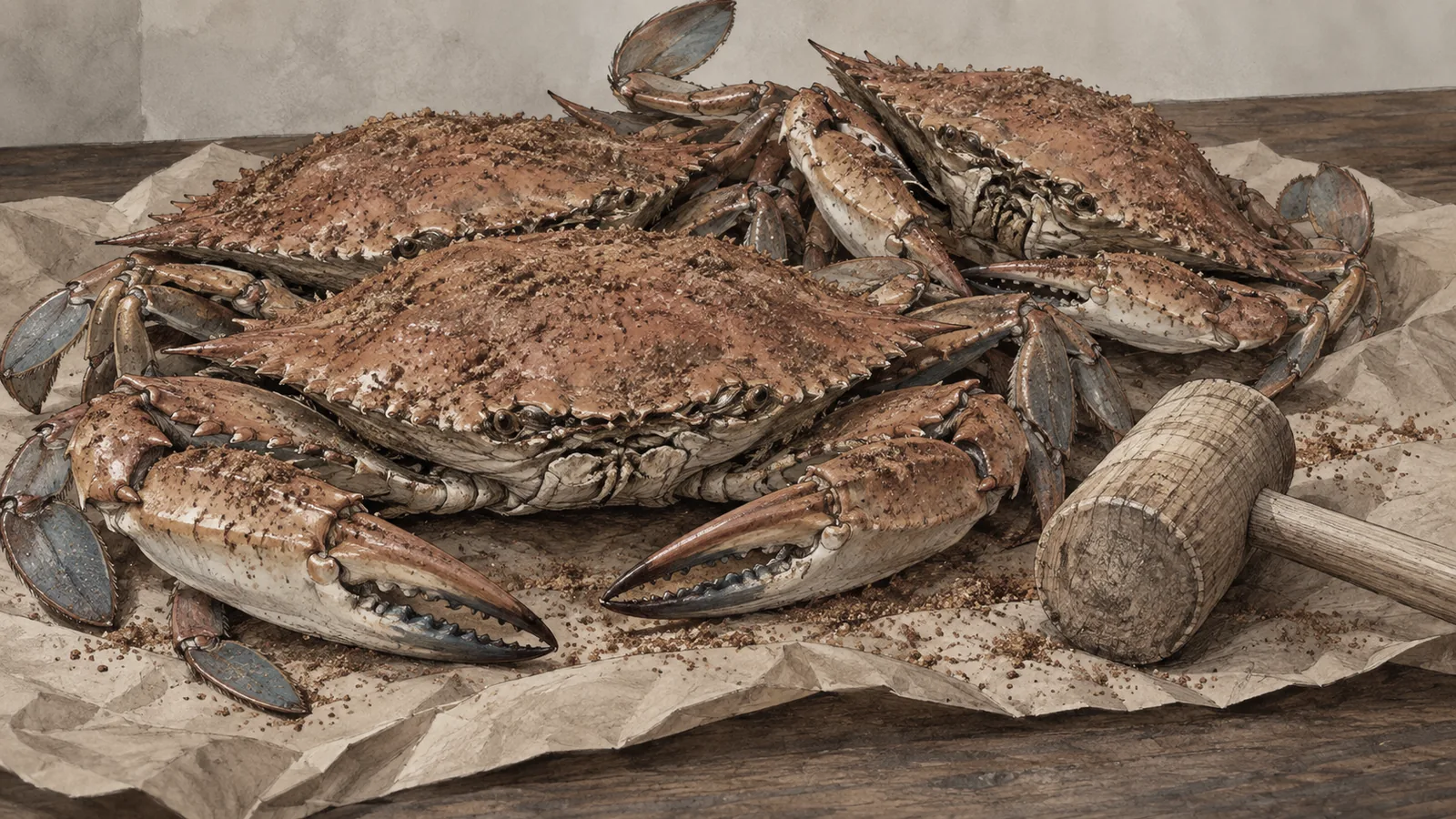
McCormick’s current panel for Old Bay reads, in full: “Celery Salt (Salt, Celery Seed), Spices (Including Red Pepper and Black Pepper), and Paprika.” The company’s own description is celery salt, 18 herbs and spices, and paprika. The order of the ingredients is public; the proportions are not, and US law does not require them to be. By the label’s own sodium figure, roughly three-fifths of what comes out of the can is salt.
What the Old Bay label actually says
The ingredient statement is the one printed on the tin and repeated on McCormick’s product pages for the 6 oz and 24 oz sizes. It has three entries. Celery salt, which is itself declared as salt and celery seed. “Spices”, with red pepper and black pepper named inside the bracket. And paprika.
Under 21 CFR 101.4, ingredients are listed in descending order of predominance by weight. So the single hard fact the label gives you is that there is more celery salt in the can than anything else, and less paprika than anything else declared separately. Everything between those two ends is a ranking, not a recipe.
The product pages add the marketing claims: non-GMO, gluten-free, “a kitchen staple since 1939.” A foodservice nutrition sheet for the same product, issued under McCormick For Chefs and hosted by a distributor, adds a free-from list that includes crustaceans, fish, milk, eggs, wheat, soy, peanuts, tree nuts and sesame. That is worth knowing for a seafood seasoning. It is not on the retail page text we could read.
Why “spices” can hide most of the eighteen
McCormick says there are 18 herbs and spices. The label names two of them. That is lawful. 21 CFR 101.22(h)(1) allows spice, natural flavour and artificial flavour to be declared simply as “spice”, “natural flavor” or “artificial flavor”. Naming red pepper and black pepper inside the bracket is a voluntary disclosure, not a requirement.
Paprika is the interesting exception. The same section, at 101.22(a)(2), says that paprika, turmeric, saffron and other spices that are also colours must be declared as “spice and coloring” unless they are declared by their common name. A red spice cannot hide inside “spices” the way celery seed or cinnamon can. That is the most likely reason paprika sits outside the bracket on its own line. We have not seen McCormick say so; it is what the regulation would produce.
Most readers assume a long, secret spice list must be hiding something unusual. The more reasonable reading is duller. US labelling rules were written so that spice blenders could protect their formulas, and Old Bay is simply using the room the rule gives it.
How much of Old Bay is salt?
The McCormick For Chefs sheet gives a serving of 0.6 g and 140 mg of sodium, 6 per cent of the daily value. That is about 23 g of sodium per 100 g. Sodium is roughly 39 per cent of sodium chloride by weight, so if all of that sodium came from salt, the blend is about 59 per cent salt.
Read that carefully. It is our arithmetic, not a McCormick figure. It is built on two rounded numbers: US labels round sodium to the nearest 5 mg at that level, and 0.6 g is itself a rounded weight. Moving each by half a step puts the answer anywhere from the mid fifties to the mid sixties. The sheet was printed in 2021 and is hosted by a distributor. What the number does tell you, reliably, is that salt is not a minor carrier here. It is most of the product, and the celery seed that makes it celery salt is extra weight on top.
For how that compares with other seasoning salts, the arithmetic is the same one we used in sodium by salt type, and the category itself is covered in what seasoning salt is.
| What you might want to know | Where the answer is | Status |
|---|---|---|
| Which ingredient is heaviest | Ingredient order (21 CFR 101.4) | Public: celery salt |
| Names of all 18 herbs and spices | Collective “spices” (101.22(h)(1)) | Not disclosed; two named voluntarily |
| Why paprika is listed by name | Colour-spice rule (101.22(a)(2)) | Required to be named or called “coloring” |
| Proportion of each ingredient | Nowhere on the label | Proprietary; no US requirement to publish |
| Approximate salt content | Derived from the sodium line | About 59 per cent, our calculation, wide error |
Why the proportions are not public
Because nothing obliges McCormick to publish them, and the formula is the asset. When McCormick bought the brand in 1990, the Baltimore Sun reported that the formulas passed with the sale and described the seasoning only as “celery salt, pepper, mustard and several other spices.” The price, which McCormick declined to confirm, was put by an industry executive at $11 million to $14 million.
Two further hints come from outside the label. The 1990 report names mustard. And the inventor’s son, Ralph Brunn, is quoted in several Baltimore histories saying the background of the blend came from “the most unlikely things, including cinnamon and nutmeg and cloves.” Both are recollection and reporting, not a current McCormick disclosure. Neither tells you how much.
Which means every “copycat Old Bay” recipe on the internet is a guess that happens to match the order on the tin. Some are good guesses. None of them is the formula, and any page claiming to reveal the exact proportions is claiming something McCormick has never published.
Who made it: Gustav Brunn and Baltimore, 1939
The core of the story holds up across every source we checked. Gustav Brunn was a German-Jewish spice merchant. He was arrested during Kristallnacht in November 1938 and held at Buchenwald, and was released after his family paid for a lawyer. He left Germany with his family and settled in Baltimore.
There he set up the Baltimore Spice Company on the second floor of 26 Market Place, across from the city’s wholesale fish market. The Baltimore Sun’s 1990 report says he founded the company in 1939. McCormick’s own pages say Old Bay has been around “since 1939”. The name came from the Old Bay Line, a steamship service between Baltimore and Norfolk, Virginia. Preservation Maryland and Maryland 400 both give the blend’s earlier name as “Delicious Brand Shrimp and Crab Seasoning.”
The details are where the sources part company, and we would rather show the seams than sand them off:
- Arrival year. Preservation Maryland has the family leaving in 1938, about ten days after his release. Baltimore Heritage has them arriving in Baltimore in 1939.
- The blend’s date. McCormick and the 1990 Sun report say 1939. Baltimore Heritage says Old Bay was developed “around 1940”. The company and the blend may simply not be the same age.
- A brief job at McCormick. Two accounts say Brunn worked at McCormick briefly before starting on his own, and they disagree on why it ended. Preservation Maryland says he was let go quickly, “attributed to his lack of facility with English.” Baltimore Heritage says he was fired for being Jewish. We are not going to pick one.
“Baltimore, 1939, Gustav Brunn” is a fair summary. “Invented in 1939” is the brand’s date and is well supported. What is not supported is the confident single-sentence version with an exact day, a single recipe moment and a tidy motive.
The Chesapeake crab context
The location explains the product. A spice grinder working across the street from a wholesale fish market, in a city whose shellfish came off the Chesapeake, made a seasoning named for shrimp and crab and then for a Chesapeake steamer. Baltimore Heritage records that Brunn built the blend after watching local crab steamers at work.
That is also why a celery-salt base is less odd than it looks. A crab seasoning is shaken heavily over shellfish that are steamed in the shell, so the salt and the aromatics have to arrive together in one pour. Salt carries the celery. It is the same logic as any seasoning salt, which is part of why regional salt blends so often lead with salt and name one dominant aromatic after it.
Old Bay is sold nationally now, and McCormick’s own pages suggest it for chicken, fries and vegetables as readily as for crab cakes. The label has not moved to follow it. On the tin it is still a Chesapeake seafood seasoning, sold everywhere.
What the label does not tell you
It does not tell you the eighteen names, the ratio of celery seed to salt, or the grind. It does not tell you whether mustard, which the 1990 report named, is still in the blend. In the US that does not have to be spelled out: mustard is not one of the nine major food allergens. In the EU and the UK, mustard and celery are both declarable allergens, and Canada lists mustard, so an export label would have to name them if present. We could not find a current McCormick panel from those markets to compare.
None of this makes Old Bay dishonest. The panel is lawful, the ordering is real, and the brand discloses more than it has to by naming the two peppers. It is a proprietary blend doing exactly what the rules allow. That is a deliberate design choice and a defensible one. It is simply not the same thing as telling you what is in it.
We are developing seasoning blends of our own, none of them yet a product. One question that development is trying to answer is whether we can publish proportions as well as order. The salt glossary covers the terms used on panels like this one.
A caveat on our own sourcing: the ingredient statement comes from McCormick’s current product pages, but the serving size and sodium figure come from a McCormick For Chefs sheet, printed in 2021 and hosted by a distributor, because the retail pages show nutrition only as an image we could not read as text. The history relies on a 1990 newspaper report and on Baltimore and Maryland heritage organisations, which disagree on two dates. We found no McCormick page that tells the Brunn story in its own words.
Sources
- McCormick — OLD BAY Seasoning, 6 oz, ingredients and description
- McCormick For Chefs — Old Bay Seasoning nutrition sheet (distributor-hosted, printed 2021)
- eCFR — 21 CFR 101.4, ingredient order by weight
- eCFR — 21 CFR 101.22, spices, flavourings and colour-spices
- Baltimore Sun — McCormick buys locally invented Old Bay crab spice (1990)
- Baltimore Heritage — Gustav Brunn’s Baltimore Spice Company
- Preservation Maryland — Old Bay was created in Baltimore by a German-Jewish immigrant
- Maryland 400 — Gustav Brunn develops Old Bay seasoning
Read next
- What Is Seasoning Salt — the category Old Bay belongs to
- Sodium by Salt Type — the arithmetic behind the 59 per cent
- Salt Blends Around the World — other regional salt-led blends
- Patagonian Sea Salt — the salt we import, and how we document it
The Salt Guide
We are recording the salts on the American shelf one jar at a time — label, panel, price paid, crystal on white. Browse the guide →