
Himalayan Pink Salt Is Neither
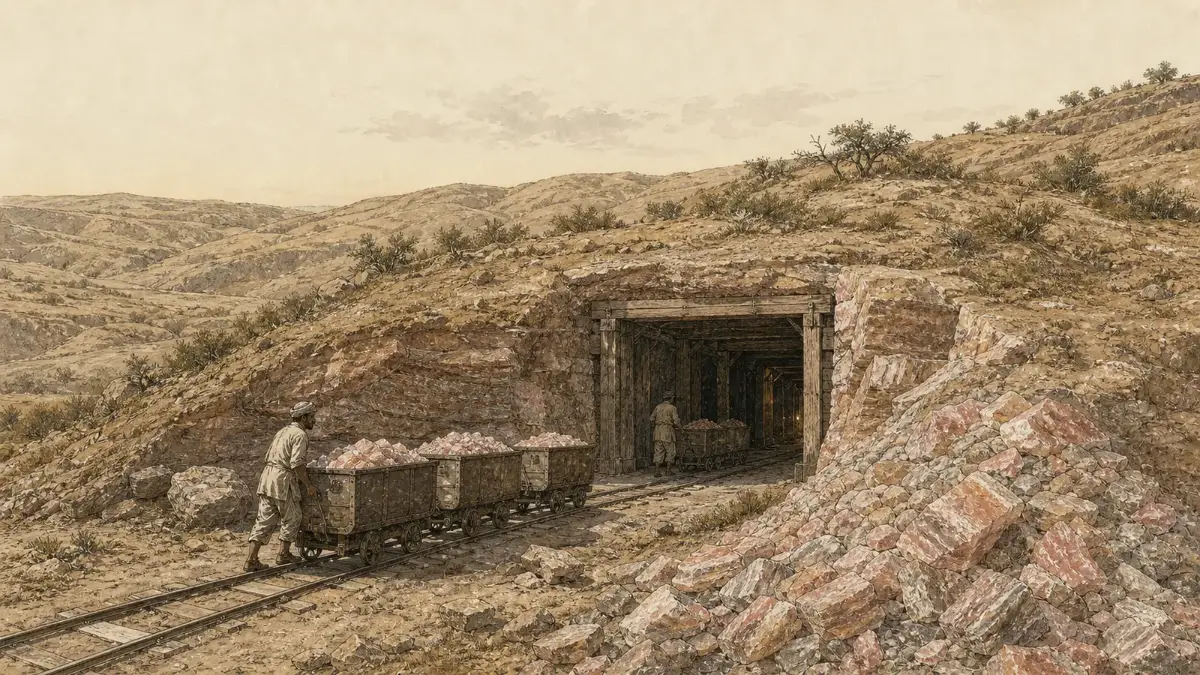
It is mined, not evaporated. It comes from Punjab, not the Himalayas. It is 96 to 99 per cent sodium chloride, which makes it slightly less pure than refined table salt, not more. And the famous 84 trace minerals come from a single uncontrolled analysis that reports plutonium and radium in table salt. It is a perfectly good salt sold with a story that does not survive ten minutes of checking.
Where it actually comes from
The Khewra Salt Mine, in Jhelum District, Punjab, Pakistan. It is the second-largest salt mine in the world, it has been worked since long before anyone marketed it, and it is operated by the state-owned Pakistan Mineral Development Corporation.
Khewra sits in the Salt Range, a low range of hills well south of the Himalayas proper. The name on the packet is doing geographical work the geology does not support.
It is rock salt, and it is old
The deposit is an evaporite of the Salt Range Formation, laid down somewhere around the Ediacaran to early Cambrian — before fish, before land plants, before almost anything you would recognise as alive. An inland sea dried out and the salt was buried.
So it is not sea salt in any sense a cook means it. Nothing about it involves present-day seawater, evaporation ponds, tides or coastline. It is a mineral, quarried out of a hillside, crushed and graded.
The 84 minerals
This is the claim that sells it, and it does have a document behind it. That document is the problem. What circulates is a one-page “Certificate of the Analysis of the Original Himalayan Crystal Salt”, reproduced from Barbara Hendel and Peter Ferreira’s book Water & Salt and credited to an Institute of Biophysical Research in Las Vegas, June 2001. It runs to ninety-four rows, hydrogen through plutonium.
It is not an analysis a food buyer should accept. Most of the values are reported as “less than” a detection limit — less than 1 ppm, less than 0.001 ppm — which is a statement about the instrument and not about the salt. It lists plutonium, radium and polonium in a culinary salt. Two of its rows, technetium and promethium, are annotated as unstable artificial isotopes, which is the certificate conceding they are not there. It gives no sampling protocol and no replicate count. And the figure eighty-four is not printed on it anywhere: somebody arrived at that count afterwards, from a table of ninety-four.
So the honest version is not that the claim traces back to nothing. It traces to exactly one uncontrolled analysis, printed in a book that sells salt and copied between sellers ever since. That is the more damning finding, because you can go and read it.
Proper compositional work does exist, and it is a different document entirely. Fayet-Moore and colleagues measured twenty-five elements across thirty-one pink salts on sale in Australia and published the figures in Foods in 2020 — a stated sample count, stated methods, and numbers another laboratory can contradict. Nobody selling the eighty-four cites it.
What is documented is that Khewra salt is 96 to 99 per cent sodium chloride. Eight Khewra samples analysed for the Pakistan Journal of Scientific and Industrial Research in 2017 ran from 96.3 to 98.9 per cent; the circulated certificate puts its own sample at 97.41. Refined table salt — the thing pink salt is sold as an upgrade from — runs at 99.7 per cent or better on the Institute of Food Technologists’ figure. The Codex floor for food-grade salt is 97 per cent on a dry basis, and one of those eight samples sat under it. Pink salt is the less refined of the two. That is the direction of the difference, and it is the opposite of the one the packet implies.
Which makes the one to four per cent that is not sodium chloride the whole of the story. In that same 2017 analysis it is mostly sulfate, at 0.39 to 0.91 per cent by weight, with calcium at 0.15 to 0.32 and magnesium at 0.11 to 0.35. Iron came in at 0.2 to 1.85 milligrams per kilo — thousands of times below the sulfate. The Australian survey of thirty-one samples puts iron higher, at a mean of 63.75 mg/kg, so the two disagree by about two orders of magnitude. It does not matter which is right. On either figure the iron oxide doing the colouring is a trace of a trace. A very small quantity of it is enough to turn a crystal pink, which is a fact about how iron oxide absorbs light rather than a fact about what is in the salt.
Even taking the claim at face value: a quarter-teaspoon of salt is about 1.4 g. The one to four per cent of it that is not sodium chloride comes to 14 to 56 mg, spread across every element present, and most of that is sulfate. Against a daily magnesium requirement near 400 mg, or iron near 8 to 18 mg, the contribution is not measurable in any way that matters. You cannot eat enough salt to make it a supplement, and you should not try.
What is actually protected
Pakistan has moved to register the salt as a geographical indication, and reporting indicates the registered name is “Khewra Pink Rock Salt.” The generic phrase “Himalayan pink salt” is not itself a protected name, which is part of why the shelf is full of it from a dozen unrelated packers.
We could not reach Pakistan’s IP registry directly to confirm a certificate number or date, so treat the GI as reported rather than verified. If you know the registration details, we would like them.
None of which makes it bad salt
It is clean, it is consistent, it is inexpensive, the colour is genuinely attractive on a plate, and the coarse grind works well in a mill. If you like it, keep using it.
The objection is not to the salt. It is to a category built almost entirely on a name that misplaces it by several hundred kilometres, a “sea salt” framing for a rock, and a mineral count that rests on one uncontrolled analysis nobody has ever repeated. Those three things did most of the work of turning a commodity into a premium product, and none of them is true.
It is worth asking what the honest version of a salt story looks like. Ours names a real coast, cites a standard we did not write, and shows the numbers behind every claim. That is less romantic than an ancient sea beneath the world’s highest mountains. It has the advantage of being checkable.
Sources
- Khewra Salt Mine, Jhelum District, Punjab — geology and operation
- Ittefaq Salt — announcement of GI certification for Khewra Pink Rock Salt
- Trends in Intellectual Property Research — GI protection in Pakistan
- Hassan, Mohy Uddin & Ali (2017), Pak. J. Sci. Ind. Res. A 60(2) — Chemical Characterisation of Himalayan Rock Salt
- Fayet-Moore et al. (2020), Foods 9(10):1490 — mineral composition of 31 pink salts
- A seller’s republication of the Hendel and Ferreira “spectral analysis” — the document behind the 84 figure
- Institute of Food Technologists, Food Technology (2014) — refined salt at 99.7 per cent or better
- Codex Alimentarius CXS 150-1985 — Standard for Food Grade Salt
Related
- Patagonian Sea Salt — what the category actually is
- What Is Actually in Maldon — the same reading, applied to a better salt
The Salt Guide
We are recording the salts on the American shelf one jar at a time — label, panel, price paid, crystal on white. Browse the guide →
Get the next guide
An email when we publish a new salt guide or recipe, and first word when the Patagonian salts are ready to order.
We write when there is something to say, not on a schedule.