
Most Salt Is Not for Eating
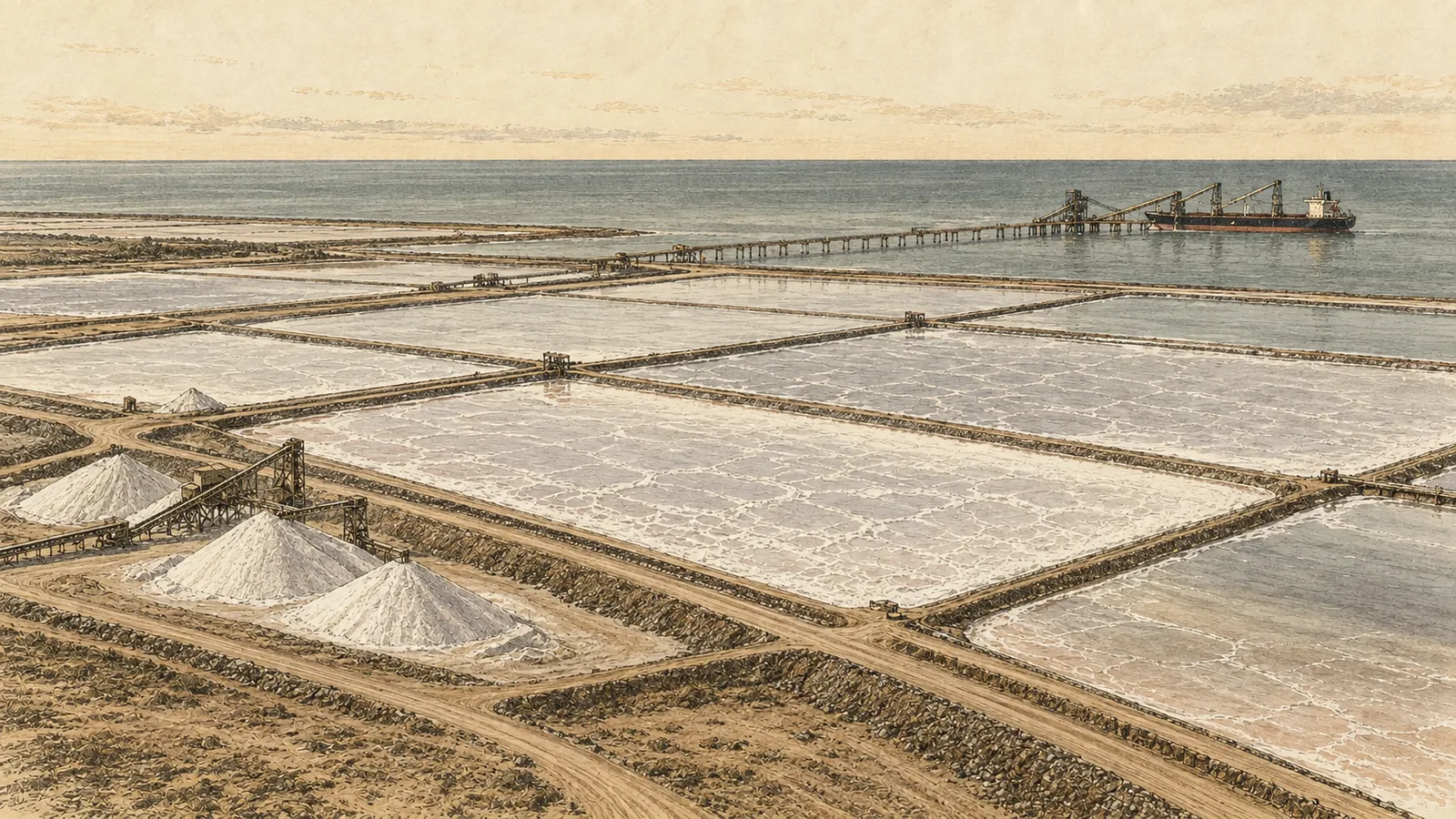
World salt production was an estimated 270 million tonnes in 2025, and almost none of it is destined for a plate. In the United States — the only market that publishes a clean breakdown — food processing accounted for 4 per cent of salt sold or used in 2024, against 41 per cent for highway de-icing and 39 per cent for the chemical industry. The salt business is landscape-scale infrastructure that happens to have a small, noisy, beautiful annexe attached to it. That annexe is where every salt in your kitchen comes from.
How much salt does the world actually make?
The US Geological Survey’s Mineral Commodity Summaries is the standard annual count. The 2026 edition puts world total production at 270 million tonnes for 2025, an estimate, rounded. The 2025 edition put 2024 at 280 million tonnes, which tells you something useful about the precision available: these are national reporting aggregates, not meter readings.
The 2025 edition’s 2024 country figures run China at 55 million tonnes, the United States at 40, India at 28, Germany at 16, Australia at 13, Canada at 12, and Mexico and Turkey at 9 each. Note that this counts all salt by every recovery method — rock salt mined from bedded deposits, brine from solution wells, and marine solar salt together. Sea salt is a minority of the total, and the culinary fraction of the sea salt is a minority of that minority.
What is all of it for?
The USGS breaks out end use for salt sold or used in the United States. For 2024:
- highway de-icing — 41 per cent
- chemical industry — 39 per cent
- distributors — 9 per cent
- food processing — 4 per cent
- agricultural — 3 per cent
- general industrial — 2 per cent
- primary water treatment — 1 per cent
- miscellaneous — 1 per cent
The 2026 edition, covering 2025, gives the two big categories as about 42 per cent chemical and about 37 per cent de-icing, and does not itemise the rest. The order changes year to year with the weather; a hard winter moves de-icing above chemicals and a mild one does not.
Read the 4 per cent carefully. It is a US figure, not a world figure, and “food processing” is a category of buyer, not a description of every grain that gets eaten. The 9 per cent going to distributors includes the table salt that reaches shops. So the honest statement is not “4 per cent of salt is eaten”. It is that eating is a single-digit-to-low-teens share of tonnage in the one market with published numbers, and that the two things actually holding the industry up are chlorine chemistry and frozen roads.
Guerrero Negro is the clearest example
Exportadora de Sal, S.A. de C.V. operates the saltworks at Guerrero Negro in Baja California Sur. Its own company booklet describes a facility covering approximately 33,000 hectares with production capacity above 8.0 million tonnes annually, and, in a separate table, production totalling 7,181 thousand metric tonnes. Keep those apart: the first is a stated capacity, the second what the company says actually came out. Mitsubishi’s 2024 release on the sale of its stake also gives 8 million tonnes of capacity; the production figure has only one publisher.
The interesting number is not the tonnage. It is the sales mix. ESSA’s booklet puts the chlor-alkali industry at 78.3 per cent of sales, sodium carbonate manufacture at 8.5 per cent, road de-icing at 6.1 per cent and industrial water softening at 5.1 per cent. Add those up and you have 98 per cent of the largest marine saltworks on earth going into chlorine, caustic soda, PVC, softened water and winter roads.
The ownership changed recently. Mitsubishi Corporation announced on 26 February 2024 that it had agreed, on 24 February, to sell its entire 49 per cent stake in ESSA to the Mexican state, through the Fideicomiso de Fomento Minero under the Ministry of Economy. ESSA’s own material states that as of February 2024 the company is state-owned with 100 per cent Mexican capital. Mitsubishi’s release describes an enterprise founded in 1954 with around 1,100 employees.
The Bahamian works changed hands in 2026
If you look up the solar saltworks at Matthew Town on Great Inagua, a good deal of what you find will be out of date. Lusca Group announced on 7 May 2026 that it had received final approvals to acquire 100 per cent of the shares of Morton Bahamas Limited, the operator of that facility, with closing set for 1 June 2026, and that the company would be renamed Lusca Salt Bahamas Limited. It committed up to US$125 million across the salt facility and wider island development.
Two details from that announcement are worth more than the headline. The buyer says it intends to double production volumes over two years. And it says it will study developing an on-site salt upgrading and packaging facility capable of producing food-quality salt. A saltworks of that size has been running for decades without one. The salt was never for eating.
| Operation | Owner | Where | Stated scale | Mostly feeds |
|---|---|---|---|---|
| Exportadora de Sal (ESSA) | Mexican state, 100% since Feb 2024 | Guerrero Negro, Baja California Sur | Capacity above 8.0 Mt/yr, production 7,181 kt; ~33,000 ha (company figures) | Chlor-alkali, 78.3% of sales |
| Lusca Salt Bahamas | Lusca Group, from June 2026 | Matthew Town, Great Inagua | Output not published; buyer plans to double it | Industrial; food-grade plant only under study |
| Dampier Salt | Rio Tinto 68%, Marubeni 22%, Sojitz 10% | Dampier and Port Hedland, Western Australia | “Millions of tonnes each year”; no figure published | Chemical manufacture, seaborne export |
| Cargill Newark | Cargill, Inc. | San Francisco Bay, California | Three to five years pond to harvest | Mixed industrial and food network |
| Saltverk | Private, Iceland | Westfjords | Around 10 tonnes per month (reported) | Kitchens |
It takes years, not weeks
The thing most people get wrong about solar salt is the clock, and the mistake is entirely reasonable: a photograph of a crystallising pond looks like an afternoon’s work. Cargill describes Bay water moving through concentrators where it evaporates over “a couple of seasons” before reaching the crystallisers, and states that “depending upon the weather, it can take between three and five years for a sea salt crop”, with harvest between September and December.
Three to five years, not three. We had the shorter figure in our own notes and it was wrong; the company’s published range is wider. A pond system on that scale is closer to a slow reservoir than to a kitchen process, and the capital tied up in it is the reason the business is owned by states, mining groups and trading houses rather than by families.
The export terminal is the real product
ESSA operates ship-loading facilities on Cedros Island able to receive and load vessels of up to 180,000 tonnes. Rio Tinto describes Dampier Salt as one of the world’s largest exporters of seaborne salt, harvesting millions of tonnes each year across two solar operations after the Lake MacLeod operation was sold to Leichhardt Industrials Group, a sale completed on 2 December 2024.
That is what an industrial saltworks is: an arid coastline, a very large flat area, and a deepwater berth. The salt is the cheapest part. Any operation without the berth is in a different business, whatever it evaporates. For the geography of why those three things rarely occur together, our piece on where salt is made covers the climate side of it.
What the eating end looks like by comparison
Saltverk, in the Icelandic Westfjords, evaporates seawater with geothermal heat and has been reported as producing around ten tonnes a month. That is roughly 120 tonnes a year, from an operation whose salt sits on tables in restaurants people fly to. Against the 7,181 thousand tonnes in ESSA’s own production table, that is about one tonne in sixty thousand — 0.0017 per cent, better read as a fraction. Against the 8.0 million tonne capacity, one in sixty-seven thousand.
The Patagonian producer we buy from makes roughly 1.5 tonnes a month. It is a two-person operation on the Chubut coast. We state that because it is the scale, not because it is an argument: small output is a fact about a business, and it tells you nothing whatsoever about how the salt tastes or what is in it. Plenty of very large operations make excellent food-grade salt, and a small producer with a bad process makes bad salt slowly.
What small output does explain is price and availability, and what the industrial picture explains is why the culinary market competes the way it does. When almost all of the tonnage is decided by purity specification, chloride content and freight cost, the remaining slice has nothing to compete on but crystal shape, texture, hand work and provenance. That is why the finishing-salt aisle is full of stories. The stories are the only variable left. Some of them are true, which is the argument we make in what is actually in Maldon, and it is also why we spend so much of this journal reading specification sheets rather than adjectives.
What none of this means
It does not mean industrial salt is worse. Vacuum and washed solar salts are more consistent and far purer than anything hand-raked, and consistency is a real virtue in a food plant. It does not mean a small producer is more honest; disclosure is a choice, not a size.
And it does not mean that a culinary salt is nutritionally distinguishable from a de-icing one. Sodium chloride is sodium chloride. If you want that argument in full, with the numbers, we set it out in sodium by salt type. The differences between salts that matter to a cook are grain, moisture, dissolution rate and what the label discloses. They are not differences of kind.
The useful conclusion is narrower and more practical. When you read a sea salt label, you are reading a document from the smallest and least regulated corner of a very large commodity industry, written by the only part of that industry that has any reason to talk to you at all. That is a deliberate design choice and a defensible one. It is not an accident and it is not a shortcoming.
On our own sourcing: the 1.5 tonnes a month is what our producer has told us, not a figure we have audited or seen a weighbridge ticket for, and it varies with season. ESSA’s 8 million tonnes is likewise a stated capacity in company literature rather than a verified annual output, and the two numbers are not the same kind of number. The 7,181 thousand tonne table carries no year label we could read. The Saltverk figure comes from an interview in the trade press, not from the company’s own filings. We would treat all three as indicative of order of magnitude and nothing finer. For an explanation of how the ponds themselves work, see how sea salt is made.
Sources
- USGS Mineral Commodity Summaries 2026 — Salt
- USGS Mineral Commodity Summaries 2025 — Salt, with 2024 end-use breakdown
- Exportadora de Sal, S.A. de C.V. — company booklet, capacity and sales mix
- Mitsubishi Corporation — sale of its entire 49% stake in Exportadora de Sal, February 2024
- Lusca Group — final approvals for the acquisition of Morton Bahamas Limited, rebrand as Lusca Salt Bahamas
- Rio Tinto — Dampier Salt operations and ownership
- Cargill — sea salt harvesting in San Francisco Bay
- InsideHook — Saltverk, reported monthly output and geothermal method
Read next
- Where Salt Is Made — the climates that allow a pond system at all
- How Sea Salt Is Made — the pond sequence, step by step
- Sodium by Salt Type — why none of this is a nutrition story
- Patagonian Sea Salt — the small end of the scale, in full
The Salt Guide
We are recording the salts on the American shelf one jar at a time — label, panel, price paid, crystal on white. Browse the guide →