
What Is Actually in Tajin
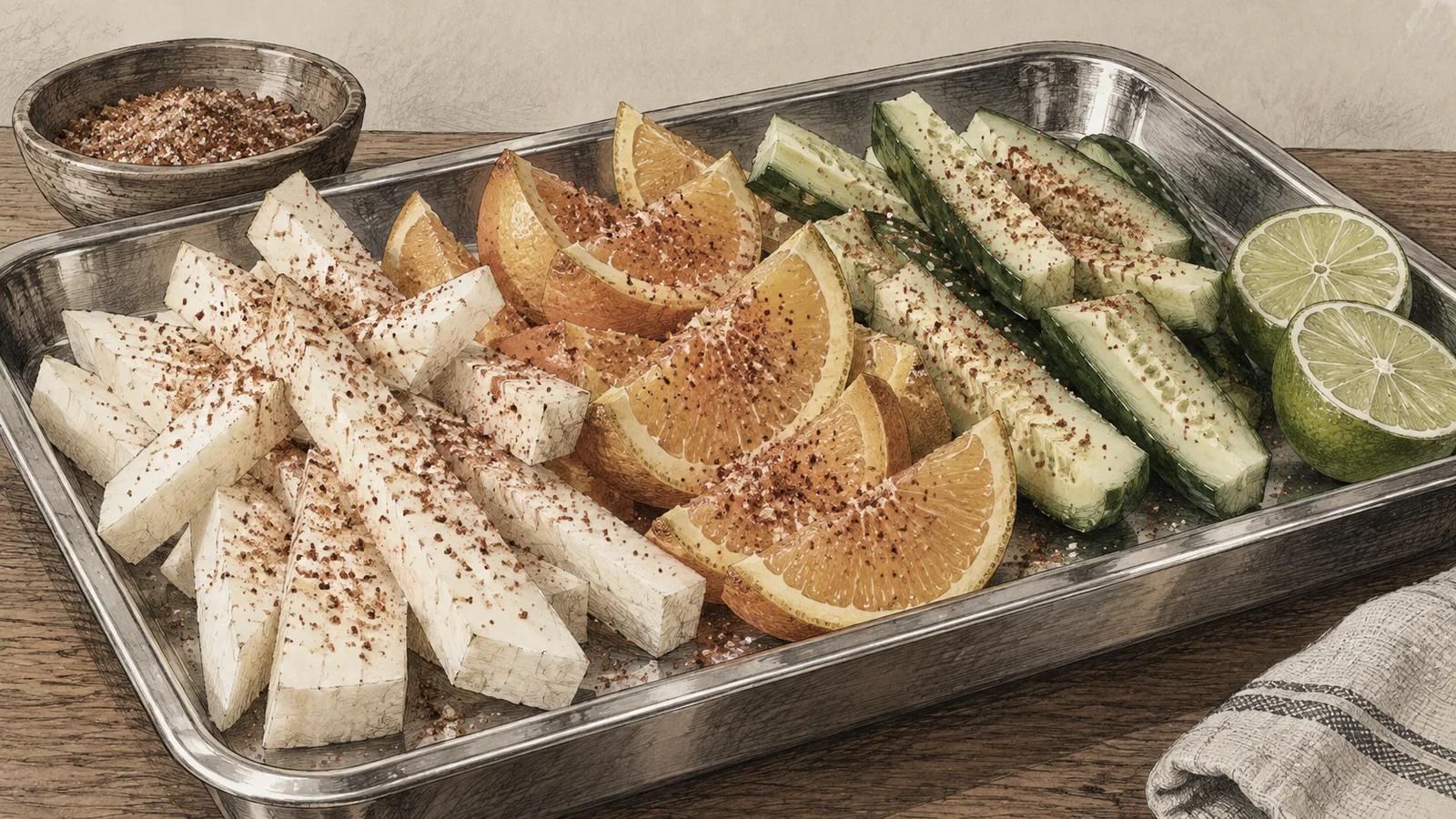
Tajín Clásico is chile peppers, sea salt and dehydrated lime juice, with silicon dioxide added to stop it clumping. That is the maker’s own description. A quarter-teaspoon serving of 1 g carries 190 mg of sodium, which makes it roughly half salt by weight. It was launched in 1985 and is made today in Tala, Jalisco. The idea it bottled — chile, lime and salt on fresh fruit — appears, in the snippets of it we could read, in a Mexican cookbook printed nearly forty years before that.
What the maker says is in it
Tajín’s US website does not print a formal ingredient statement as text. The nutrition panels on its product pages are images, and they carry no ingredient line. What the company does publish, on its US frequently-asked-questions page, is this:
“Our blend contains only the essentials: quality chiles, sea salt, and dehydrated lime juice. To prevent the powder from clumping with humidity, we use silicon dioxide.”
So four ingredients, in that order. If the order mirrors the label, as it usually does, chile is the largest component by weight and salt the second. The product page adds the claims: kosher, sugar free, no artificial colours or flavours added, gluten free. The company says the chiles are Mexican and mild, and does not name the varieties.
The lime is dehydrated lime juice, not citric acid and not lime flavouring. That is a real distinction. Across the chile-lime category, sourness can come from dehydrated lime or from citric acid; Tajín says its comes from the lime. The silicon dioxide is a flow agent, the same fine silica used in powdered spices generally. The company gives it a full paragraph of its FAQ.
How much of it is salt
The label does not say, but the nutrition panel lets you estimate it. 190 mg of sodium in 1 g is 19 per cent sodium by weight. Sodium is about 39 per cent of sodium chloride. Chile and lime juice bring almost no sodium of their own, so if nearly all of it comes from the salt, Tajín Clásico is about 48 per cent salt.
That is arithmetic on a rounded label, not a laboratory figure. US rules round sodium above 140 mg to the nearest 10 mg, so the true figure could be anywhere from 185 to 195 mg, and the salt share anywhere from about 47 to 50 per cent. “About half” is the correct level of precision. It is also, on the same arithmetic, a lower share than a salt-first shaker seasoning; our piece on what seasoning salt is goes through the category.
The same reading, applied to a green blend, is in how much of chimichurri salt is salt.
Clásico and Reduced Sodium, side by side
| Tajín Clásico | Tajín Clásico Reduced Sodium | |
|---|---|---|
| Serving as printed | 1/4 tsp (1 g) | 1/4 tsp (1 g) |
| Sodium per serving | 190 mg (8% DV) | 120 mg |
| Potassium per serving | 10 mg | 50 mg |
| Calories | 0 | 0 |
| Maker’s claim | “100% natural chile peppers, lime & sea salt” | “37% less sodium” |
| Published ingredient statement | In prose, on the US FAQ page | “Mild Chili Peppers, Lime, Sea Salt”, on the Canadian page |
The Clásico figures are from the US nutrition panel for the 5 oz bottle; the 14 oz panel prints the same numbers. The Reduced Sodium figures are from the company’s Canadian product page. 120 against 190 is 36.8 per cent less, so the “37%” checks out on the company’s own numbers.
Note the potassium: 10 mg in Clásico, 50 mg in Reduced Sodium. Something in the reformulation carries potassium. The Canadian page does publish an ingredient line for the reduced version, and it reads “Mild Chili Peppers, Lime, Sea Salt” — nothing on that list obviously accounts for five times the potassium, and it names no potassium salt. We will not guess what does. The printed bottle is the place to check. For what potassium chloride is when it does appear on a label, see lower-sodium salt substitutes.
1985, Jalisco and a grandmother’s salsa
The company tells its own origin story in two versions, and they agree on the essentials. The US site says Tajín “was born on December 23, 1985”, and that in its early days it was sold store to store, one bottle at a time. It was first exported to the United States in 1993, and in 2012 the company set out, in its words, to cross over into mainstream American stores.
The Mexican site tells it through the founder, whom it names only as Horacio. As a boy, his grandmother, Mamá Necha, made a salsa of seven different chiles, and he liked it best poured over freshly cooked corn. He later worked out how to dehydrate lime and chiles without losing their flavour, so that anyone could have that salsa. The company calls itself a pioneer of salsa en polvo, powdered salsa, which is exactly what the product is.
On place, the company does not name Guadalajara. Its US FAQ says Tajín is made in Jalisco, with 100% Mexican chiles, and names the plant: Tala, Jalisco, which it says holds LEED Gold certification. Tala is a town west of Guadalajara. We have written what the company writes.
One small inconsistency, for completeness: the US site says Tajín is sold in over 30 countries, and the Mexican site says more than 40. Both are the company’s own numbers, on pages of different vintages.
Where the name comes from, and a word that does not
The company says Horacio took the name from the archaeological zone of El Tajín in Veracruz, after a visit there. That part is simple. El Tajín is a pre-Hispanic city in northern Veracruz and a UNESCO World Heritage Site.
The company’s story adds that he chose it on discovering that “ají” means chile in Náhuatl. It is a charming detail, and the dictionaries do not support it. The Real Academia Española gives ají as a word of Taíno origin, from the Caribbean, used for the pepper plant in South America and the Antilles. The Náhuatl word is chilli, which is where Spanish got chile. The name comes from a real place; the etymology attached to it does not hold up. Nothing about the product depends on it.
Chile, lime and salt on fruit, before Tajín
This is the interesting part, and the part the brand’s success tends to obscure. If you first met chile and lime on mango or watermelon through a Tajín bottle, it is reasonable to assume the bottle came first. It did not. The combination is old Jalisco food, and it was written down.
In 1946 Josefina Velázquez de León published Platillos regionales de la República Mexicana, a survey of regional cooking. On page 106, among its Jalisco recipes, is a pico de gallo, listed as an aperitivo: three cups of jícama cut in small cubes, two cups of peeled orange segments, two limes, and salt and a little powdered chile piquín. That is fruit, lime, salt and dried chile powder, in Jalisco, thirty-nine years before Tajín.
A year earlier, Leovigildo Islas Escárcega’s Vocabulario campesino nacional (1945) defined pico de gallo as a manjar común en Jalisco, a common Jalisco dish of jícama, orange, green chile, onion and salt, taken more as a refreshment than a meal. Fresh chile there rather than powder, but the same logic: sweet, watery fruit, sharpened with chile and salt.
So what did Tajín actually do? It took the dry half of a Jalisco fruit dressing, solved the hard part — getting lime into a shelf-stable powder without it caking or going flat — and made it identical in every bottle. That is not a small achievement. It is not an invention of the combination either, and to its credit, the company’s own story never claims it is. It credits a grandmother.
What the label cannot tell you
Which chiles, in what proportion, and how hot each lot runs. The ratio of chile to salt, beyond what the sodium figure lets you infer. Where the sea salt was made, how it was processed, or how fine it was ground; on a Mexican blend or any other, “sea salt” tells you where the water came from and nothing more, which is the argument of who actually makes your sea salt. And, for Reduced Sodium, what replaced the salt.
What the panel does tell you is that this is a chile seasoning with a lot of salt in it, rather than a salt with some chile. That is the right way round for what it is used for. For how chile-lime salt sits alongside the other traditions, see salt blends around the world.
Three caveats on our own sourcing. The ingredient wording is the company’s FAQ prose, not a transcribed bottle label, because the site does not print one. The Reduced Sodium figures come from the Canadian site, since the US page shows that panel only as an image we did not transcribe. And the 1946 and 1945 passages are from Google Books snippet views, which are scanned text broken across columns; we have read the snippets, not the printed pages. The quotations above are faithful to what the snippets show, and we would welcome a photograph of either page.
Sources
- Tajín — Clásico Seasoning, US product page and nutrition panel
- Tajín — US FAQ: ingredients, silicon dioxide, Tala plant
- Tajín — About Us, history 1985 to present
- Tajín México — Nuestra historia
- Tajín Canada — Clásico Seasoning Reduced Sodium, nutrition facts
- Josefina Velázquez de León, Platillos regionales de la República Mexicana (1946), p. 106
- Leovigildo Islas Escárcega, Vocabulario campesino nacional (1945), p. 240
- Real Academia Española — Diccionario de la lengua española, ají
Read next
- Salt Blends Around the World — where chile-lime salt sits
- What Is Seasoning Salt — the shaker category, read from the label
- Who Actually Makes Your Sea Salt — what the words sea salt do not tell you
- Patagonian Sea Salt — one salt, with its origin written down
The Salt Guide
We are recording the salts on the American shelf one jar at a time — label, panel, price paid, crystal on white. Browse the guide →