
Pickling Salt vs. Kosher Salt: Can You Substitute?
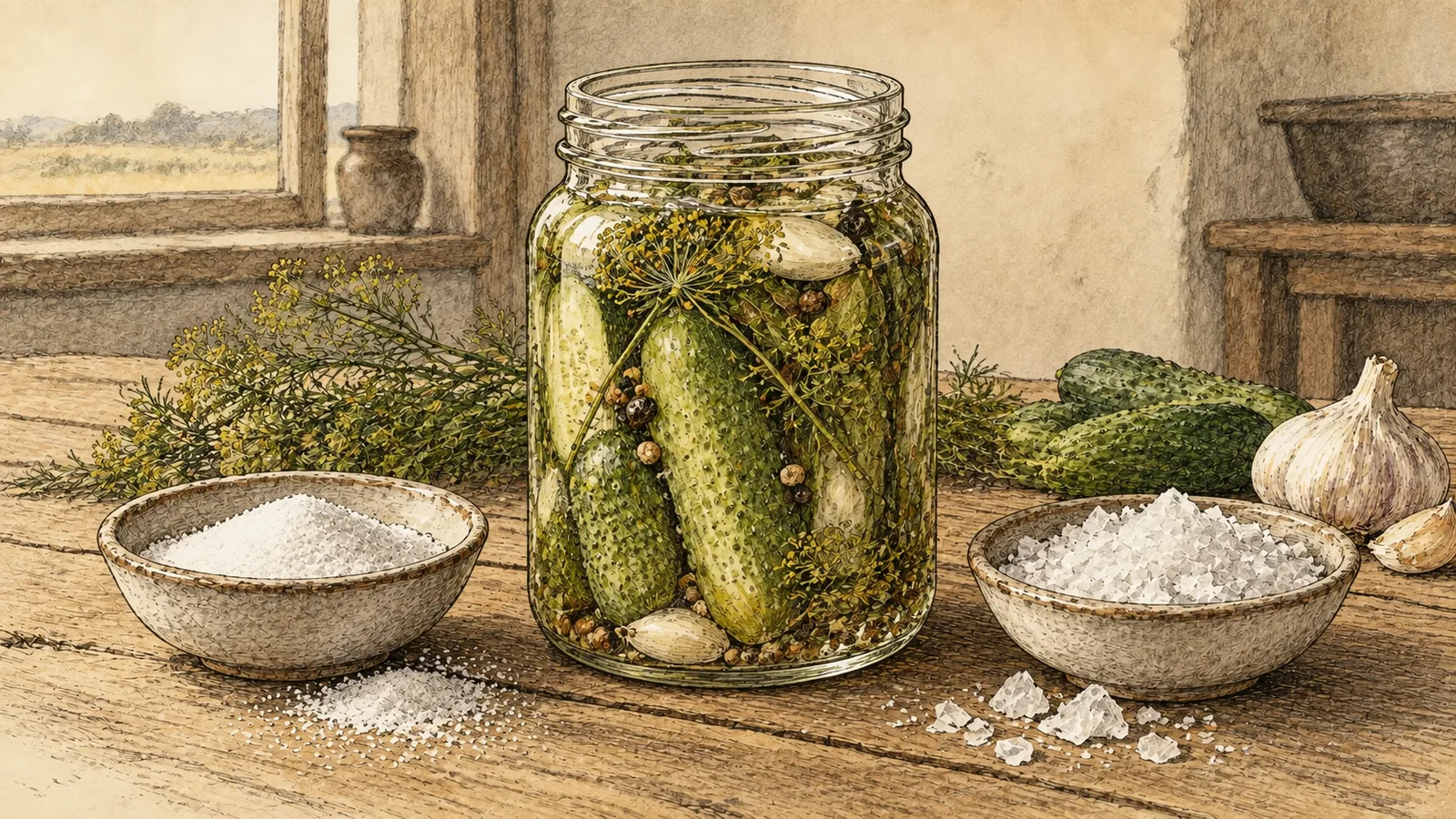
Pickling salt and canning salt are two names for the same practical format: fine, granulated salt without ingredients that cloud the brine. Kosher salt is usually a larger crystal and varies greatly by brand. Do not exchange them cup for cup in a preservation recipe.
Why pickling salt is specified
Fine grains dissolve quickly. The absence of anti-caking material helps the brine stay clear. Neither feature is mystical, but both are useful when a jar is meant to be measured, processed and inspected.
The National Center for Home Food Preservation recommends canning or pickling salt. It also says iodized or non-iodized table salt can safely be used for fermented and non-fermented pickles, while noting that anti-caking materials may make the brine cloudy.
Why kosher salt is not a cup-for-cup substitute
Kosher salts do not share one crystal. One brand may be a light, broad flake; another may be a denser compact grain. A cup measures the empty space between those crystals along with the salt itself.
That makes a casual volume substitution especially poor in fermentation, where salt concentration is part of the process. If a tested recipe specifies a weight and allows plain salt, use that weight. If it specifies a volume of canning salt, use the named salt unless the recipe publisher provides a tested alternative.
What about sea salt and flake salt?
Sea salt is a source description, not a standard grain. A fine, additive-free sea salt may look much like pickling salt, but you still follow the tested recipe. The National Center specifically says flake salt varies in density and is not recommended for pickling.
| Salt | Typical physical form | Preservation note |
|---|---|---|
| Pickling or canning salt | Fine, granulated | The recommended default. |
| Table salt | Fine, often with anti-caking material | Can be safe, but may cloud brine. |
| Kosher salt | Brand-dependent flakes or grains | Do not substitute by volume. |
| Finishing flakes | Large, open crystals | Density varies; not recommended. |
| Reduced-sodium salt | Mixed mineral salts | Not recommended for fermented pickles. |
Quick pickles and fermented pickles are not the same problem
The National Center allows reduced-sodium salts only in quick-pickle recipes where its guide says to use them, and warns against them in fermented pickles. That is a useful boundary: a refrigerator garnish and a fermentation are not interchangeable methods.
For home preservation, the tested recipe outranks a general conversion table. Keep its cucumber size, vinegar strength, water, salt and processing method together.
This page explains salt formats; it is not a preservation process. Use a current tested recipe from the National Center for Home Food Preservation, USDA or your extension service.
Read next
- Kosher Salt Explained — why brands fill a spoon differently
- Fine, Coarse and Flaky Salt — the geometry behind the measure
- Does Salt Expire? — clumping, moisture and storage
The Salt Guide
We are recording the salts on the American shelf one jar at a time — label, panel, price paid, crystal on white. Browse the guide →