
What Is Popcorn Salt, and Why Does It Stick?
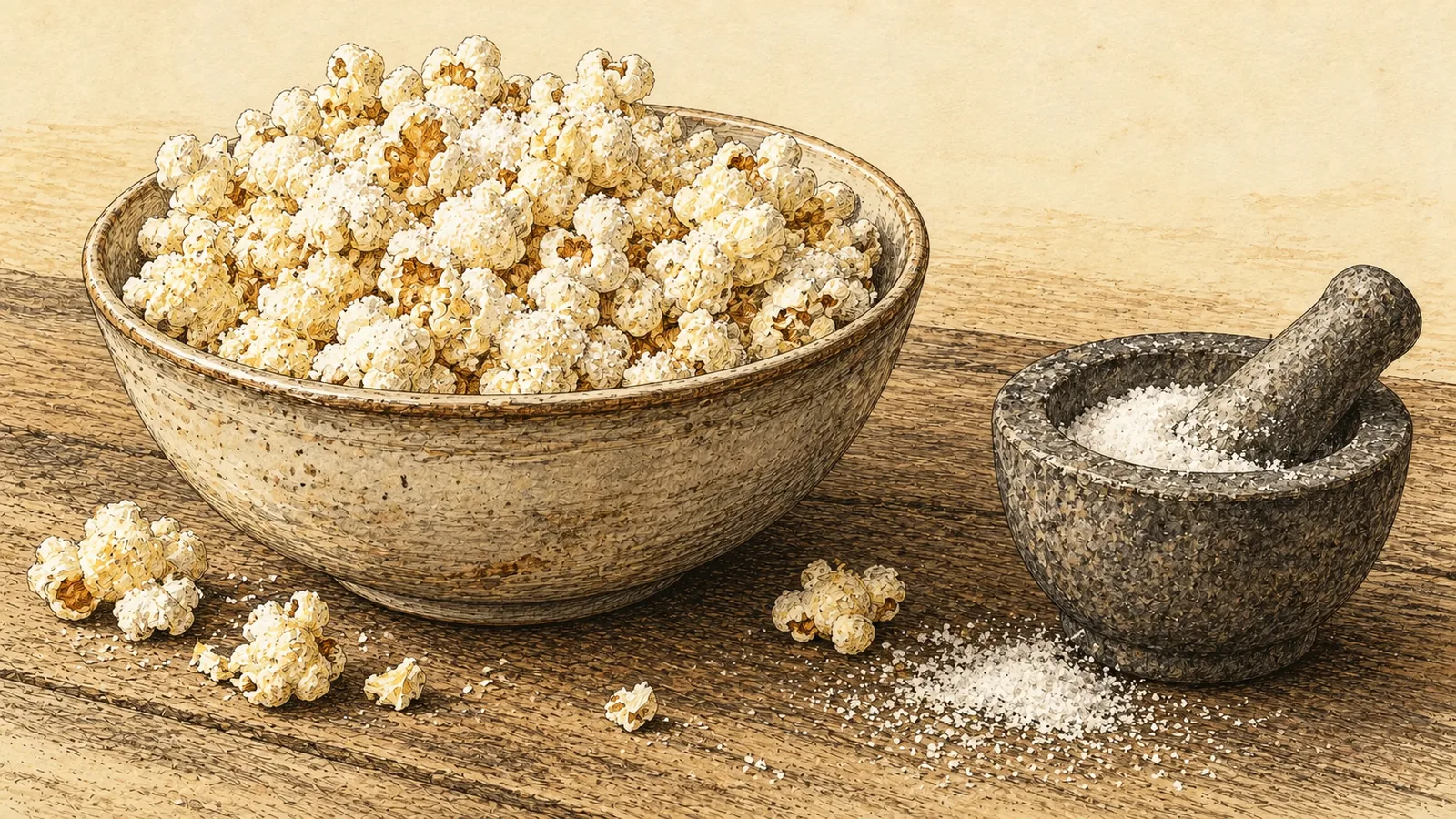
Popcorn salt is salt milled to a very fine grain. It is not a separate mineral and it does not need butter flavor. Its advantage is mechanical: many tiny particles can cling to the irregular, lightly oiled surface of popcorn where larger crystals fall away.
The grain is the product
Morton describes its popcorn salt as super-fine and designed to adhere to popcorn and other snacks. The Popcorn Board gives the same definition: a super-fine table salt made to adhere better to kernels.
That makes popcorn salt the opposite of a finishing flake. A finishing salt is meant to remain visible and crunch. Popcorn salt is meant to disappear into an even film.
Why ordinary salt ends up in the bowl
A popped kernel is large, dry and uneven. Coarse crystals touch it at only a few points. Fine particles have more chances to lodge in creases and in the thin oil or melted butter on the surface.
Timing helps. Season while the popcorn is warm and immediately after adding fat, then toss thoroughly. Adding more coarse salt does not solve an adhesion problem; it mostly leaves more salt below the kernels.
Can you make popcorn salt?
Yes. Grind a small amount of plain salt in a clean spice grinder or mortar until it is powdery. Let airborne dust settle before opening a grinder, then store the salt dry in a clearly identified container.
Start with less than you would use of a coarse salt. A fine powder distributes more completely and can pack more densely into the same spoon. Taste after tossing rather than assuming a teaspoon is a teaspoon.
Popcorn salt is not automatically theater seasoning
Some concession seasonings combine fine salt with color, flavor or other ingredients. Those are blends. Plain popcorn salt can contain only salt, or salt plus a flow aid depending on the product. The ingredient statement tells you which one you have.
| Salt style | What happens on popcorn |
|---|---|
| Super-fine popcorn salt | Coats evenly and clings readily. |
| Fine table salt | Works, though not always as finely milled. |
| Kosher or coarse salt | Provides isolated hits and often falls to the bottom. |
| Finishing flakes | Visible texture, but little uniform coverage. |
Finer salt is not lower in sodium. Because grain sizes fill a spoon differently, compare products by label serving and use a scale when precision matters.
Keep reading
- Fine, Coarse and Flaky Salt — how crystal size changes the job
- Sea Salt vs. Table Salt — source, grain and spoon density
- Anti-Caking Agents Explained — why fine salt may contain a flow aid
The Salt Guide
We are recording the salts on the American shelf one jar at a time — label, panel, price paid, crystal on white. Browse the guide →