
Cahuil: The Protected Sea Salt of Chile
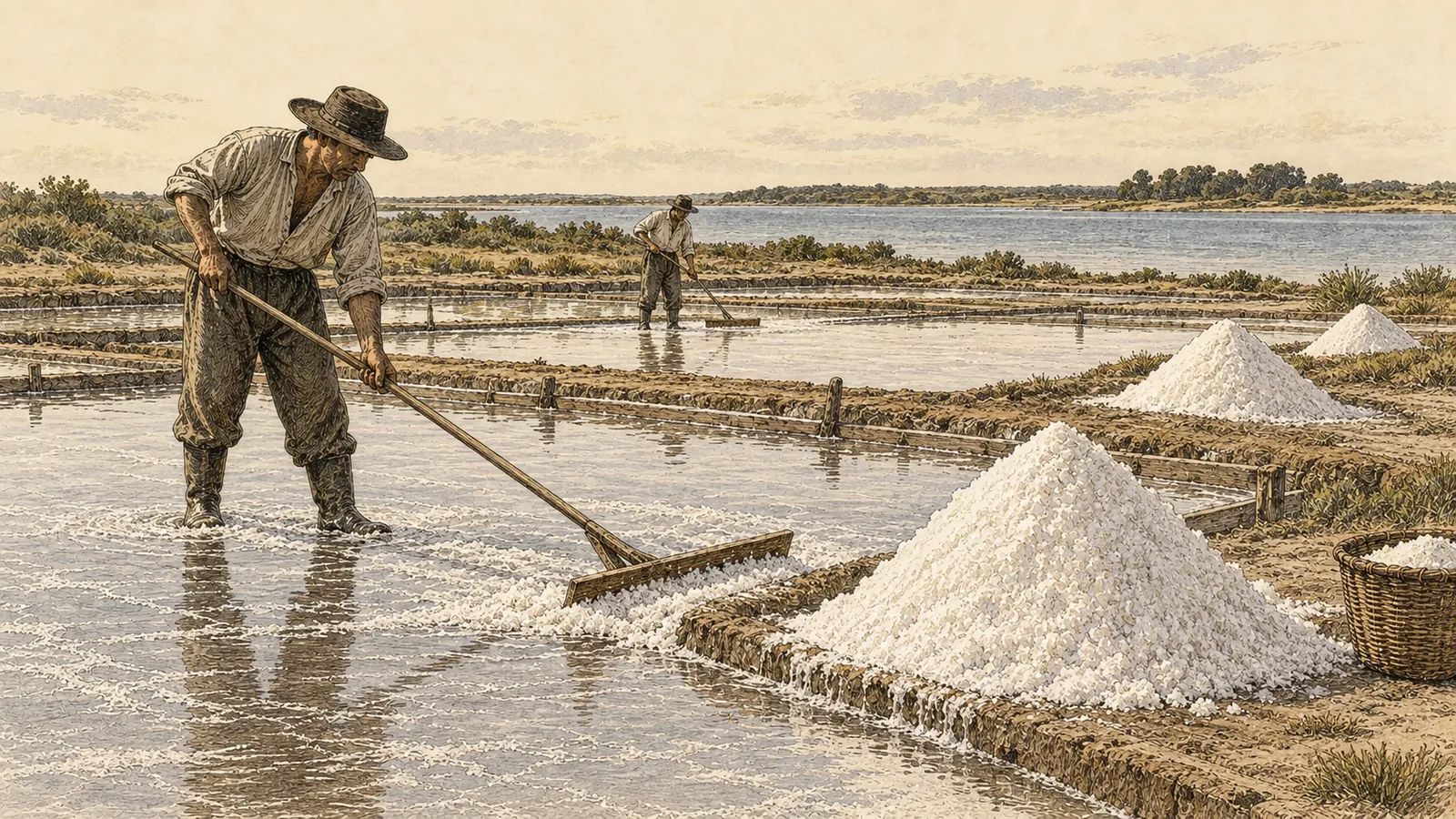
Chile protects its traditional coastal salt with a denomination of origin registered at INAPI in 2013, covering the lagoon salterns at Cáhuil, Boyeruca and Lo Valdivia on the O’Higgins and Maule coast. The title is held by a single company, Sal de Mar y Turismo Pacífico Central SpA, with a list of individual salineros attached to it as authorised users — so the useful question is never “is it Cáhuil salt” but which registered producer made the lot. By mid-2026 the government itself was describing production there as having gone to zero.
What is actually registered
The instrument is a denominación de origen under Chile’s industrial property law, Ley 19.039, administered by INAPI under its Sello de Origen programme. Chile distinguishes a geographical indication, where the qualities come from the place, from a denomination of origin, where human and cultural factors also have to be doing work. Salt from a hand-built lagoon pond is the case the second category was written for.
The registration number is 1010767, and the year is 2013. The exact name is less settled than you would expect. INAPI’s own register document heads it Sal de Cahuil – Boyeruca Lo Valdivia. INAPI’s consumer-facing page calls it Sal de Cahuil, Boyeruca, Lo Valdivia. The agriculture ministry’s own survey of Chilean geographical indications writes it Sal de Cáhuil, Boyeruca y Lo Valdivia, with the accent and the conjunction. Three Chilean state sources, three renderings.
That is worth saying rather than tidying away. If you are verifying a label, the string you search for matters, and there is no canonical spelling in the public record.
Who holds it, and who may use it
Start with the holder, because it is not what “community salt” suggests. The INAPI register document gives the titular as Sal de Mar y Turismo Pacífico Central SpA, a company at Pichilemu that Chile’s register of cultural collectives describes as the vehicle giving the region’s two salinero co-operatives a commercial outlet, trading as Ancestros del Pacífico. INAPI’s market page instead names that co-operative as holder and contact. Two pages of one agency, two answers.
Attached to the registration is a list of authorised users, all individual salineros, grouped under headings including Salineros de Cáhuil, Barranca y La Villa and Salineros Lo Valdivia–Boyeruca, contact fields marked no aplica. We will not give an exact count: the table carries no running numbers, our readings came out near fifty, and it is to be updated every two years. The sixty-six sometimes attached to Cáhuil counts something else — the 2011 citation says that of 66 salt-working sites, only two were worked that year.
This is the structural difference between Cáhuil and most salts a specialty buyer meets. A European PDO usually has a producer group and a control body behind it. Here one company holds the name and the right to use it attaches to a list of named people. So the chain of custody a buyer can check runs to a named salinero or to the co-operative that aggregates them, not to the denomination itself. A bag that says Cáhuil and names nobody has told you the region and nothing else. The reasoning is the same one we apply to any sea salt: the region is not the maker.
How the salt is made
The system is a coastal lagoon fed by the sea. The Nilahue estuary meets the Pacific at Cáhuil, south of Pichilemu; salt water comes up the estuary into the lagoon, and from the lagoon it is moved through a descending sequence of shallow hand-built ponds, using gravity and, in places, a pump. Each pond is more concentrated than the one above it. Sediment drops out along the way, which is the point of moving the brine rather than evaporating it where it lands. In the final ponds a crust forms, is broken up, raked into conical heaps to drain, and barrowed off in sacks.
The often-repeated figures come from one place: the 2011 Tesoros Humanos Vivos citation published by the national culture council. It puts the work along eight kilometres of coast southeast of Pichilemu, by a technique continuous with pre-Hispanic practice, gives the process as four to five months long, runs extraction from October to March, and names the trigger: work begins when high tides turn the Cáhuil lagoon brackish. Those are one document’s numbers, written in 2011 and not revised since. October to March is in any case the southern-hemisphere summer, the only window a salina at that latitude gets.
There is no boiling and no added heat at any stage. That makes it a close cousin of the Mediterranean and Atlantic solar traditions, and unlike the pan-boiled salts covered in our piece on how sea salt is made. The lagoon, rather than a pumped seawater intake, is the distinctive part.
The written record is thin, and mostly about tourism
We went looking for a published specification — the European kind, setting crystal size, moisture, composition, control procedures — and did not find one in the public record. What INAPI publishes is the name, the number and the list of users. Almost everything else written about Cáhuil in English or Spanish is travel writing, and it is not reliable.
One example. Chile’s own national tourism site describes the salineros as recognised by UNESCO as Living Human Treasures in 2013. The recognition is real but neither of those details is. Tesoros Humanos Vivos is a Chilean programme, run by what was then the Consejo Nacional de la Cultura y las Artes, and the Cooperativa de Salineros de Cahuil, Barrancas y La Villa was named in 2011 — two years before the denomination of origin, by a national body and not by UNESCO. The same page puts the working group at about twenty salineros, against a register list two to three times longer and a 2011 citation counting sites rather than people.
We are flagging this because we could not resolve it, not because we enjoy correcting travel copy. Nobody has published a dated count of how many people work these ponds now.
What happened in 2025 and 2026
This is the part the older writing does not have. Through 2025 and into 2026 the salineros reported that they could not make salt at all.
The cause they identify is fresh water. Releases from the Convento Viejo reservoir run down the Nilahue estuary into the Cáhuil lagoon, raising the water level and cutting the salinity — and a salina that does not reach saturation produces nothing. Fundación Terram, on 20 March 2026, put the loss at about 95 per cent of the season’s production, quoting the president of the Cáhuil, Barrancas and La Villa co-operative, Juan Moraga: a few years ago he harvested seven thousand sacks in a season; now he does not reach a hundred. On 28 July 2026 Chile’s economy minister, Daniel Mas, said production “se les ha ido a cero” — it has gone to zero for them — and undertook to look with the public works ministry at the reservoir. Regional authorities had already, at the end of 2025, approved a review of the reservoir’s environmental permit under the article 25 quinquies mechanism, which exists for impacts nobody anticipated.
Two things follow. The first is practical: any Cáhuil salt on a shelf in 2026 is older stock, and a buyer should be asking for a harvest year, not a best-before date. The second is that the threat here is not the one the guidebooks name. It is not tourism and not fashion. It is a hydraulic works decision upstream, which a denomination of origin has no power over at all.
Two coasts, two ways of defending a salt
South America has one protected sea salt name and one compositional rule, and they defend a salt in opposite directions. Chile registered a name and a list of people entitled to use it. Argentina protected no name: its 2024 food-code article says what a salt must contain and where the seawater must come from, and any producer meeting those terms may use the wording. That is a standard of identity, not a denomination of origin — and neither instrument covers our own salt, which carries no protected designation at all.
| Chile | Argentina | |
|---|---|---|
| Instrument | Denomination of origin, INAPI, Ley 19.039 | Article 1264 tris of the food code, Resolución Conjunta 6/2024 |
| Year | 2013 | 2024 |
| What it constrains | Place, and the people entitled to use the name | Composition, plus Argentine seawater as the source |
| Who may use it | A closed list of registered salineros | Any producer whose salt meets the numbers |
| Testable on the salt itself | No | Yes — a lab analysis against the floors |
| Ocean | Pacific, via a coastal lagoon | Atlantic, from the Patagonian coast |
Neither route is better. They fail in different directions. A denomination of origin protects a community and a landscape and says nothing about what is in the bag; a compositional rule says what is in the bag and nothing about who made it. Argentina’s bargain is set out in our piece on the 2024 law.
The European systems try to do both at once, with a place, a method and sometimes a composition floor written into one specification. That is more ambitious and considerably more expensive to run, and it is the subject of the companion piece on protected names.
Is it comparable to our salt
Not really, and it is worth being clear about why. Cáhuil is a seasonal lagoon salina worked by a community on the Pacific coast, with a name protected by place. Ours comes from the Atlantic side, from the Chubut coast, from a small operation, using a low-temperature process as the producer publishes it, and with no protected name — the background is in what Patagonian sea salt actually is.
The temptation is to make the shared continent mean something. It does not. Two coasts three thousand kilometres apart, on opposite sides of a mountain chain, in different oceans and under different law, produce salts that have their unrefined state in common and very little else. Saying so costs us a nice sentence about South American sea salt and we would rather lose the sentence.
On the limits of this piece. We have not tasted Cáhuil salt and we have not seen a lab analysis of it, so nothing here describes how it behaves in a kitchen. We could not locate a published product specification behind the denomination, so we cannot tell you what it forbids — only what it names. The production description above comes from Chilean state heritage and tourism sources, which agree on the broad sequence and disagree on detail and on how many people are still doing it. And our own position is worse, not better: our salt has no protected designation, no denomination of origin and no register entry anywhere.
Sources
- INAPI — Sello de Origen register record, Sal de Cahuil – Boyeruca Lo Valdivia, registro 1010767
- INAPI Mercado de Origen — Sal de Cahuil, Boyeruca, Lo Valdivia
- ODEPA — Indicaciones geográficas y denominaciones de origen en Chile
- Ministerio de las Culturas — Tesoros Humanos Vivos 2011, including the Cáhuil salineros cooperative
- Fundación Terram — salineros report historic losses and point to the Convento Viejo reservoir, March 2026
- Emol — Cáhuil salt production close to zero, 28 July 2026
- SIGPA — Sal de Mar y Turismo Pacífico Central SpA, the salineros’ commercial vehicle
- Chile es Tuyo (Sernatur) — la ruta de la sal de Cahuil
Read next
- Argentina Wrote Sea Salt Into Law in 2024 — the other South American route
- PDO, PGI, DO: Which Sea Salts Have Protected Names — the whole protected-name register
- What Is Patagonian Sea Salt — the Atlantic side, unprotected
- Patagonian Sea Salt — ours, and what we can evidence
The Salt Guide
We are recording the salts on the American shelf one jar at a time — label, panel, price paid, crystal on white. Browse the guide →