
Smoke, Salt and Polycyclic Aromatic Hydrocarbons
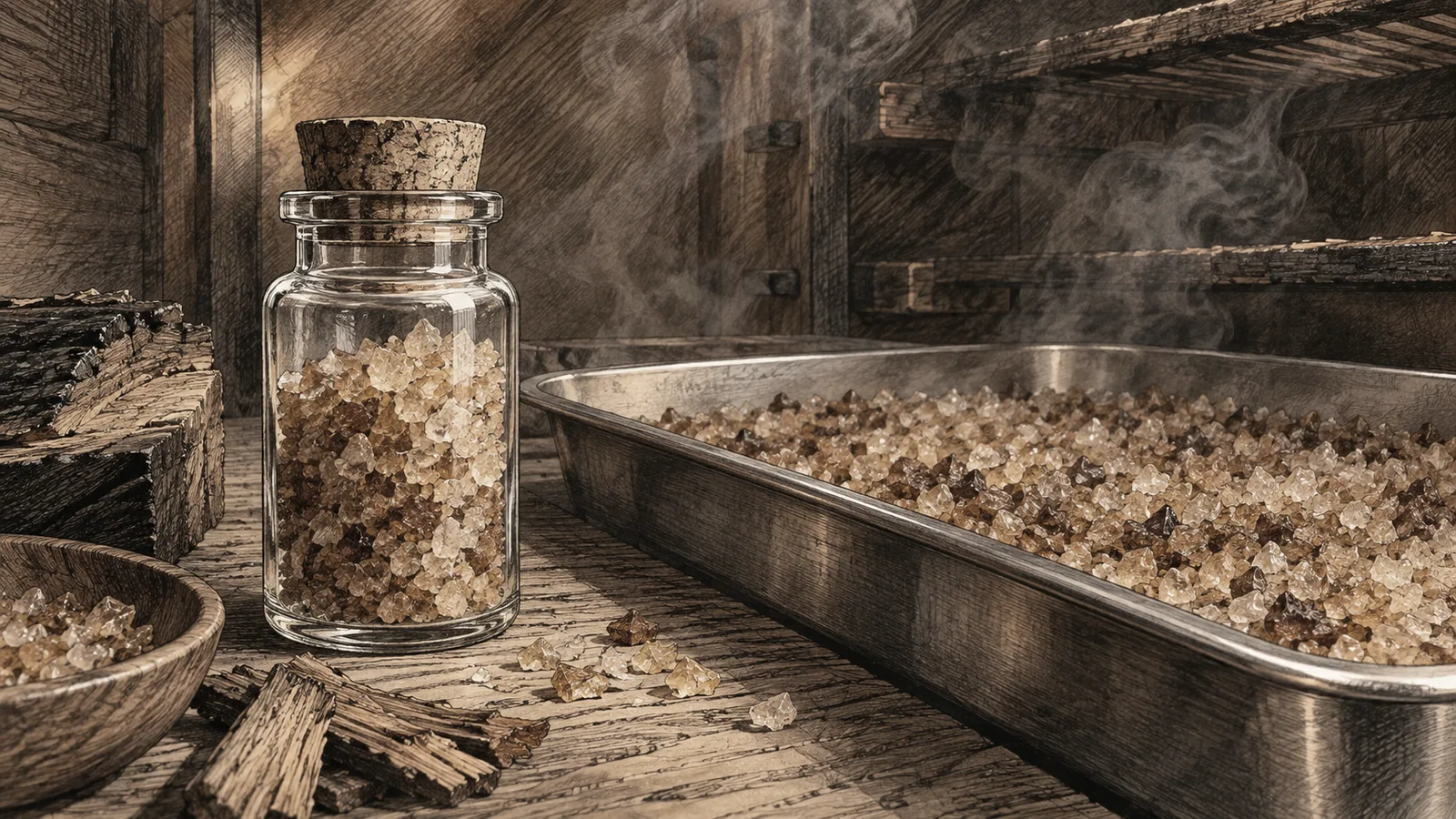
Wood smoke carries polycyclic aromatic hydrocarbons (PAHs), including benzo[a]pyrene, and anything held in it collects some. But no EU maximum level applies to smoked salt: Regulation (EU) 2023/915 caps benzo[a]pyrene at 2.0 µg/kg in smoked meat and smoked fish and has no line for salt at all. The only official survey of smoked salt we could find — 22 samples tested in Austria in 2017 — reported every one compliant and published no numbers.
What PAHs are, in one paragraph
PAHs are a large family of compounds formed when organic material burns incompletely or is pyrolysed: wood, coal, fuel, and food on a grill or in a smokehouse. Austria’s food safety agency, AGES, describes them as carcinogenic, fat-soluble and poorly soluble in water. Regulators do not try to limit all of them. The EU uses benzo[a]pyrene as a marker and a sum of four — benzo[a]pyrene, benz[a]anthracene, benzo[b]fluoranthene and chrysene — usually written PAH4.
Two facts about formation matter for everything below. The Codex code of practice on smoking says PAH formation increases with smoke-generation temperature, and that PAHs travel bound to particles, which is why filters and scrubbers work. We covered the temperature window for clean flavour in oak vs applewood vs mesquite. This article is about what happens after the smoke reaches the salt.
What does the EU actually limit?
Regulation (EU) 2023/915 is the EU’s contaminants rulebook. It replaced the older Regulation 1881/2006 in May 2023. Section 5.1 of its Annex sets PAH maximum levels by food category. The figures below are from the regulation as adopted; the amendments since have dealt with other contaminants, and we found none that changed these entries.
| Category (Annex I, point) | Benzo[a]pyrene | PAH4 |
|---|---|---|
| Smoked meat and smoked meat products (5.1.6) | 2.0 µg/kg | 12.0 µg/kg |
| Smoked fishery products, other than 5.1.8 (5.1.7) | 2.0 µg/kg | 12.0 µg/kg |
| Smoked sprats, small smoked Baltic herring, katsuobushi, fresh bivalves, heat-treated meat sold to the consumer (5.1.8) | 5.0 µg/kg | 30.0 µg/kg |
| Smoked bivalve molluscs (5.1.9) | 6.0 µg/kg | 35.0 µg/kg |
| Traditionally smoked meat or fish, national derogation (Article 7) | 5.0 µg/kg | 30.0 µg/kg |
| Dried spices, except cardamom and smoked Capsicum (5.1.10) | 10.0 µg/kg | 50.0 µg/kg |
| Smoked salt | no entry | no entry |
Read those numbers as what they are. They are legal ceilings on the food as sold, in micrograms per kilogram, not typical levels and not a safety line drawn for salt. The derogation row is a permission: ten member states, including Ireland, Spain, Poland, Finland and Sweden, may let traditionally smoked meat reach the higher figures on their own markets, and Latvia, Finland and Sweden may do the same for fish.
The word “salt” does not appear anywhere in section 5 of the Annex. Smoked salt is not an overlooked sub-category of something else. It is simply not there.
The one smoked seasoning it names, it exempts
This is the detail most summaries miss. The only smoked seasoning the PAH table mentions is smoked Capsicum — smoked paprika and smoked chillies — and it is mentioned in order to be excluded. The dried-spice limit of 10 µg/kg applies to dried spices “except cardamom and smoked Capsicum spp.”
The regulation does not say why, and we are not going to guess on its behalf. The practical effect is plain enough. In the EU, the two smoked pantry ingredients a cook is most likely to own — smoked paprika and smoked salt — carry no specific PAH maximum. Smoked meat and fish carry some of the tightest limits in the table. The seasonings that imitate them carry none.
That is not the same as saying smoked salt is unregulated. Council Regulation (EEC) 315/93 still forbids placing food on the market with contaminants at levels unacceptable from a public health viewpoint, whether or not a number is written down, and a producer is expected to know its own hazards. What is missing is a number a buyer can hold a certificate against.
Has anyone measured PAHs in smoked salt?
Almost no one, in public. This is what we found.
- Austria, 2017. AGES ran priority action A-004-17, PAK in Rauchsalz: 22 samples of smoked salt bought across Austria and tested for PAHs, including benzo[a]pyrene and PAH4. The published result is one sentence: all samples complied with food law on composition and PAH content. Four were objected to — two for labelling, two for packaging rules. No concentrations, no ranges, no reference value.
- UK, 2012. The Food Standards Agency surveyed PAHs in 230 foods, 120 of them traditionally smoked. Salt was not among them.
- Peer-reviewed literature. We found controlled studies of PAHs in smoked sausage, fish, cheese and poultry, and in liquid smoke. We did not find one that measured smoked salt.
The Austrian result deserves a careful reading. “Compliant” is a real finding, and 22 samples is not nothing. But the page does not say what the salt was compliant with, since no salt limit exists. Nor does it separate genuinely smoked salt from salt coated with smoke flavouring. It tells us that an official laboratory looked and did not raise an alarm. It does not tell us how much.
We wrote in how to tell if smoked salt was actually smoked that we had found no published PAH measurement of smoked salt. That was too strong. There is one survey. Its numbers are not public.
Why salt might behave differently from meat
There are reasons to think salt could hold less than a smoked sausage, and they are worth stating precisely because none of them has been tested.
PAHs are fat-soluble. Meat and fish have fat and a moist surface for smoke to dissolve into. A salt crystal has neither; as we explained in what smoked salt is, smoke on salt is a surface coating, not an infusion. Against that, smoked salt spends far longer in the chamber: producers publish 30, 48 and 72 hours. In one controlled study of pork sausages, PAH levels rose with smoking temperature and time, and benzo[a]pyrene tended to level off after about six hours. Nobody has run that curve on salt.
It is tempting to conclude that salt, having no fat, collects less. It may. Nobody has shown it, and a surface that sits in smoke for three days is not obviously cleaner than one that sits there for three hours. We are not going to turn a plausible mechanism into a finding.
Europe has started asking the question
Smoked salt has become regulatory business because of what happened to smoke flavourings. Implementing Regulation (EU) 2024/2067 removed all ten authorised smoke flavouring primary products from the Union list. For every food category outside cheese, meat and processed fish, the transition ended on 1 July 2026. Directly smoked ingredients are the obvious replacement, which puts them in front of regulators for the first time. We set out that change in what the EU smoke flavouring ban means for salt.
- EFSA is assessing the safety of conventionally smoked meat, fish and dairy under a Commission mandate (EFSA-Q-2024-00692). Its stakeholder page states that “smoked ingredients such as smoked spices and smoked salt as alternatives for the use of smoke flavouring primary products will also be considered.” We have not seen a published opinion.
- A draft Commission Recommendation circulated for consultation in December 2024 asked member states to monitor PAHs and four other smoke compounds during 2025, 2026 and 2027 in smoked foods and in “smoked ingredients such as smoked spices, smoked yeast and smoked salt.” We could not confirm that it was adopted in that form.
So the honest summary is that the EU does not yet know what is in smoked salt, has said so, and has begun collecting data. That is the correct order of events.
What to ask a smoked salt producer
In the absence of a limit, the useful questions come from the Codex Alimentarius code of practice for reducing PAHs from smoking (CXC 68-2009), which applies to any smoked food. It says to avoid treated wood and fuels such as waste oil. It says to avoid high-lignin conifers, generate smoke at controlled temperature, and clean the smoke by filtering, scrubbing or cooling. It also says to keep distance between fire and food, keep smoking time as short as the product allows, and clean the chamber on a schedule.
- Which wood, from where, and is it untreated? Is bark removed?
- Is the smoke made in a separate generator or by a fire inside the chamber? Is it filtered?
- What temperature does the smoke generator run at, and for how long is the salt exposed?
- Has the finished salt been tested for benzo[a]pyrene and PAH4? By which laboratory, on which lot, against what reference value?
- Is it salt and smoke only, or salt and a smoke flavouring? The answer changes both the chemistry and, in the EU, the legality.
A producer who answers the fourth question with a lot-specific result from an accredited laboratory is telling you something real. A producer who says smoked salt is exempt is telling you something true about the law and nothing about the salt. We covered what a certificate does and does not prove in what a salt certificate actually covers.
A caveat on our own position. We are developing smoked salts and have none on sale. We have no PAH result of our own to show, and this article is, in effect, the list of questions we are putting to ourselves. Two further gaps: we could not find the underlying data from the 2017 Austrian survey, and we could not confirm the current status of either the EFSA opinion or the draft monitoring recommendation. If you have any of the three, we would like to see it.
Sources
- Commission Regulation (EU) 2023/915 — maximum levels for certain contaminants in food, Annex I section 5.1
- AGES — PAHs in smoked salt, priority action A-004-17
- EFSA — technical meeting on the safety of conventionally smoked food, March 2025
- Commission Implementing Regulation (EU) 2024/2067 — smoke flavouring primary products
- Draft Commission Recommendation on monitoring contaminants in smoked food, December 2024 (consultation copy)
- Food Standards Agency — PAHs in cereals, vegetables and traditionally smoked foods, survey 2012
- Codex Alimentarius — Code of Practice for the reduction of PAH contamination from smoking and direct drying (CXC 68-2009)
- Racovita et al. (2020), smoking temperature, time and wood type and PAHs in smoked pork sausages, J. Agric. Food Chem.
Read next
- How Can You Tell If Smoked Salt Was Actually Smoked? — the sodium test, and liquid smoke
- Oak vs. Applewood vs. Mesquite — why smoke temperature matters
- What a Salt Certificate Actually Covers — reading the paperwork
- Patagonian Sea Salt — the salt, before any smoke
The Salt Guide
We are recording the salts on the American shelf one jar at a time — label, panel, price paid, crystal on white. Browse the guide →