
Alder, Cherry, Hickory, Birch, Red Gum: The Other Smoking Woods
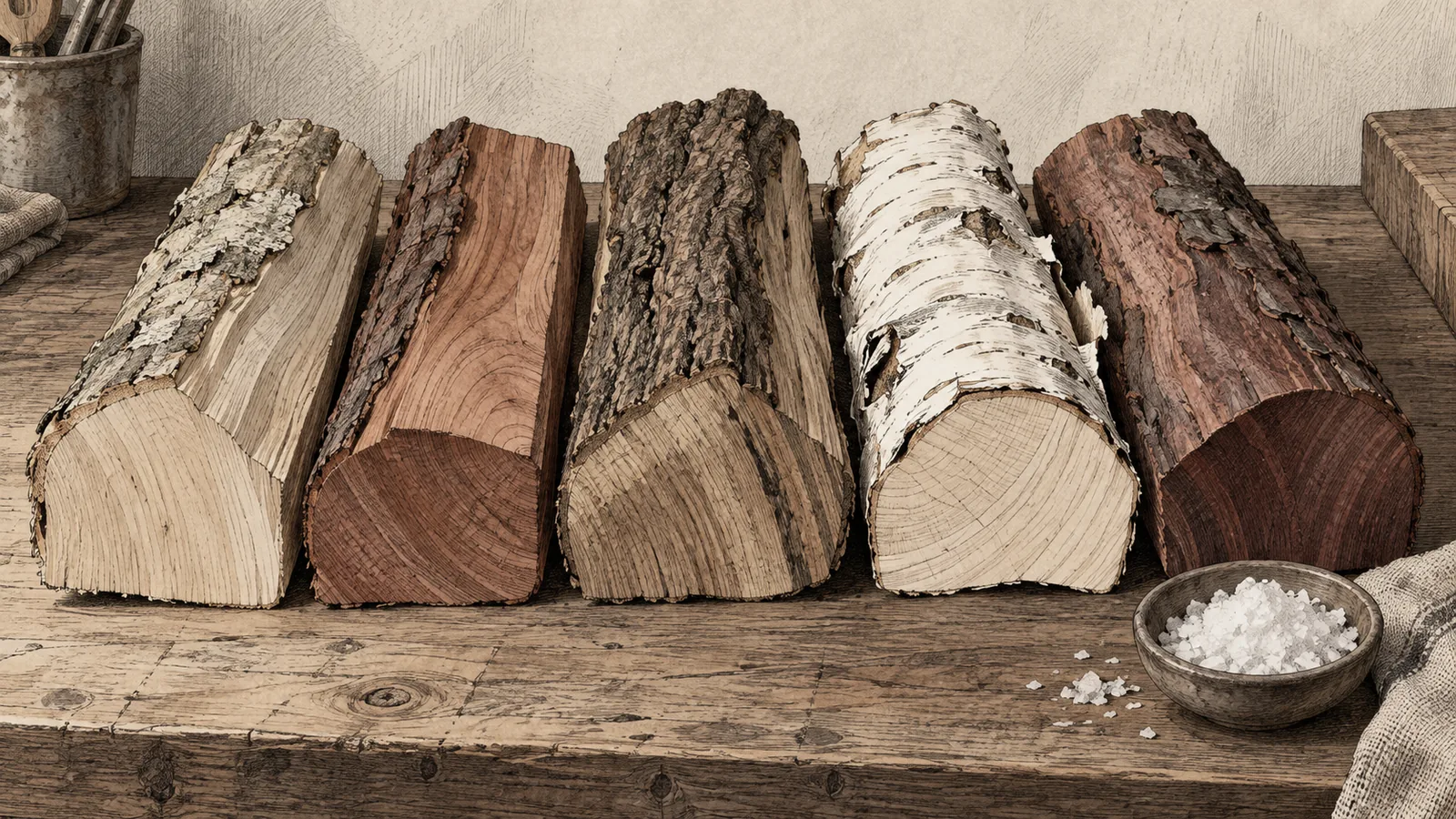
Beyond oak, apple and mesquite, five woods appear on smoked salt labels: alder (Alaska Pure, SaltWorks Salish), cherry (Jacobsen, Redmond), hickory (Redmond), birch (Saltverk) and red gum (Olsson’s). What the jars say about each wood is producer description, not measured chemistry. The little controlled work that exists says how a wood is burned matters at least as much as which wood it is. And the hickory and cherry salts from one well-known American maker are, by its own account, smoked over two woods each.
What a wood name on a jar actually tells you
Less than it appears to. The sensory words attached to smoking woods — alder “delicate”, hickory “bacon”, cherry “fruity” — are repeated across producers, recipe sites and supplier catalogues until they read like data. Almost none of them come from a tasting panel, and none of the ones below come from a panel that tasted salt.
We set out the chemistry of smoke, and why smouldering temperature moves flavour as much as species does, in oak vs applewood vs mesquite. That article covers the three woods most people know. This one covers the next five, and the honest answer for most of them is that the evidence is thinner than the label copy.
Who smokes salt over which wood
Every entry below is from the maker’s own current product page. Where the page does not say something, the table says so.
| Wood | Product | What the maker publishes | Declared ingredients |
|---|---|---|---|
| Alder | Alaska Pure Alder Smoked Flake Sea Salt | Own Alaska salt flakes smoked “over burning Alder wood”; no time or temperature given | Sea Salt, Alder Smoke |
| Alder | SaltWorks Salish Alderwood | “Bark-free, red alder”; cold smoked 48 hours | Smoked Sea Salt |
| Cherry | Jacobsen Cherrywood Smoked Salt | Own flake salt “cold-smoked with Cherrywood”; no time given | Sea Salt, Smoke |
| Cherry + alder | Redmond Smoked Real Salt, Cherry | Smoked “with cherry wood and alderwood for 30 hours” | Smoked ancient sea salt (Redmond Real Salt) |
| Hickory + alder | Redmond Smoked Real Salt, Hickory | Smoked “with red alderwood and hickory for 30 hours” | Smoked ancient sea salt (Redmond Real Salt) |
| Birch | Saltverk Birch Smoked Salt | Icelandic flake salt smoked with Icelandic birch “for over 48 hours” | Not listed as a panel; page says no additives or anti-caking agents |
| Red gum | Olsson’s Red Gum Smoked Salt | “Cold Australian smoked on red gum for 72hrs”; species not named | Not shown on the page we read |
| Five woods, unnamed | Redmond Smoked Real Salt, Chef’s Blend | “Five different types of wood” for 42 hours | Smoked ancient sea salt (Redmond Real Salt) |
Two things stand out before we get to any single wood. First, the published smoking times run from 30 to 72 hours, a factor of more than two, for products sold side by side as the same kind of thing. Second, only three of these pages give any time at all without also naming a second wood.
Alder: the Pacific Northwest default
Alder is the wood of the northern Pacific coast, and the salts that use it say so. Alaska Pure writes that Alaskans have long used alder as “the preferred wood for preserving food and smoking salmon”. That is a statement about tradition, and a reasonable one. It is not a statement about flavour.
SaltWorks is more specific about process than most: red alder, bark removed, 48 hours of cold smoke. Alaska Pure’s page gives the wood and the ingredient list — sea salt, alder smoke — and nothing about time.
Alder’s quieter role is as a base. Redmond’s smoked salts start from red alderwood, and the company’s hickory and cherry versions are alder plus the named wood. That is a legitimate way to build a smoke, and Redmond says it openly. It also means the jar that says hickory is, by its maker’s own description, partly alder.
On the chemistry, one controlled study is relevant, and it points somewhere the label copy does not. Racovita and colleagues smoked pork sausages over seven hardwoods and found that alder, birch and plum sawdust produced considerably higher PAH levels than beech. Apple was lower, and, in the abstract’s words, “oak showed similar levels to beech.” That was sausage, smoked at 55 to 95 °C for two to nine hours. Whether it transfers to salt in a different chamber is unknown, and we would not quote it as a property of alder.
Cherry: two producers, no measurements
Jacobsen cold-smokes its own flake salt over cherrywood and lists two ingredients: sea salt, smoke. Redmond’s cherry is cherry and alder for 30 hours. Neither product page describes a cherry flavour at all.
We found no controlled sensory or compositional study that included cherry among the woods tested. The widespread belief that cherry gives a darker colour and a rounder, fruitier smoke may be right. On the evidence we could find, it is a trade description. We would rather say that than dress it up.
Hickory: the one with numbers
Hickory is the best-measured wood on this list. All of the measuring was done on meat.
Two findings are worth having. A trained panel at the University of Georgia scored hickory-smoked chicken as the smokiest of four smoke sources, and it carried the highest level of smoke-related phenols (the numbers are in our oak, apple and mesquite comparison). And a German study of 51 smoking trials found that hickory and poplar cut PAH content in sausages by 35 to 55 per cent compared with beech, the standard European smoking wood.
So hickory is measurably assertive and, in one careful set of experiments, relatively clean. The trap is to carry both findings over to salt. Both were measured on meat. The German work also found that softwoods did not raise PAH levels, which cuts against the Codex code of practice that recommends avoiding high-lignin conifers. When two authoritative sources disagree about wood, the sensible conclusion is that wood is not the whole story.
Birch: an Icelandic revival
Saltverk makes its salt from Westfjords seawater, evaporated with geothermal heat, and smokes the flakes with Icelandic birch for more than 48 hours. The company frames it as following “old Icelandic tradition” and describes the result as “woodsy” with “a hint of sweetness”.
That is the producer’s description, and it is the only birch-smoked salt we could verify. Birch appears in the same sausage study as alder, in the higher-PAH group. The same caveat applies, and so does a second one: that study also showed PAH levels rising with smoking temperature and time. The same wood burned differently gives a different result, which is the point of this article in one sentence.
Red gum: nothing published
The Australian salt company Olsson’s cold smokes flakes over red gum for 72 hours, the longest time on this list. Its page describes the aroma as that of an outback campfire. It does not name the eucalyptus species, and “red gum” is used for more than one in Australia.
We found no sensory, compositional or PAH study of red gum smoke on any food. That is not a criticism of the salt. It is the state of the evidence, and anyone telling you what red gum does chemically is guessing.
When the jar names five woods, or none
Redmond’s Chef’s Blend is smoked for 42 hours using “five different types of wood”. The woods are not named. That is a design choice and a defensible one: a blend lets a producer build a profile no single wood gives, and hold it steady when one supply changes.
What a blend cannot do is teach you what a wood tastes like. The same is true, more quietly, of every salt smoked over a base wood plus a named one. If your aim is to learn the difference between alder and cherry, you need two salts smoked the same way on the same base, differing only in wood. None of the products above was made to answer that question, and none claims to.
What we are and are not saying
We are not saying the woods taste alike. We are saying that the words on a smoked salt label bundle together four things — species, how the wood was burned, for how long, and over what base — and only the first gets printed in large type.
We are developing smoked salts now, and none is on sale. The first question that work has to answer is not which wood is best. It is whether, at a fixed time and temperature on a fixed salt, the difference between two woods survives on the crystal at all. Our note on how smoke sits on salt explains why that is a real question and not a formality. What each wood leaves behind besides flavour is the subject of smoke, salt and PAHs; for telling a genuinely smoked salt from a flavoured one, start with the sodium test.
Three caveats on our sourcing. Every flavour description in this article is the producer’s own and is reported as such. The only PAH comparisons by wood that we could find were made on sausages, not salt, and do not include cherry or red gum. And we could not load current product pages for two other producers our research listed — including one said to smoke over oak, apple and cherry — so they are left out rather than described from memory.
Sources
- Alaska Pure Sea Salt Co — Alder Smoked Flake Sea Salt
- SaltWorks — Salish Alderwood Smoked Sea Salt
- Jacobsen Salt Co — Cherrywood Smoked Salt
- Redmond — Smoked Real Salt (Hickory, Cherry, Chef’s Blend)
- Saltverk — Birch Smoked Salt
- Olsson’s — Red Gum Smoked Salt
- Racovita et al. (2020), smoking temperature, time and wood type and PAHs in smoked pork sausages, J. Agric. Food Chem.
- Hitzel et al. (2013), PAHs and phenolic substances in meat products smoked with different woods, Food Chemistry 139
Read next
- Oak vs. Applewood vs. Mesquite — the three woods everyone knows
- What Is Smoked Salt and How Is It Made? — why smoke stays on the surface
- How Can You Tell If Smoked Salt Was Actually Smoked? — the sodium test
- Patagonian Salt Flakes — the flake, unsmoked
The Salt Guide
We are recording the salts on the American shelf one jar at a time — label, panel, price paid, crystal on white. Browse the guide →